

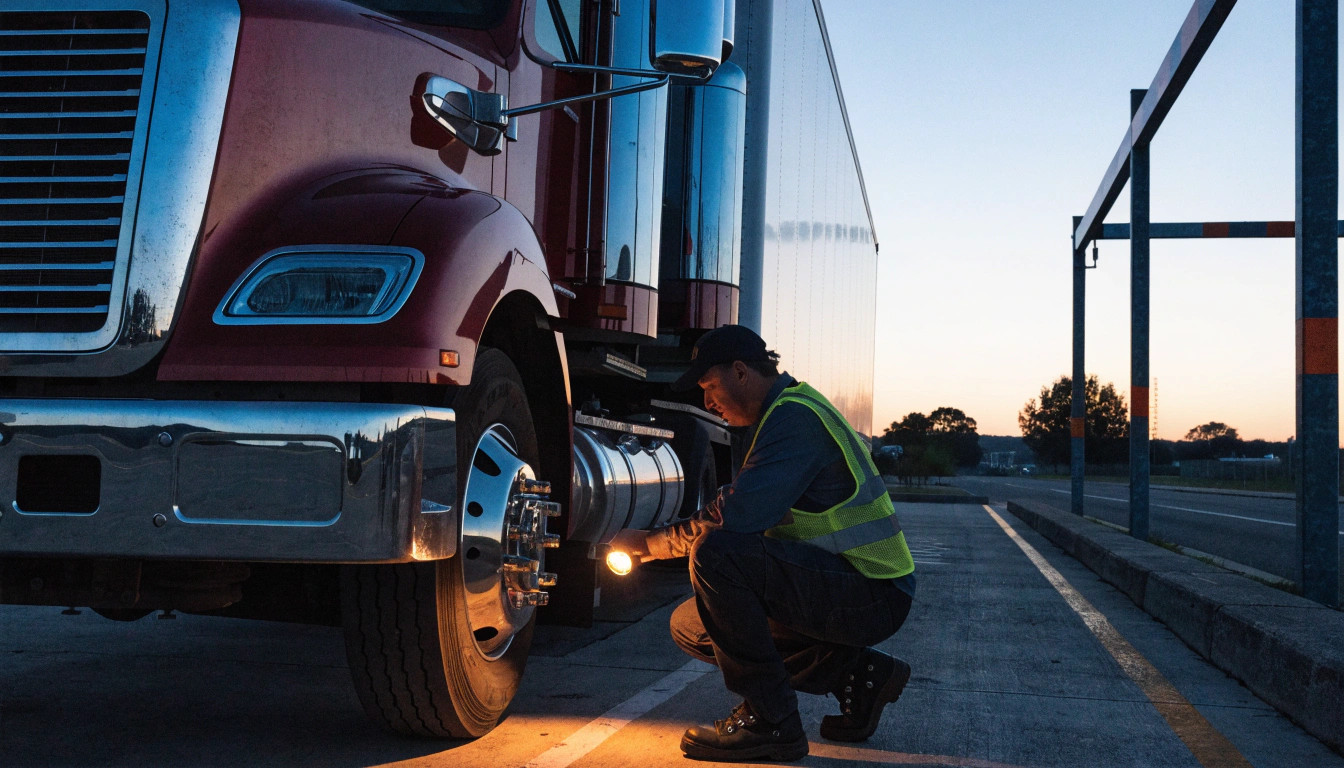
🚨 DOT Inspection: Level 1, 2 and 3 — How to Pass Clean (and Even Get Paid for It)
Sooner or later the scale light flashes "PULL IN" for everyone. The difference between drivers isn't luck — it's whether the next 45 minutes are routine paperwork or the start of a very bad week. Here's exactly what happens at each level, in the order it happens. 😎
📍 Where and when it can happen
An inspection isn't only a weigh-station event. Officers can inspect you:
- at a weigh station or an inspection facility,
- on the road after being pulled over,
- in a parking lot or rest area while you're stopped,
- and even while you're moving on Personal Conveyance — PC status doesn't make you invisible.
Depth varies from a basic document check (Level 3) to a complete teardown-level examination of the equipment (Level 1). Which one you get is up to the officer.
📄 Level 3 — the driver and the paperwork
The most common inspection. The officer checks documents; the truck itself is barely touched. Have these ready:
- Insurance
- IFTA
- Registration for both truck and trailer
- CDL
- Logbook (ELD records)
- Permits
- DOT medical certificate
- Annual inspection report
- The ELD instruction manual — the paperwork explaining how your logbook device works
- Blank paper log sheets — at least 8
🔍 Level 2 — walk-around
Everything from Level 3, plus an inspection of the truck that doesn't require the officer to go underneath. Expect to be asked where you're coming from and going, to park in a specific spot, and to have your documents ready. Then, on the truck itself, the officer may ask you to:
- state the current air pressure in the system,
- turn on all exterior lights — the officer stands in front of the truck and calls out which one to switch: low beam, high beam, turn signals and so on,
- activate left/right turn signals and hazards,
- run the wipers at different speeds and the windshield washer,
- sound the horn,
- show the fire extinguisher and warning triangles,
- cut the trailer air supply and pump the brake pedal.
🔧 Level 1 — the full inspection, step by step
This is the deep one, done at a facility with proper equipment and a pit. It usually runs in this order:
1. Brake test on the stand
You pull onto the brake test position. The officer will typically tell you they're going to raise their hand — that's your cue to get ready — then count "2, 3, 4… step on it". Start pressing the pedal smoothly as the count begins; "step on it" means press it fully. Hold the pedal down until you're told to release. The officer measures pushrod travel under braking and checks for air leaks and the condition of the hoses.
They'll then ask what the air pressure in the system is. Report it: around 90 psi is fine to run the test; if it's lower, build it up first. After the steer axle, you'll be asked to pull forward for the drive axle test, then the trailer axles — same procedure each time. When all axles are done, the brake test is over.
2. Visual inspection and the pit
You pull forward again so the officer can walk around the truck from every side and examine the underside over the pit. They'll come to you for documents — CDL, medical card, truck and trailer paperwork, paper logs — and may ask you to transfer the ELD data. Then they'll usually have you switch on the ignition so they can check the ABS lights on the dash.
3. Front of the truck
Headlights, low and high beam, brake lights, turn signals, hazards, license plate light, wipers and washer, horn. Non-standard colours and aftermarket bulbs are not acceptable.
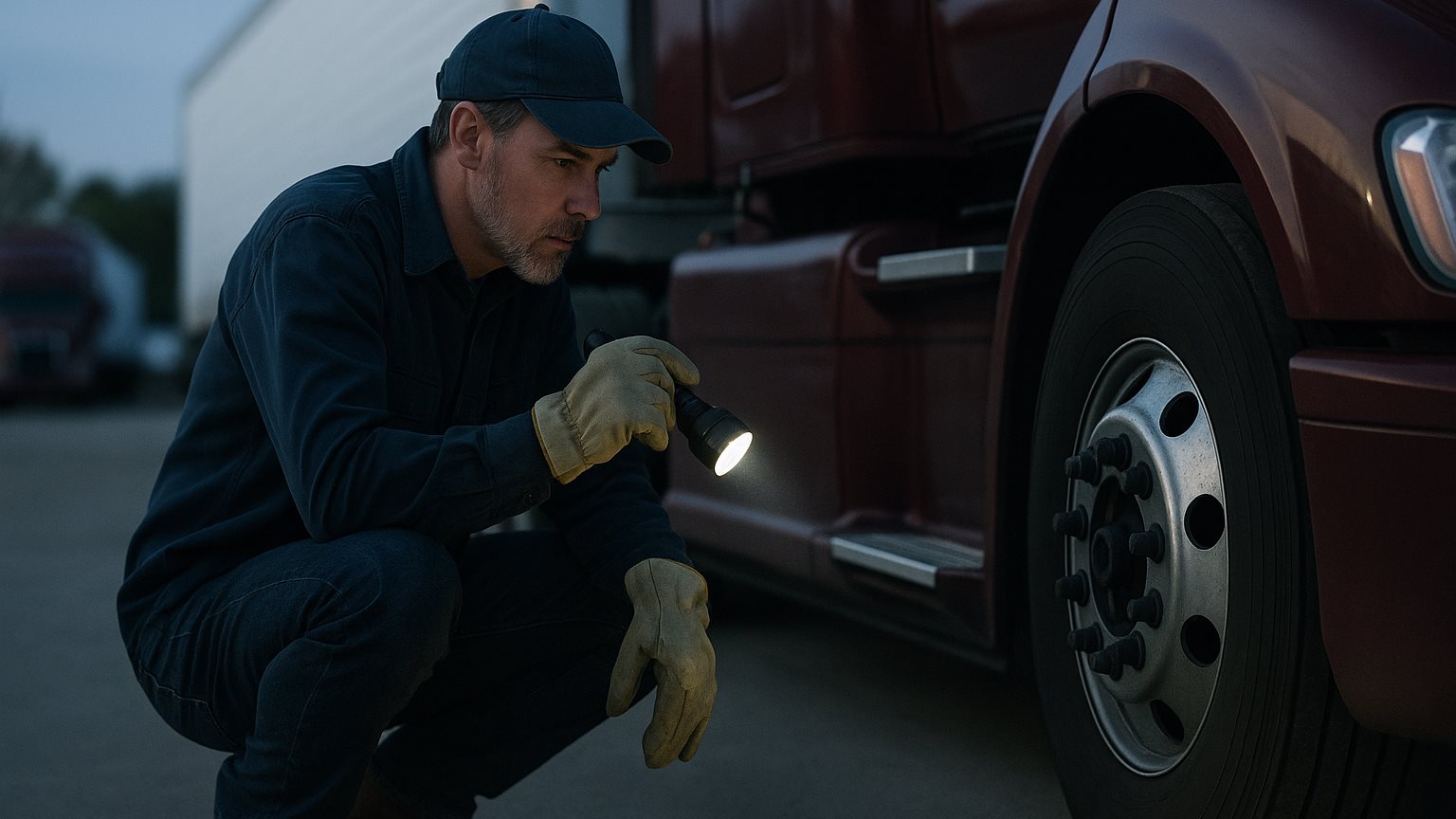
4. Tires and wheels
Left side first, truck and trailer: pressure, remaining tread, general condition, sidewall damage. Tread depth must be at least 4/32" on steer tires and 2/32" on the rest. Pressure gets checked when wear looks suspicious — and pressure below 50% is a critical violation.
5. Underneath, frame and coupling
Fuel tank, air hoses at the rear of the tractor — the officer looks for chafing, abrasion and tears. Exposed white cord on a plastic air line is an automatic Out of Service. They also inspect the frame, the fifth wheel, the trailer, rear clearance lights, turn signals, brake lights and the tandem system. At the back of the trailer they'll check that brake lights, turn signals and hazards work.
If the trailer is loaded, they may ask you to open it to check cargo securement. If there's a seal on the doors, they'll cut it, and after the check they'll apply a new seal and hand you the old one. Then they move to the right side.
6. Under the hood and steering
You'll be asked to open the hood, and possibly to turn the steering wheel left and right in short movements several times. After the engine bay, the officer goes down into the pit and may again ask you to work the steering and press the brakes — release the pedal only on command — while they check each brake.
7. Air system check
The officer moves to the air system and asks you to disconnect the service line and the emergency line. Once they're off, go to the cab: the red Trailer air supply valve should pop out. They may ask you to climb in and read the pressure, then to press the brake pedal — again, release only on command — sometimes repeatedly until the BRAKE AIR warning lights up on the dash.
8. Final checks and signature
They may ask you to start the truck so they can work the steering themselves and take measurements, then check the fire extinguisher and warning triangle. The last item is often the fifth wheel: you'll be asked to pull slightly forward, then back. That ends your part — the officer finishes the paperwork and gives you their report to sign.
⚠️ Violations vs Out of Service
Findings come in two flavours. Not every violation means a fine or a shutdown — but every violation is recorded and follows both you and your carrier. If you're placed Out of Service, you cannot move until the cause is fixed.
Counted as violations
- Missing stickers (IFTA, registration, MC/DOT numbers) or unreadable markings.
- Invalid documents — insurance, registration, annual inspection.
- Burnt-out bulbs or non-standard lights.
- Tires worn below the limit.
- Air leaks during the brake test.
- Play in the steering.
- Fewer than 8 blank paper log sheets on board.
- No warning triangles or fire extinguisher — including an extinguisher that's present but not properly secured.
- Poorly secured fifth wheel.
- Incorrect carrier markings — wrong DOT numbers or company name.
- Play in the steering.
- Tire pressure below 50%.
- Visible damage to air hoses, exposed cord.
- ABS not working.
- Critical air leaks.
- Damaged or loose fifth wheel coupling.
✅ How to pass clean
- Do a real pre-trip every day. Lights, tires, brakes, hoses, coupling, leaks. Most of the list above is visible before you ever start rolling — brakes remain the single biggest out-of-service category in the industry.
- Keep the document folder complete. Insurance, IFTA, registrations, medical card, annual inspection, permits, ELD manual and 8+ blank log sheets. Fumbling for ten minutes sets the tone of the whole inspection.
- Know your ELD. Be able to transfer data on request without hunting through menus.
- Keep your logs honest. Falsifying or "adjusting" logs is exactly what inspectors were specifically trained to look for in 2026. If the ELD malfunctions, document it and switch to paper per procedure.
- Fix the small stuff immediately. A dead marker light costs $5 tonight and a permanent record entry tomorrow.
- Be professional. Seat belt on, tidy cab, calm answers, follow commands exactly — especially "release the pedal on command". Don't argue at the roadside; disputes have a formal process afterwards.
❓ Frequently asked questions
What are the levels of a DOT inspection?
In practice drivers meet three: Level 3 checks the driver's documents; Level 2 adds a walk-around of the truck without going underneath; Level 1 is the full inspection, including a brake test on the stand and an examination of the underside over a pit.
What documents does a DOT officer check?
Insurance, IFTA, truck and trailer registration, CDL, logbook, permits, DOT medical certificate, annual inspection report, the ELD instruction manual, and at least 8 blank paper log sheets.
Do I have to show fuel receipts or my phone during a DOT inspection?
An officer may ask for fuel receipts or the logbook app on your personal phone, but you are not obliged to provide them. Stay polite and cooperative on everything that is required.
What puts a truck out of service at a DOT inspection?
Play in the steering, tire pressure below 50%, visible air hose damage with exposed cord, non-functioning ABS, critical air leaks, or a damaged or loose fifth wheel coupling. You cannot move until the cause is fixed.
What is the minimum tire tread depth for a DOT inspection?
At least 4/32" on steer tires and 2/32" on all others. Tire pressure below 50% is treated as a critical violation.
Do carriers pay drivers for clean inspections?
Some do. ASTEL, for example, pays a bonus of $50 for a clean Level 3, $200 for Level 2 and $500 for Level 1.
🚛 Drive a truck that's ready for any scale
ASTEL runs a maintained fleet with its own mechanics — and pays $50/$200/$500 bonuses for clean inspections. Drivers earn $90,000–$110,000 a year, paid weekly.
Apply in 2 minutes →Procedures described reflect how Level 1–3 inspections are conducted in practice as of 2026; the exact sequence, requests and measurements are at the inspecting officer's discretion and vary by state and facility. Tread depth, pressure and out-of-service criteria per current federal standards — verify with FMCSA/CVSA, as rules and enforcement practice change. Bonus amounts are ASTEL policy and may be updated.