

DEF Derate Limits From 5 mph to 25 mph and What EPA Plans Next
A DEF derate on older engine software can end at 5 mph, and EPA's guidance from 2007–2013 described getting there about four hours after the fault. At 5 mph, a shop 30 miles away is six hours of your 11-hour driving limit. EPA's guidance of August 11, 2025 lets engine makers reprogram trucks already on the road so the final cap is 25 mph and comes only after 8,400 miles or 160 hours. A proposal published July 14, 2026 would go further and swap derates on new engines for alarms. As of October 16, 2026 it is still only a proposal.
The derate schedule on your truck depends on its software
| Stage | When it starts | What the engine does |
|---|---|---|
| Old software, built to EPA guidance from 2007–2013 | About 4 hours after the fault, in EPA's own description of that guidance | Warning, power loss, final speed limit as low as 5 mph |
| 2025 guidance, before the first step | From the confirmed fault up to 650 miles or 10 hours | Warning on the dash, full power |
| 2025 guidance, initial step | 650 miles or 10 hours | 15% torque derate, ramped in, no speed cap yet |
| 2025 guidance, secondary step | 4,200 miles or 80 hours | 30% torque derate, ramped in |
| 2025 guidance, final step | 8,400 miles or 160 hours | 25 mph limit; the maker may lift the torque derate at this point |
| New engines, model years 2027–2028 (40 CFR 1036.111) | A highway truck is held to 65 mph right away, then steps down over up to 164 hours of non-idle operation; slower trucks get there sooner | Final limit 25 mph |
| July 2026 proposal (not final), new engines by model year 2029 | 3 hours before the DEF tank runs empty, or when a fault is detected | Warning light and a 90-second audible alarm, no derate |
Miles and hours count from the moment the engine confirms the fault. The software tracks one or the other, depending on the engine maker, so the 650 miles and the 10 hours are two versions of the same step. Now put that against a real week. At the 600–700 miles a day ASTEL expects from 11 hours of driving, the first torque cut lands after about one day and the 25 mph cap after about two weeks. That stretch is for booking a shop. Old software may give you four hours.
SCR with DEF came to heavy-duty highway engines in model year 2010, so nearly every truck you'll drive has some version of this schedule. Which row applies depends on the model year and on whether an update was installed. Only a shop with the right scan tool can tell you for sure.
Low fluid is only one cause of a DEF derate
EPA guidance from 2007–2013 built derates to make sure drivers kept the tank full and didn't dilute the fluid. In its July 2026 proposal the agency writes that the list of triggers has grown far beyond that, and that defective sensors or corroded wiring derate trucks with good fluid and a full tank. These are the usual causes.
- Low DEF level. The 2023 rule sets the trigger at 2.5% of tank capacity or about three hours of engine operation left. At least two engine makers kept their low-tank derate steps when they shipped 2026 updates, so this one can still bite fast.
- Wrong or diluted fluid. The quality sensor checks the urea concentration against the 32.5% standard.
- A failed quality sensor. EPA says these sensors have some of the highest failure rates of any SCR part, and its first look at the warranty data it collected in 2026 points to them as a significant source of claims and derates.
- Corroded wiring or connectors. After hundreds of thousands of miles, a bad reading can look like tampering to the engine computer.
- Urea crystals plugging the doser or the lines. One engine maker told EPA its diagnostics have a hard time telling that apart from tampering.
- An open circuit, such as an unplugged DEF pump, which the 2023 rule treats as a tampering trigger.
Only the first one is yours to fix at a fuel island. The rest go to a shop. On February 3, 2026 EPA required the 14 largest highway and nonroad diesel engine makers to hand over warranty and failure data on SCR parts. In March 2026 it issued guidance letting makers judge DEF quality through NOx sensors instead of, or alongside, a separate quality sensor, and a software change of that kind is not treated as tampering.
EPA's 2025 guidance reaches your truck through a software update
The document is a letter to manufacturers, IACD-2025-10, signed August 11, 2025 and announced at the Iowa State Fair the next day. It applies backward to every heavy-duty engine with SCR. For new trucks it covers model years 2025 and 2026, because model year 2027 and later engines fall under the 2023 rule in 40 CFR 1036.111.
The letter itself changes nothing. It gives engine makers three choices: keep their existing derate strategy, switch to the 2023 rule, or adopt the new schedule in its Table 1. Your truck stays the same until the maker writes an update and a shop flashes it. EPA states that changes made under the guidance are not tampering.
Updates started reaching trucks in 2026. Transport Topics reported on July 13 that one engine maker's program covers more than 1.5 million engines, some as old as model year 2017. Another maker said in June that its update is optional and goes in at a shop through a diagnostic plug, not over the air. Read the details. Reports from June and July 2026 show at least two makers stretched the timing for quality and component faults and left the low-tank steps as they were. At the next PM, ask whether the 2025 inducement update is on your engine and which faults it covers, then keep the answer in your notes.
The guidance itself has no force of law. EPA wrote that into the letter. It is permission for engine makers, not a rule that binds you or your carrier.
EPA's July 2026 proposal would trade derates for a 90-second alarm
EPA published the proposed rule in the Federal Register on July 14, 2026 (91 FR 43154, docket EPA-HQ-OAR-2026-0728). Comments closed on August 29, 2026. As of October 16, 2026, the Federal Register lists the proposal and no final rule on that docket.
Under the proposal, low DEF would set off a 90-second audible alert 3 hours before the tank runs dry, again when it's empty, then 30 and 60 minutes later, then every hour until you fill it. A quality or tampering fault would sound at detection, then 30 and 90 minutes after, then every 3 hours. Engine makers could still use derates to protect the engine or aftertreatment from serious damage, for example when a dry DEF injector is about to overheat.
News reports split on the model year. The text settles it. Makers would have to switch to alarms by model year 2029 at the latest and could do it sooner. Model years 2027 and 2028 would stay under the 2023 rule, with speed limits that step down to 25 mph. Trucks already on the road are outside the proposal, though EPA says it is considering separate guidance for them and warns that retrofitting older engines on a wide scale may be unrealistic.
The same proposal would keep emission warranties on model year 2027 and later engines at the model year 2026 length instead of the longer terms in the 2023 rule. Longer useful-life periods would wait until model year 2030. Reactions were mixed.
- ATA's Patrick Kelly told Transport Topics on July 13, 2026 that derates can leave trucks stranded and asked for a balanced approach.
- OOIDA objected to the shorter warranty periods at EPA's public hearing, Land Line reported on July 30, 2026.
- NATSO and SIGMA, the truck stop and fuel marketer groups, said on July 10, 2026 that the change would confuse buyers and could cut DEF availability and raise its price.
- Attorneys general from California and 17 other states asked EPA to withdraw the proposal at the end of August 2026. Environmental groups including NRDC and the Sierra Club filed comments against it on August 28.
DEF is simple fluid that's easy to ruin
DEF is 32.5% urea in purified water, the ISO 22241 standard that EPA cites in its proposal. When SCR trucks first came out, engine makers predicted DEF use of 2–3% of the diesel you burn. One major maker now gives 3–5% for its current 15-liter engine, and heavy loads with long idling push it up. Say you run 3,500–3,700 miles a week, the August–March peak at ASTEL, at 6.5 mpg. That's roughly 540–570 gallons of diesel and 11–28 gallons of DEF, depending on the engine.
It freezes at 12°F (−11°C), and the heated tank and lines thaw it after start-up. Cold weather and DEF are covered in our article on diesel gelling, so here it's enough to say freezing alone doesn't ruin the fluid.
Heat is worse. Under the storage table in part 3 of ISO 22241, DEF kept at a steady 86°F (30°C) is good for about 12 months, and at 95°F (35°C) for about 6. A jug that spent the summer on a sunny pallet is a gamble. The pump at the diesel island is the better bet, and EPA notes that filling stations often sell DEF from pumps in the same lanes as diesel.
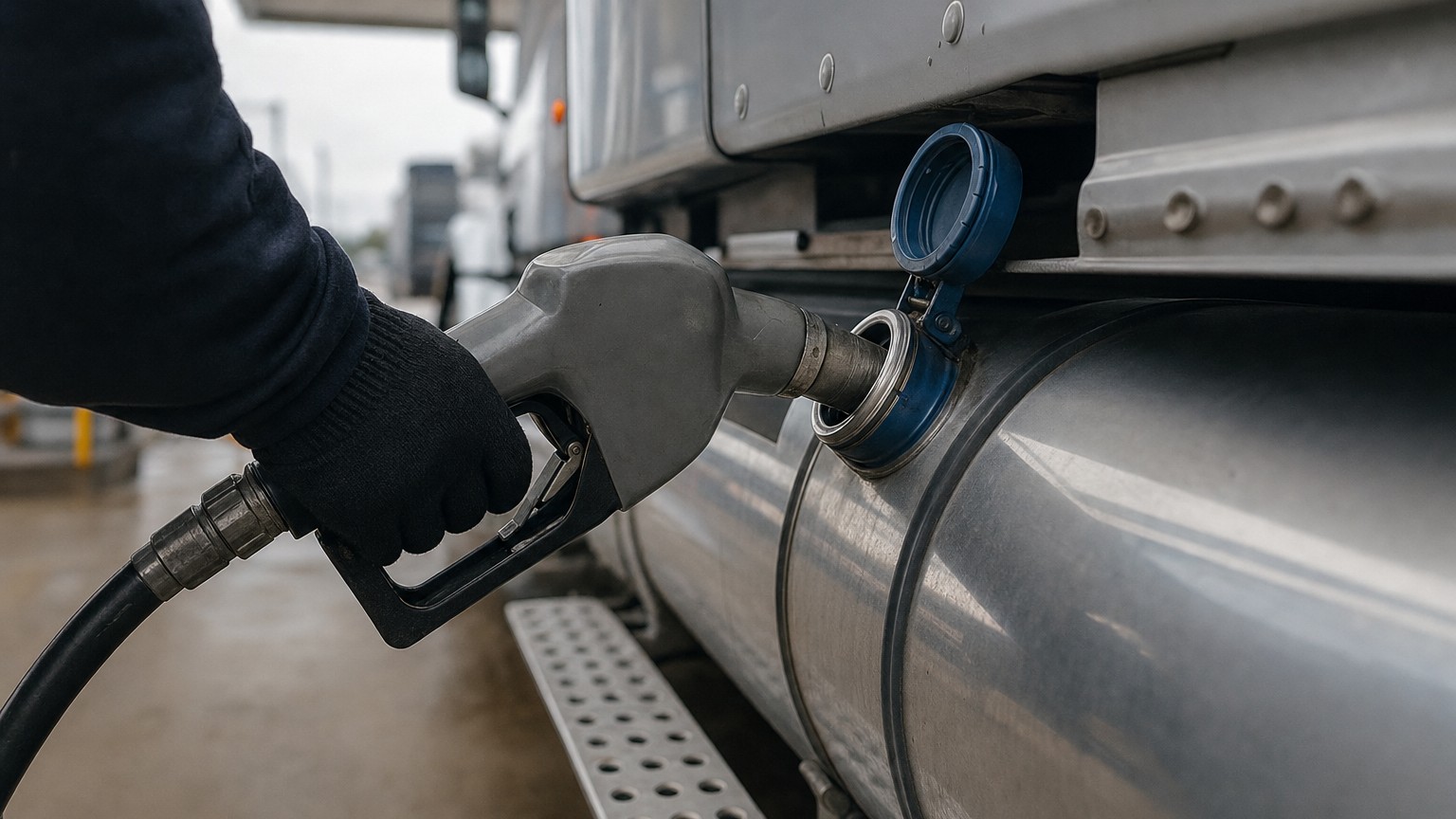
The blue-capped tank takes DEF and nothing else. Water dilutes it, and many engines then inject more fluid to make up the difference, so the tank empties faster and the quality sensor complains anyway. Diesel, coolant or washer fluid in that tank is a shop job, and EPA's own example of the fix is a flush and a refill. If the wrong fluid goes in, stop and call dispatch before you drive on.
At ASTEL trucks fuel at Pilot / Flying J or where dispatch agrees, and the Fuel bonus pays up to $0.02 per mile for good MPG and fueling by the rules. One stop covers both. Fuel habits that move MPG are in fuel-efficient truck driving, and the current diesel price picture is in diesel prices for truck drivers.
The first warning light is your cheapest moment
The minute the DEF or emissions light comes on, the truck usually still runs at full speed, and that window is worth more than anything you do once derating starts.
- Take a photo of the dash message, the fault code if it shows, and the odometer, with the time.
- Check the DEF gauge. If it's low, fill at the next stop and watch whether the warning clears.
- Call dispatch while you still have full power. Dispatch is on the line 24/7, and the route to a shop is easier to plan at 65 mph than at 5.
- Tell dispatch the load's appointment time, your hours left and the nearest shop you know of.
- Don't keep driving and hoping it clears. On engines built to the 2023 rule, a fault that comes back within 40 hours of engine operation restarts derating at the step where it stopped.
ASTEL has its own mechanics and a replacement truck for breakdowns. Drivers run late-model Volvo trucks with automatic transmissions, reviewed in our article on driving a Volvo semi truck. When the truck does stop on the road, the steps are in what to do when your truck breaks down.
Most DEF trouble shows up early. During the pre-trip inspection, look at the DEF level, then check the tank, lines and doser for white crust or wet spots. White crust is dried urea. It points to a leak or a plugged line, and it costs less to report at the yard than at a scale.
A truck in derate still burns your 11 hours
Under 49 CFR 395.2, driving time is all time at the controls of a truck in operation. Speed doesn't matter. An hour at 5 mph is an hour off your 11-hour limit and your 14-hour window, same as an hour at 65. At a 25 mph cap, 50 miles to the shop take two hours. At 5 mph the same 50 miles take ten. Ask dispatch about a tow.
Don't count on the adverse driving conditions exception. The rule defines those conditions as snow, ice, sleet, fog, other bad weather, or unusual road and traffic conditions that you couldn't have known about before your duty day, or the carrier before dispatch. A DEF derate is an equipment problem, and the definition says nothing about equipment. The full set of limits is in our guide to hours of service rules.
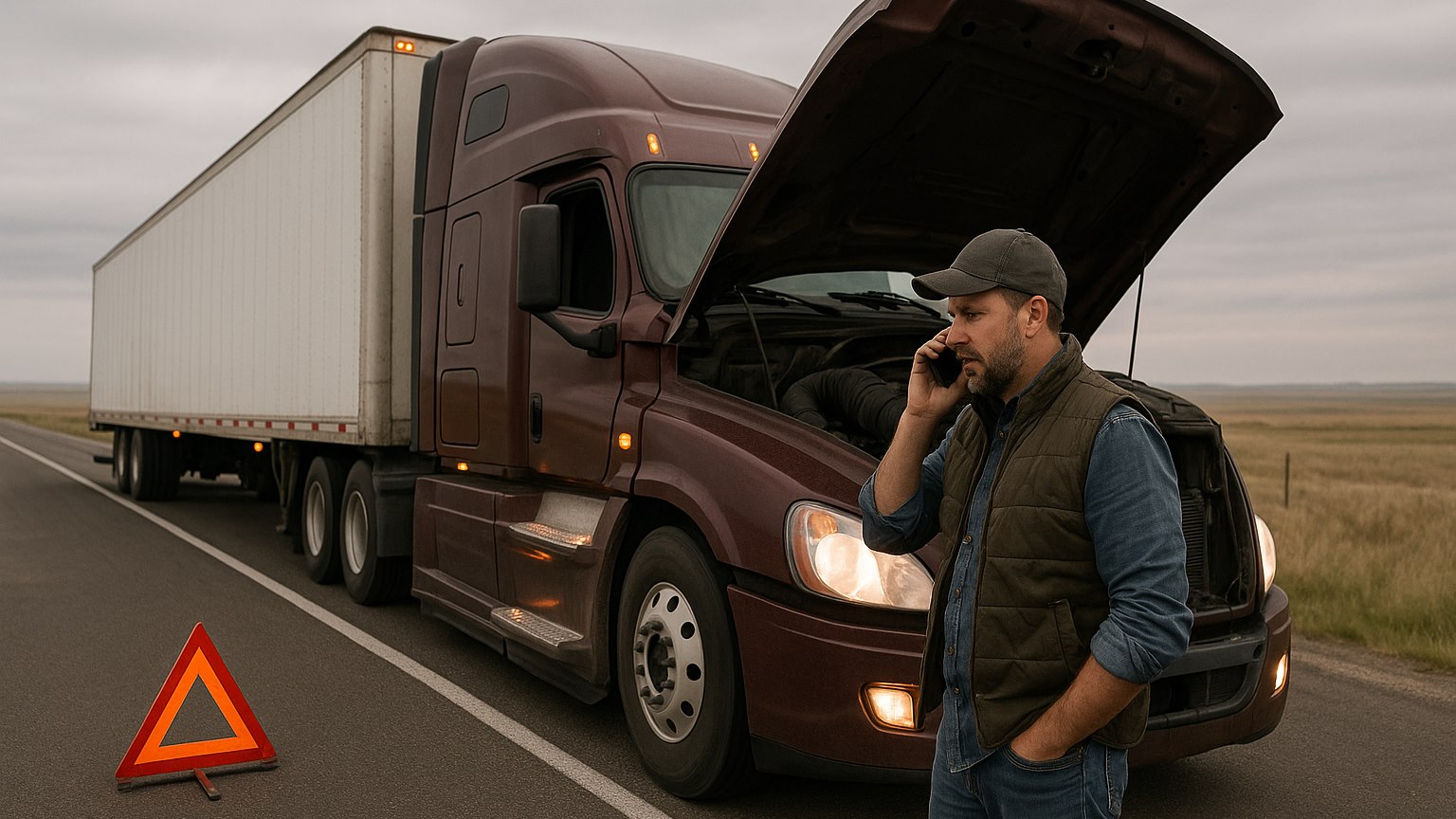
A truck limited to 25 mph doesn't belong in the left lanes. Some interstates also post a minimum speed. Take the next exit and use the shoulder only as a last resort. If you do stop on the shoulder, 49 CFR 392.22 requires hazard flashers right away and warning triangles within 10 minutes.
If an officer stops you, show the dash message and your photos and say which shop you're headed to. The call log with dispatch backs that up. A winter derate on a dark two-lane road is its own risk, so check winter driving for truck drivers before December.
Frequently asked questions
How long can you drive with a DEF warning light on?
It depends on the software and the fault. After an update under EPA's August 2025 guidance, a quality or component fault leaves full power for 650 miles or 10 hours, then torque cuts of 15% and 30%, and a 25 mph cap after 8,400 miles or 160 hours. On some engines a low tank still derates much sooner. Older software can drop the truck to 5 mph within hours. Plan the shop visit at the first light.
Will adding DEF get a truck out of derate?
Only when low fluid caused it. Filling the tank removes that trigger, and the system should lift the derate once it reads the new level. A DEF derate caused by a failed sensor, corroded wiring, crystals or bad fluid won't clear with a refill and needs a shop with a scan tool.
Is EPA getting rid of DEF derates?
It has proposed to. The proposed rule published July 14, 2026 would replace derates with warning lights and a 90-second alarm on new engines no later than model year 2029. Comments closed August 29, 2026, and as of October 16, 2026 there is no final rule. Trucks already on the road would keep their current software unless the engine maker offers an update.
Can you put water in a DEF tank?
No. DEF is 32.5% urea in purified water, and adding water drops the concentration below spec. The quality sensor can flag it and start derating, and many engines inject more diluted fluid, so the tank empties faster. If water or any other fluid went in, the tank usually needs a flush and a refill at a shop.
Does driving in derate count against hours of service?
Yes. Under 49 CFR 395.2, driving time is all time at the controls of a truck in operation, at any speed. An hour at 5 or 25 mph counts toward the 11-hour driving limit and the 14-hour window, and a DEF derate doesn't qualify as an adverse driving condition.
Drive for a carrier with its own mechanics and a replacement truck
ASTEL is a family-owned carrier out of Chicago running refrigerated freight year-round on late-model Volvo trucks, with our own repair shop and mechanics, 24/7 dispatch and a direct line to the owner. Drivers earn $90,000–$110,000 a year — $2,400–2,700+ a week gross, a flat $0.80 per mile for drivers with 1+ year of experience, all miles paid ZIP-to-ZIP, weekly pay, plus $50/$200/$500 bonuses for clean DOT inspections.
Apply in 2 minutes →Sources: EPA letter IACD-2025-10 on SCR inducements (August 11, 2025), Table 1; EPA proposed rule, 91 FR 43154 (July 14, 2026), docket EPA-HQ-OAR-2026-0728, sections I and V; EPA guidance IACD-2026-05 on DEF quality monitoring (March 2026); 40 CFR 1036.111; ISO 22241, parts 1 and 3; 49 CFR 395.2, 395.3 and 392.22; Transport Topics (June 23 and July 13, 2026); Fleet Equipment (July 1, 2026); Trucking Info (August 25, 2011 and July 7, 2026); NATSO and SIGMA (July 10, 2026); Land Line (July 30, 2026); California Attorney General (August 31, 2026); environmental groups' comments (August 28, 2026); engine maker data on DEF use (May 2026). Current as of October 2026; EPA rules, guidance and engine software may change. Pay, bonus and fueling terms describe ASTEL driver terms, not guarantees. General information, not legal advice.