

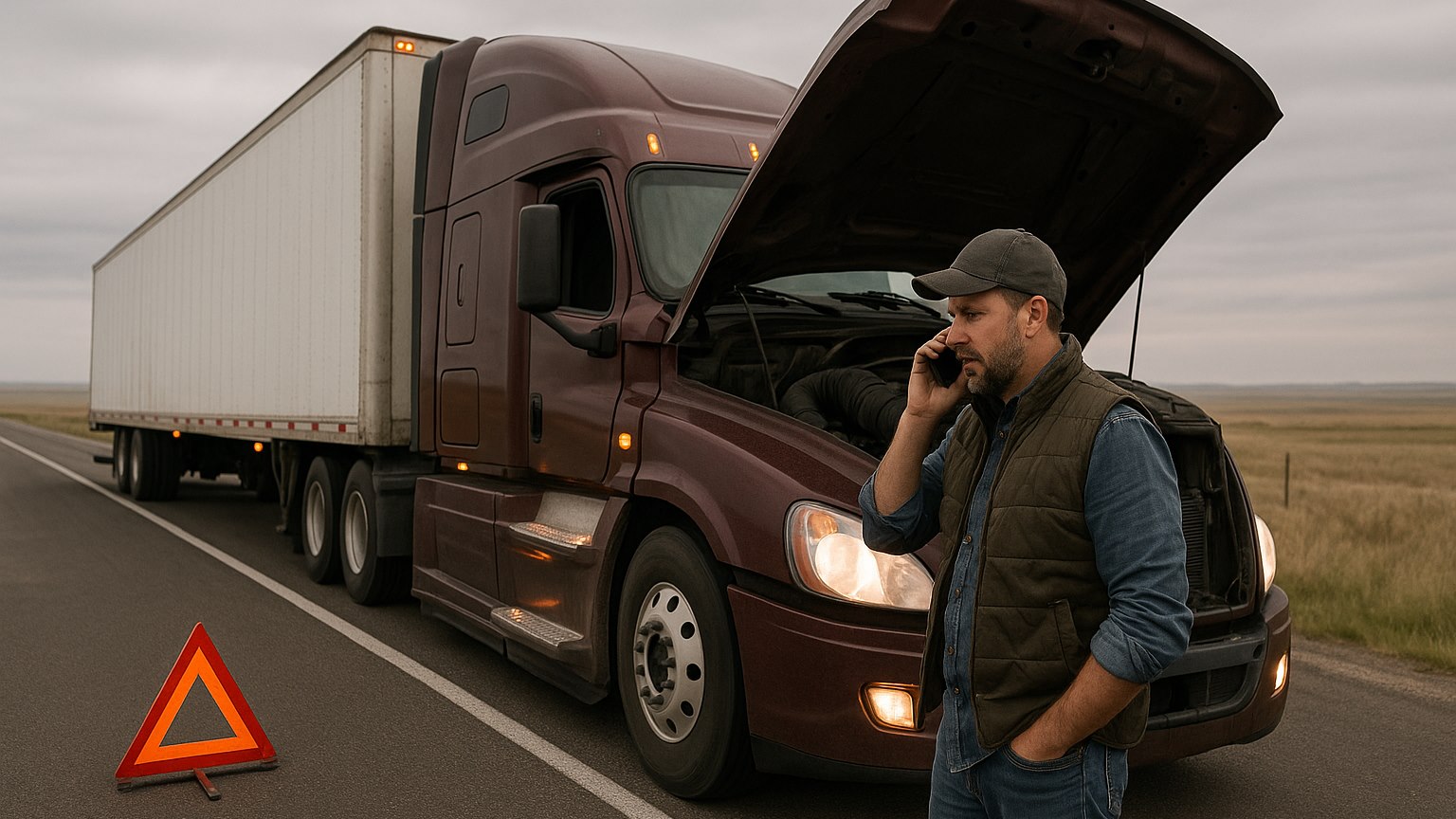
🔧 What to Do When Your Truck Breaks Down: A Step-by-Step Plan
Run OTR long enough and a breakdown stops being an "if": a steer tire at 70 mph, an air leak you can hear over the radio. What separates a bad hour from a bad week is the order you do things in. Here is the whole plan — from the first shudder to the tow bill. 🚛
🛑 How do you get a failing truck off the road safely?
Most breakdowns give a warning window — a climbing gauge, a pull in the steering, a new noise. Use it to choose where you stop: the most dangerous place in trucking is a rig sitting half on the shoulder of a live interstate.
- Hazard flashers on the moment something feels wrong. The rule requires them immediately once stopped; smart drivers run them as soon as they start slowing out of the flow.
- Aim for an exit if the truck will make it. A parking lot, ramp shoulder or rest area beats the interstate shoulder every time. Don't nurse an overheating engine or a shredding tire for miles — but if the truck has half a mile left in it, spend it getting somewhere flat, straight and wide.
- If it's the shoulder, take all of it. Every wheel as far right as pavement allows, steer turned away from traffic — and don't stop just past a curve or hill crest where traffic can't see you in time.
- Get out on the passenger side. Never stand between the truck and traffic or linger at the driver's door. Vest on before your boots hit the ground.
- Decide where to wait: well off the road behind the barrier is safest, the cab with the seatbelt on is second best, next to the trailer is last.
If the truck dies in a live lane and won't move — 911 first, then dispatch: police can protect the scene with lights, you can't.
🔺 Where do the warning triangles go under 49 CFR 392.22?
Federal rule 49 CFR 392.22 gives you 10 minutes from stopping to have your three reflective triangles out. Inspectors write violations for missing devices, but the real reason to hustle: triangles are what makes a car in the right lane move over a quarter mile early. As of September 2026 the scheme looks like this (rules may change — the current text controls):
| Where you're stopped | Where the three triangles go |
|---|---|
| Two-lane road (traffic in both directions) | One about 10 feet (4 paces) from the truck on the traffic side, toward approaching traffic; one about 100 feet (40 paces) behind; one about 100 feet ahead — traffic comes from both ends |
| Divided or one-way highway (interstate) | All three behind the truck, facing approaching traffic: about 10, 100 and 200 feet back |
| Within 500 feet of a curve, hill crest or other obstruction | Move the triangle on that side out 100 to 500 feet, far enough that traffic sees a warning before it sees you |
| Business or residential district | Triangles not required if street lighting makes the truck visible from 500 feet — flashers still are |
Pace it off — 40 normal paces is close to 100 feet — and walk facing traffic, triangles held so the reflective faces show. Flares (fusees) are sometimes allowed as extra warning, but never near a fuel leak or flammable cargo; for a reefer outfit, triangles are the tool. The 10-minute discipline matters most at night — one more reason to keep your winter kit stocked.
📞 Who do you call first — and what do you tell them?
Once the scene is safe, the order of calls is short:
- 911 — only if the truck is blocking a lane, something is leaking, smoking or burning, or anyone is hurt.
- Your dispatcher. Always, before any repair decision. Dispatch knows the company's road-service accounts, the nearest approved shops, what the load can tolerate and who can authorize money. At ASTEL that line answers 24/7 and can loop in our own Chicago mechanics before any outside vendor touches the truck.
- Road service — the number dispatch gives you, not the first billboard tow number visible from the shoulder. Unsolicited "helpers" are how a blown airline turns into a four-figure invoice.
What the mechanic on the phone needs — ready before you dial:
- Exact location: highway, direction, mile marker or last exit, which side you're on. Phone GPS coordinates settle every ambiguity.
- Symptoms in plain words: what you saw, heard and smelled, what changed and when. "Lost air pressure to about 60 psi in ten minutes, leak audible behind the cab" beats "it's broken" by an hour of diagnosis.
- Every code and light on the dash: read them out, then photograph the cluster — modern trucks tell half the story themselves.
- Photos and video: the tire, the puddle, the dash — a mechanic who arrives with the right part fixes you in one trip.
- Truck, trailer and load info: unit numbers, and for a reefer — commodity, setpoint and current box temperature; that drives how fast everyone moves.
🔩 What breaks most often — and can you keep driving?
Industry maintenance data has said the same thing for years: tires cause roughly half of all roadside breakdowns, with brakes and air-system problems, batteries and electrical faults, cooling and aftertreatment (DEF/regen) issues covering most of the rest — and a reefer driver hauls one more machine that can quit. The first decision on the shoulder is always the same: is this a stop-now problem or a get-to-a-shop problem?
| Symptom | Drive or stop? |
|---|---|
| Steer tire losing air, vibration or blowout | Stop now. Steer tires are non-negotiable — off the road at the next safe spot and call it in |
| One blown tire in a trailer dual set | Stop at the next safe spot and call. The surviving dual overloads and overheats; shredded casing takes out airlines and fenders |
| Air pressure dropping, audible leak | Stop while you still control where. Below about 60 psi the warning comes on; keep falling and spring brakes will pick the spot for you |
| Coolant temperature climbing, low-coolant light | Shut down. Ten more miles on an overheating engine can turn a hose clamp into an engine job |
| Amber check-engine light, truck runs normal | Usually drivable. Call it in, log it, plan a shop visit — don't ignore it for a week |
| Red stop-engine light or oil-pressure alarm | Stop now. The engine is protecting itself; some trucks derate or shut down on their own |
| DEF fault or regen warning with a derate countdown | Drivable for a limited window, typically at reduced power or speed — get to a shop before the countdown ends |
| Reefer unit alarm or shutdown | Truck drives, clock ticks. The load is now the emergency — see below |
When in doubt: a call to dispatch is free; a seized engine or a burned wheel-end is not.
❄️ What happens to the load — especially a reefer load?
A dry-van load mostly waits. A refrigerated load is on its own clock, and the first hour decides whether the breakdown costs a repair bill — or a repair bill plus a claim.
Whatever the trailer holds, the load is the carrier's contract, not your personal debt: your part is honest information and a paper trail, dispatch's part is deciding whether the load waits, gets a rescue tractor or gets transloaded.
🪝 How does towing work, and who pays for it?
If the truck can't be fixed where it sits, dispatch arranges the tow with a vendor the company knows. Two things every company driver should understand:
- Who pays: normally the company. For a company driver, towing, road service and repairs on company equipment are a cost of running the fleet — details vary by carrier, so know your policy before you need it. What lands on drivers at some outfits is damage from clear negligence — one more reason your photos and timestamps matter.
- Don't freelance the tow. Never authorize work, sign an invoice or accept a tow dispatch didn't arrange. An operator who hooks up first and names a price later is a classic shoulder scam — and the signature on the paper is yours.
This is where carriers genuinely differ. ASTEL runs its own repair shop and mechanics at the Chicago yard, so a breakdown decision starts with people who know these exact Volvos — and when a repair will take days, the answer is a replacement truck, not a driver in a motel watching his week evaporate. That, plus a 24/7 dispatcher and a direct line to the owner, is the difference between a breakdown and a lost paycheck.
⏱️ How do you log a breakdown on your HOS?
A breakdown does not stop your clocks and is not automatic off-duty. As of September 2026 the hours-of-service rules treat it like this:
- Repairing, getting help or staying with a disabled truck is on-duty (not driving). Straight from the definition of on-duty time: waiting for road service, watching the mechanic work, riding along with the tow — line 4.
- Off-duty requires being relieved. If the truck is in a shop, the company has taken responsibility for it and the load, and you're free to walk away, that can be off-duty. The practical standard: dispatch knows, and your ELD note says so.
- Sleeper berth still counts as sleeper berth. If the wait will be long, the bunk toward a break is usually smarter than burning the day on line 4.
- Your 14-hour window keeps running. A three-hour midday repair usually kills today's plan — tell dispatch early so the appointment gets moved, not missed.
- Don't count on the adverse-conditions exception — it's written for weather and traffic you couldn't foresee, not mechanical failures. If the hours are gone, the answer is a 10-hour break, not creative logging.
Annotate the ELD as it happens: breakdown time, location, what failed, when service arrived — a log that matches the repair invoice never has to be defended.
🎒 What should you keep in the truck for a breakdown?
You can't carry a shop, but a small crate behind the seat turns most breakdowns from misery into inconvenience:
- Visibility: triangles where you can grab them without unpacking, a vest hanging in the cab, a serious flashlight or headlamp with spare batteries.
- Hands and weather: work gloves, rain shell, a warm layer even in summer — shoulders are cold at 3 a.m. everywhere.
- Small fixes: a basic tool roll, electrical tape, zip ties, spare gladhand seals and fuses, a jug of coolant and a gallon of water.
- Waiting it out: drinking water and a day of food that doesn't spoil, a charged power bank, phone numbers on paper in case your phone dies.
- Paper: registration, permits and insurance where you can find them in the dark.
Most of this costs less than an hour of roadside labor and fits in one box — our road-expenses guide covers what's worth buying up front. From November through March add blankets, fuel treatment and the rest of the winter driving kit: the same breakdown at 10°F is a different animal.
🛡️ Why is the boring pre-trip your best breakdown plan?
Look back at the causes: tires, air leaks, batteries, coolant. Most of them advertise for days before they fail — a tire running hot, a slow psi bleed-down, a lazy crank on a warm morning, a coolant level dropping an inch a week. That is exactly what a real pre-trip inspection exists to catch. Add two habits between pre-trips: walk the tires with the back of your hand at every fuel stop, and treat any new noise, smell or gauge reading as information, not background. Drivers who do this still break down — steel and rubber fail — but rarely, and almost never in the left lane at rush hour.
❓ Frequently asked questions
How far apart do I place warning triangles when my truck breaks down?
You have 10 minutes under 49 CFR 392.22. On a two-lane road: one triangle about 10 feet from the truck toward traffic, one about 100 feet behind, one about 100 feet ahead. On a divided or one-way highway, all three go behind the truck at about 10, 100 and 200 feet. Near a curve or hill crest, move the triangle on that side out 100 to 500 feet.
Is breakdown time on-duty or off-duty on my log?
Time repairing, getting assistance or staying with a disabled truck is on-duty (not driving). Off-duty works only if you're actually relieved of responsibility for the truck and the load — say, the truck is in a shop and dispatch confirmed you're free. Sleeper-berth time still counts as sleeper berth.
Do company drivers pay for towing and roadside repairs?
Normally no: towing and repairs on company equipment are the carrier's cost, though policies vary and negligence can be treated differently. Never authorize a tow or repair yourself — call dispatch and let the company route and pay an approved vendor.
How long will a reefer load hold temperature if the unit shuts down?
A pre-cooled, loaded trailer with the doors shut typically holds temperature for a few hours — the insulation does most of the work. Keep the doors closed, photograph the controller and the time, call dispatch immediately, and log box temperature until the unit runs again.
Should I try to fix the truck myself on the shoulder?
Only trivial, safe fixes — a gladhand seal, a fuse, a light. Anything that puts you under the truck, near live traffic or into a hot or pressurized system belongs to road service. Your job on the shoulder is visibility, information and photos, not repairs.
🚛 Break down with a whole company behind you
ASTEL is a family-owned carrier out of Chicago running refrigerated freight year-round on late-model Volvo trucks, with our own repair shop and mechanics, 24/7 dispatch and a direct line to the owner. Drivers earn $90,000–$110,000 a year — $2,400–2,700+ a week gross, a flat $0.80 per mile for drivers with 1+ year of experience, all miles paid ZIP-to-ZIP, weekly pay, plus $50/$200/$500 bonuses for clean DOT inspections.
Apply in 2 minutes →Regulatory details reflect 49 CFR 392.22 (emergency signals for stopped commercial vehicles) and FMCSA hours-of-service rules (49 CFR 395) as of September 2026 and may change; the current text of the regulations controls. The share of breakdowns caused by tires reflects industry maintenance-council (TMC) figures as cited in trade press. Pay and mileage figures describe ASTEL driver ranges, not guarantees. This article is general information, not legal advice and not a substitute for your company's procedures.