

🚨 What to Do After a Semi Truck Accident: A Driver's Step-by-Step Guide
It's the phone call no driver wants to make and the shoulder nobody wants to stand on. But run enough miles and the odds find everyone eventually — a four-wheeler cuts across your hood, a car rear-ends you at a light, black ice makes the decision for you. What you do in the next hour shapes how the next five years of your driving record read. Here is the sequence, step by step: at the scene, on the phone, and in the weeks after.
⛑️ What should you do in the first 15 minutes after a truck accident?
Every carrier keeps an accident packet in the truck and a procedure in the driver handbook, and they all boil down to the same six moves in the same order:
- Stop. Stay. Secure the truck. Leaving the scene of any accident — even a mirror tap in a fuel island — turns a bad day into a criminal problem. Get the rig as far out of traffic as you safely can, set the brakes, flip on the four-ways, and shut the engine down if you smell fuel.
- People before metal. Check yourself, then everyone else involved. Call 911 and report the location (route, direction, mile marker or exit), the number of vehicles, injuries, anything leaking or burning, and which lanes are blocked. Don't move an injured person unless fire or traffic makes staying more dangerous — say so to the operator and follow their instructions.
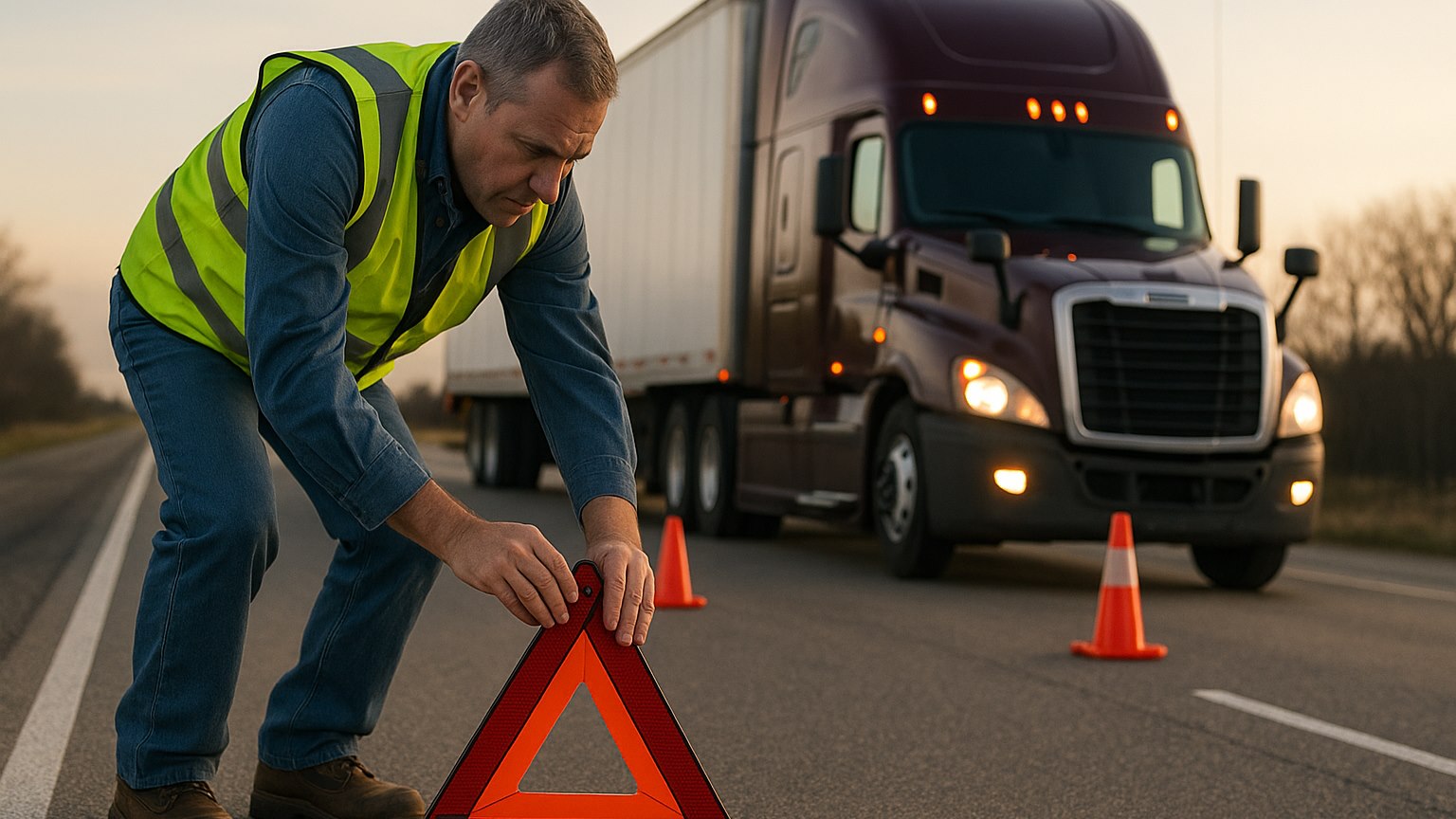
- Set out your triangles. The federal rule (49 CFR 392.22) gives you 10 minutes: one triangle about 10 feet from the truck on the traffic side, one about 100 feet behind, one about 100 feet ahead on a two-way road — or 100 and 200 feet to the rear on a divided highway. Put your vest on first; walking an interstate shoulder is the most dangerous part of this whole day.
- Exchange information — and nothing else. Name, carrier, insurance, plates, driver's license. Photograph the other driver's documents instead of copying them by hand.
- Admit fault to no one. Not "I'm sorry," not "I never saw you," not thinking out loud about what you could have done differently. Adrenaline makes people talk, and everything said at the scene gets repeated to the police and both insurance companies. Answer the officer's questions factually — where you were, what you saw — and let the investigation sort out the rest.
- Don't move the vehicles until you're told to, unless they're blocking live lanes and the 911 operator or an officer directs you to clear them. Final positions on the pavement are evidence — which is why the wide photos in the section below come before anything rolls.
📞 Who do you call, and what does your dispatcher actually need?
Once 911 is rolling and the scene is safe, the second call is dispatch — before the other driver's insurance, before family, before anything goes on social media (post nothing, ever). A good dispatcher walks you through the company's accident procedure and starts three clocks you can't see: the tow, the insurance notification, and — if the crash qualifies — the post-accident test, which runs on federal deadlines measured in hours.
Have this ready when you dial:
- Exact location and direction of travel;
- Injuries — yes or no, and to whom;
- Whether the truck and trailer are drivable;
- Whether police are on scene, and the report number once you have it;
- Load status — reefer running, setpoint holding, seal intact, doors closed;
- Photos, sent as soon as you've taken them.
This is the moment when the company you drive for stops being a line on a settlement and becomes real. At ASTEL the accident line is the same 24/7 dispatch you talk to every day, with a direct line to the owner behind it — a former driver who has stood on that shoulder himself. Nobody is left to figure out a tow, a load transfer and a claim alone at 2 a.m.
Expect the possibility of a post-crash inspection, too: after a serious accident, an officer may go through the vehicle and your paperwork the way a scale house would. Logs, permits and medical card in order — the drill is the same as in our DOT roadside inspection guide.
📸 How do you document the scene like a professional?
Your phone is the cheapest insurance policy you own, and the scene only exists for about an hour. Shoot more than feels necessary — nobody has ever regretted too many photos. The shot list:
- Wide shots from all four directions showing both vehicles' final positions in context — before anything moves;
- Close-ups of every damage point on both vehicles, plus your trailer, the seal and the load if the doors opened;
- The road itself: skid marks, gouges, debris, fluid trails — they fade or get driven over fast;
- Context: signs, signals, lane markings, construction zones, sight lines;
- Conditions: sky, precipitation, ice, sun angle — a short video of the scene captures light and weather better than words;
- The other driver's documents: license, insurance card, registration, plate;
- Witnesses: names and phone numbers before they drive off; a twenty-second voice memo of what they saw is gold later;
- The officer: name, badge number, and the crash report number.
Why a dashcam is your best witness
A road-facing dashcam ends most he-said-she-said arguments before they start: it shows the lane change, the brake check, the light. FMCSA's crash preventability program (below) even has an eligibility category for "any other crash where video demonstrates the sequence of events" — as of September 2026, video is written into the federal process itself. Two habits matter: save the clip immediately, because most cameras overwrite their loop within days or hours, and send it to dispatch the same day along with your photos.
🧪 When is a post-accident drug and alcohol test required?
Federal rules set exactly three situations in which DOT post-accident testing is mandatory for a CDL driver. Fault doesn't decide it — outcomes and citations do. Here's 49 CFR 382.303 as of September 2026 (details may change):
| Crash outcome | Citation required? | Alcohol + drug test? |
|---|---|---|
| A human fatality | No — testing applies whether or not you're cited | Always required |
| Bodily injury with immediate medical treatment away from the scene | Yes — a moving-violation citation to you, issued within 8 hours (alcohol) / 32 hours (drugs) | Required only with the citation |
| Disabling damage — any vehicle towed from the scene | Yes — same citation windows | Required only with the citation |
The clocks are short. The alcohol test should happen as soon as possible — after 2 hours the employer has to document why it hasn't, and at 8 hours the attempt stops. The drug test must happen within 32 hours. Until you're tested or 8 hours pass, no alcohol, period — and you're expected to stay readily available for testing. Riding away in an ambulance obviously doesn't count against you: the rule explicitly says nothing in it should delay medical attention.
Two practical notes. First, many carriers test after any DOT-recordable crash as company policy, beyond the federal minimum — and refusing a required test carries the same consequences as failing one. How collection, the MRO review and the Clearinghouse work is covered in our DOT drug test guide. Second, notice how much rides on that citation: the same fender-bender with a tow is a federal test if you're cited and no test if you're not. Your dispatcher needs to know about the ticket the minute it's written.
🗂️ What makes a crash DOT-recordable — and is that the same as at fault?
The federal definition of an accident (49 CFR 390.5) catches any crash involving a commercial motor vehicle on a public road that results in a fatality, an injury treated away from the scene, or any vehicle towed with disabling damage. Notice what's missing from that definition: fault. Three different labels get mixed up here, and they're decided by three different people:
| Label | Who decides | What it means for you |
|---|---|---|
| DOT-recordable | The definition itself (390.5) | The crash goes on the carrier's accident register and into FMCSA's data — fault-blind |
| Preventable | FMCSA's review program, or your carrier's safety department | Could a reasonably careful driver have avoided it? Drives CSA math and internal consequences |
| At fault | Police, insurers, courts | Citations, claims, liability — separate from FMCSA's bookkeeping |
A recordable crash flows from the state crash report into FMCSA's system and lands in two places: the carrier's Crash Indicator BASIC in CSA, and your own PSP file. Both are unpacked in our CSA, PSP and MVR guide. Yes, that means getting rear-ended at a red light is recordable. Which is exactly why the next section exists.
⚖️ Can a not-at-fault crash be reviewed and flagged on your record?
Reviewed and flagged — yes; erased — no. FMCSA's Crash Preventability Determination Program (CPDP) lets a carrier or driver submit an eligible crash for a preventability review. As of September 2026 the program covers 21 crash types (the list was expanded in December 2024 and may change again). The big ones:
- You were struck in the rear, or struck on the side at the rear;
- You were hit while legally stopped or parked;
- The other driver failed to stop, ran a signal, or made an illegal turn or U-turn;
- A wrong-way driver, or a motorist who lost control of their vehicle;
- The other driver was under the influence, asleep, distracted, or had a medical emergency;
- An animal strike, a suicide or attempted suicide, or a vehicle entering from a driveway or parking lot;
- Crashes involving a non-motorist — and a catch-all: any crash where video demonstrates the sequence of events.
The request goes through DataQs, FMCSA's data-review portal — usually filed by the carrier's safety department, though drivers can file too — with the police report, photos and any video attached. If the review comes back Not Preventable, the crash is removed from the carrier's Crash Indicator calculation and the determination is noted on your PSP. The crash itself still appears there; the flag next to it is what tells your next employer the real story. Which brings us to the paper trail you started building at minute one: the wide shots, the witnesses, the dashcam clip — that's the evidence a DataQs review runs on.
🧭 What happens to your record — and your next job?
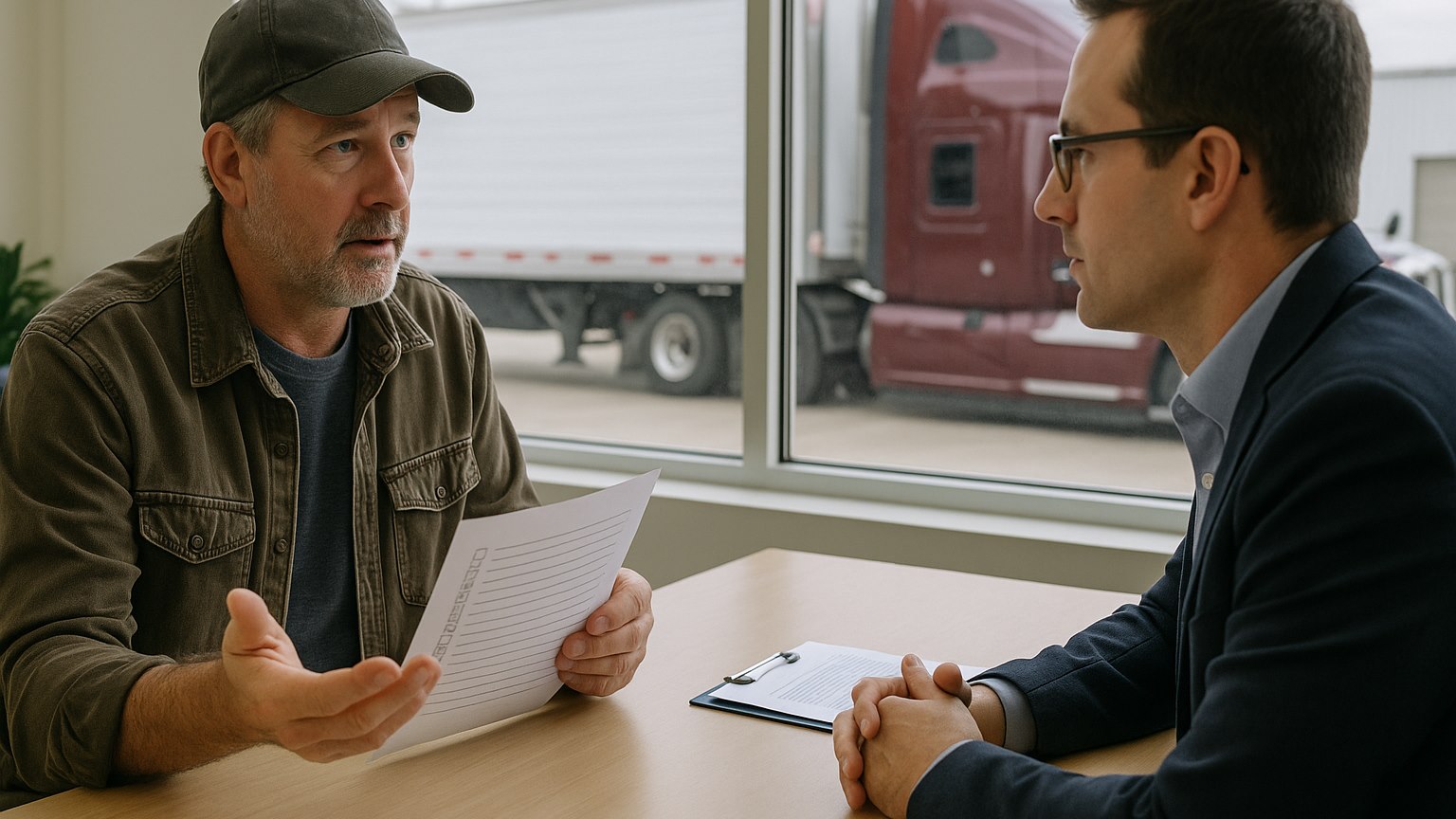
In the days after a crash, expect calls. The other driver's insurance company — and sometimes a law office — may ask for a recorded statement. As a company driver, route all of it to your carrier's safety department: that's the professional answer, not an evasive one. Don't give recorded statements, don't sign anything beyond the required exchange of information, don't discuss the crash online. If your own interests need protecting — you were hurt, or you plan to fight a citation — that's a conversation for a lawyer of your own choosing, not for the other side's adjuster.
Then there's hiring. Your PSP shows five years of crash history and three years of inspections, and nearly every carrier pulls it, with your consent, when you apply. So the honesty math is simple: the crash will be seen. A driver who explains — "rear-ended at a light outside Gary, reviewed through DataQs, determined not preventable" — reads completely differently from a driver whose application claimed a clean history the PSP then contradicts. If you're changing jobs after an accident, do it the clean way: our guide on how to switch trucking companies covers timing and paperwork.
And the best accident file is the one that never gets opened. The crashes that are yours to prevent cluster where speed meets conditions: following distance in rain, black ice and chain country in our winter driving guide, brake fade and runaway ramps in the mountain driving guide. Slowing down is cheap. The shoulder is expensive.
❓ Frequently asked questions
Do I have to take a drug test after every semi truck accident?
No. Federal post-accident testing under 49 CFR 382.303 applies in three cases: any crash with a fatality (always), and crashes where you receive a moving-violation citation and either someone gets immediate medical treatment away from the scene or any vehicle is towed with disabling damage. Alcohol testing happens within hours and the drug test within 32; many carriers test more broadly under their own policy.
What counts as a DOT-recordable accident?
Under 49 CFR 390.5, a crash involving a commercial motor vehicle on a public road is recordable if it results in a fatality, an injury treated away from the scene, or any vehicle towed due to disabling damage. Fault is not part of the definition — a recordable crash can be entirely the other driver's doing.
How long does an accident stay on my PSP record?
A PSP report shows five years of crash history and three years of roadside inspection history. A crash reviewed through FMCSA's Crash Preventability Determination Program and found Not Preventable still appears, but with that determination noted — which is exactly what you want a future employer to see next to it.
Should I talk to the other driver's insurance company after a truck accident?
As a company driver, no — refer every call from the other side's insurer or attorney to your carrier's safety department, and don't give recorded statements or sign anything at the scene beyond the required information exchange. If you personally were injured or cited, discuss that with a lawyer of your own choosing.
Can a crash that wasn't my fault be removed from my record?
Not erased, but flagged. Through FMCSA's Crash Preventability Determination Program, eligible crashes — struck in the rear, hit while legally parked, hit by an impaired or wrong-way driver and more — can be submitted through DataQs with the police report and video. A Not Preventable finding removes the crash from the carrier's CSA Crash Indicator calculation and is noted on your PSP.
🚛 A carrier that doesn't leave you alone on the shoulder
ASTEL is a family-owned carrier out of Chicago running refrigerated freight year-round on late-model Volvo trucks, with our own repair shop and mechanics, 24/7 dispatch and a direct line to the owner. Drivers earn $90,000–$110,000 a year — $2,400–2,700+ a week gross, a flat $0.80 per mile for drivers with 1+ year of experience, all miles paid ZIP-to-ZIP, weekly pay, plus $50/$200/$500 bonuses for clean DOT inspections.
Apply in 2 minutes →Regulatory details — post-accident testing under 49 CFR 382.303, warning devices under 49 CFR 392.22, the accident definition in 49 CFR 390.5, the FMCSA Crash Preventability Determination Program, DataQs and the Pre-Employment Screening Program (PSP) — reflect FMCSA rules and program descriptions as of September 2026 and may change; your company's accident procedure and state law also apply. Pay and mileage figures describe ASTEL driver ranges, not guarantees. This article is general information for professional drivers, not legal advice.