

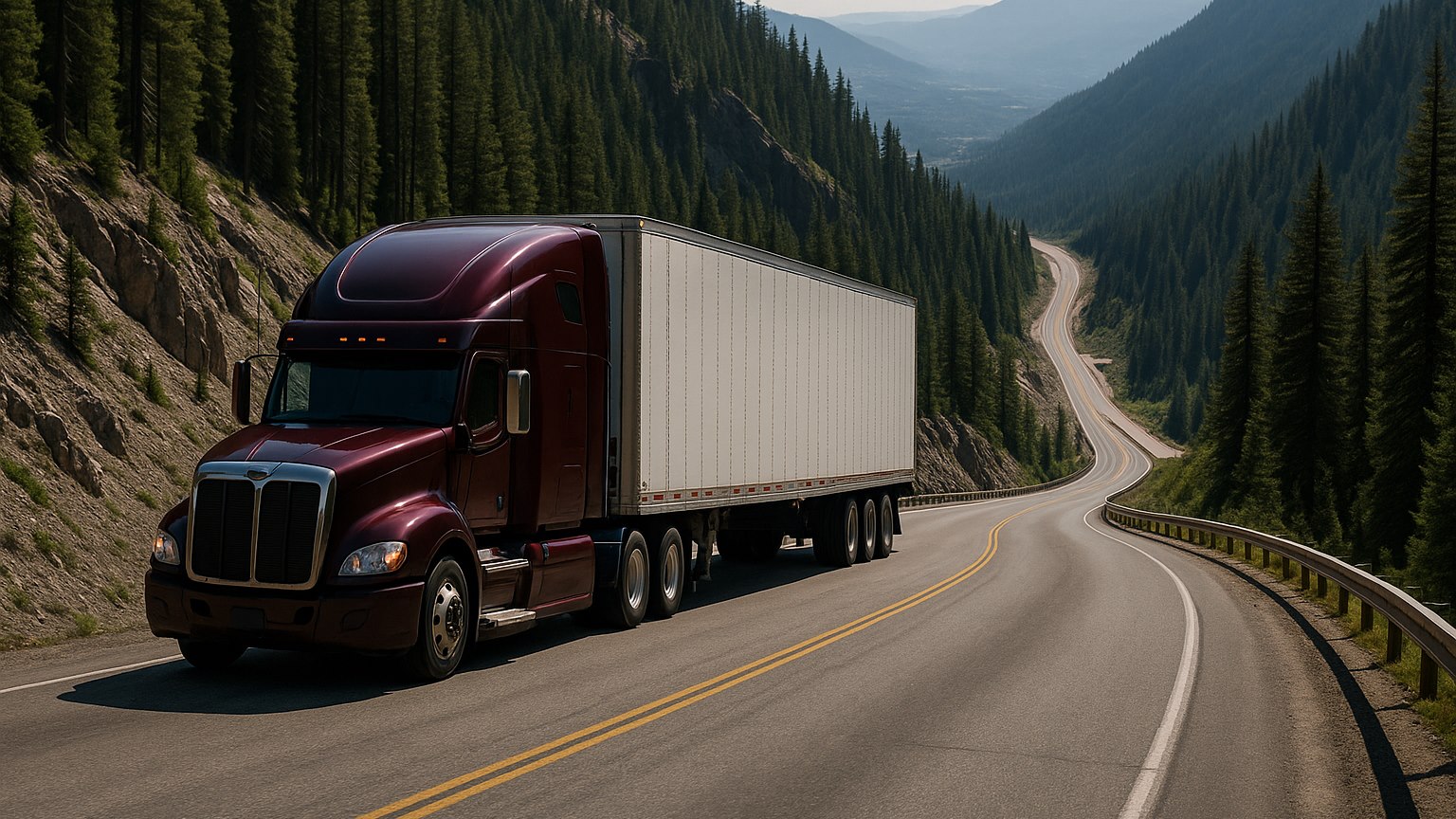
Mountain Driving for Truckers — Downgrades, Brakes and the Gear You Pick at the Top
Every driver who runs West to Midwest freight eventually meets the same sign, a yellow truck tilted on a black triangle, "6% GRADE NEXT 7 MILES." What happens in the next ten minutes gets decided in the thirty seconds before it, at the summit, with your foot off the throttle and your hand on the gear selector. This is mountain driving for truckers the way experienced drivers actually do it, not the way the CDL manual summarizes it.
Brakes fail on a long downgrade for one physical reason
Physics, not bad luck. A loaded reefer rolling down a 6% grade converts potential energy into kinetic energy the whole way; the only place that energy can go is into heat at the brakes or into the engine's compression. Drum brakes work fine up to roughly 400 to 500 degrees Fahrenheit. Past that, the friction material starts to glaze and the drums expand away from the shoes, so the same pedal pressure gives you less and less braking. That's brake fade. It doesn't announce itself. The pedal feels normal until the moment it doesn't, and by then you're going faster on a hill that isn't getting any shorter.
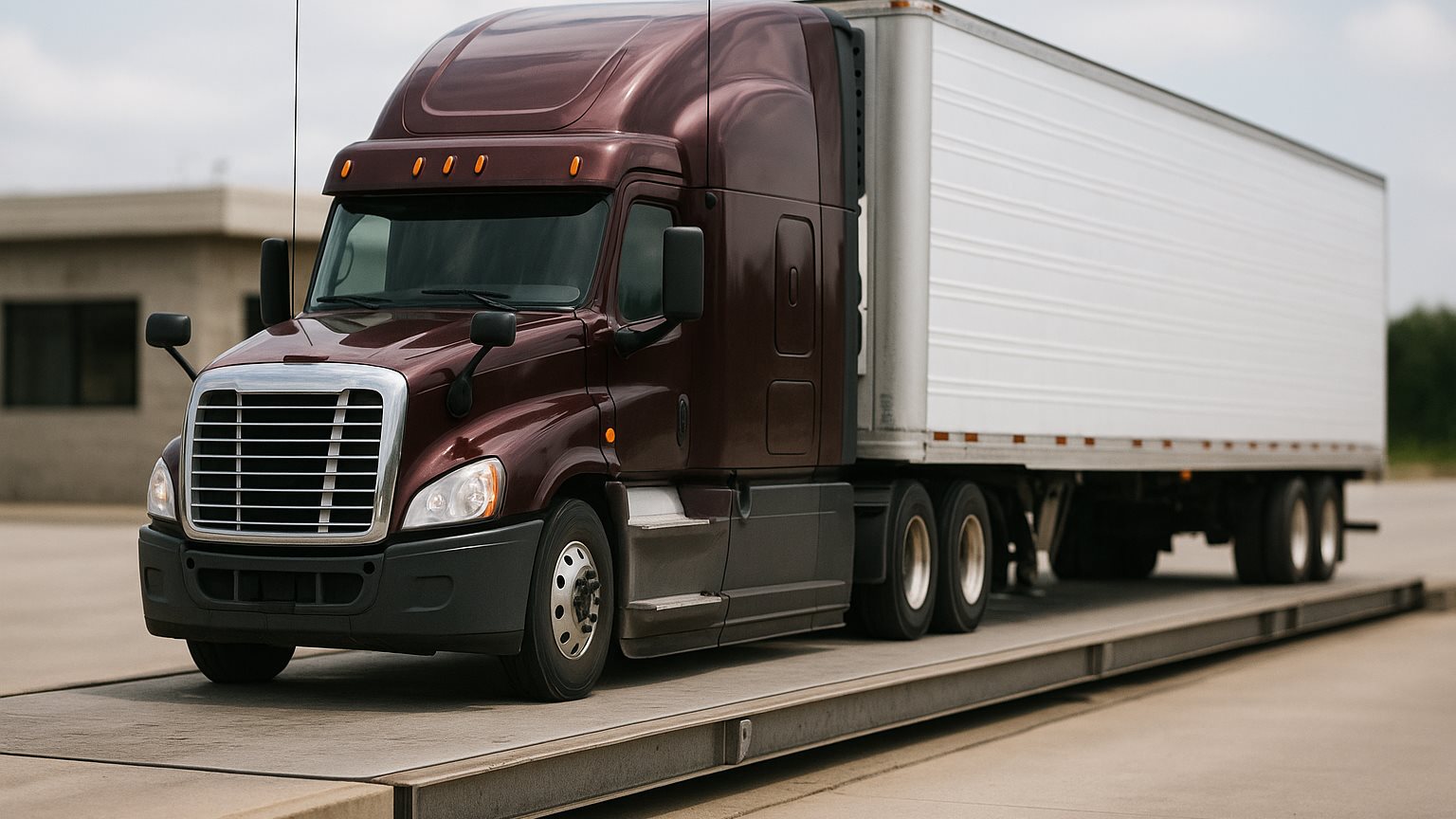
Two things make this worse for reefer drivers specifically. You're usually running close to max gross, and the reefer unit plus its fuel tank add weight at the front of the trailer. Heavier means more energy to dump per mile of descent. Check your weights before the mountains, not after; the axle math is in our weigh station and axle weight guide.
Pick the gear at the top, not on the way down
The oldest rule in the mountains still holds. Go down in the same gear you'd need to climb that hill, or one lower. The gear you start the descent in is the gear you'll finish it in. Once you're rolling fast on a grade you cannot downshift a heavy truck safely, because the engine won't match road speed and you'll end up in neutral, which is the one place you must never be on a downgrade. So the decision happens at the summit, at 25 to 35 mph, before gravity takes a vote.
A practical benchmark for a loaded combination on a 6% grade is 25 to 35 mph in a gear where the engine sits at 1,500 to 1,900 rpm with the engine brake on. If the truck holds speed with no service brakes at all, you picked right. If speed keeps climbing even with the engine brake on high, you're a gear too high, and you found out at the top, where it costs nothing to fix.
What the three engine brake stages actually do
A compression-release engine brake ("Jake brake") turns the engine into an air compressor. It opens the exhaust valves near top dead center so the compressed air bleeds off instead of pushing the piston back down. The three positions typically activate 2, 4 or all 6 cylinders. Position 1 is for slippery roads and gentle grades; position 3 on a dry 6 to 7% grade in the right gear will hold most loaded trucks without service brakes. The engine brake is strongest at high rpm, which is another reason to be in a low gear. A Jake at 1,200 rpm is a rumor, at 1,800 it's a tool. One caution from the winter driving guide: on ice or packed snow, an engine brake on high can lock the drive axles and start a jackknife, so drop it to stage 1 or off and go slower instead.
Automatics run their own descent mode
Late-model automated transmissions took most of the guesswork out of this. On the Volvo I-Shift, pull the selector into manual mode at the top and hold the gear you want. The transmission will not upshift on its own, and the engine brake integrates with cruise or the brake pedal to hold a target speed. What automation does not do is choose the summit speed for you. Hit the crest at 55 mph in 11th and the software will do its best, and it won't be enough. Slow down before the sign, select the gear, then let the truck work. We walked through the descent behavior in our Volvo VNL review, and if you're still choosing between transmissions, the mountains make one of the strongest arguments in the automatic-vs-manual debate.
Snub braking beats steady pressure for saving your brakes
Old-school advice said "light, steady pressure" all the way down. Modern training, and every fleet safety department, teaches snub braking instead, and the physics is on its side. Steady light pressure keeps the brakes engaged 100% of the time; heat builds continuously and the drums never get a chance to cool. Snubbing applies the brakes hard enough (roughly 20 to 25 psi on the gauge) to knock off 5 mph, then releases completely so air can flow over the drums. Less time engaged, more time cooling, and the brakes are still there when you need them at the bottom.
The rhythm on a 6% grade looks like this. Safe speed is 30 mph, you let the engine brake hold it, speed creeps to 35, firm snub back to 30, full release. Snubbing every few seconds means you're a gear too high; once a minute means you nailed it. Either way, never fan the brakes (rapid on-off), and never let the truck run beyond the safe speed because the ramp is right there. That's the last thought behind a lot of runaway trucks.
Running a descent step by step
- Before the trip, know the profile. A decent trip plan marks every 5%+ grade on the route, the brake check area before it and the time of day you'll hit it.
- Pre-trip, brakes are the whole game. Slack adjuster stroke, pushrod travel, air leaks, drum condition. A truck with one brake out of adjustment is a truck with 90% of its braking on a hill that needs 100%. The checklist is in our pre-trip inspection guide.
- At the brake check area, stop, even if you're sure. Get out, feel the wheel hubs and drums with the back of your hand (a drum you can't hold your hand near is already hot), listen for leaks, read the grade sign. Many states require trucks to stop here; all of them should.
- At the crest, slow down and select. Bring speed down to the posted truck limit or below before the grade starts, pick the gear, turn the engine brake to the stage that holds you. Cruise control off unless it's a descent-integrated system you've tested.
- On the grade, hold and snub. Right lane, hazard lights on if you're well below traffic speed, eyes 15 seconds ahead. Snub to safe speed, release, repeat. Do not upshift, do not touch the selector.
- Watch the mirrors and gauges. Smoke from a wheel end, a dropping air pressure gauge, a pedal that goes lower than it did five minutes ago, any of these means the next runaway ramp is yours.
- At the bottom, don't relax yet. The most common mountain crash isn't a runaway. It's a truck that reached the flats with hot brakes and a driver who stopped thinking about them. Give the brakes ten minutes before you need them hard.
Western grades that deserve the most respect
Most West to Midwest freight crosses at least two of these on every cycle. All are two-way problems: what's a grade down one direction is a long, hot climb the other way.
| Grade | Steepness & length | What drivers should know |
|---|---|---|
| Cabbage Hill, I-84, Oregon (Pendleton) | 6% for ~7 miles westbound, ~2,000 ft of drop | Runaway ramps at MP 222 and 220; fog, snow and black ice October through April. Most crashes here are out-of-state trucks with brake issues: drivers who didn't know it was coming |
| Donner Pass, I-80, California | 3 to 6% over ~30 miles; steepest ~6% for ~3 miles | Westbound brake check between Nyack and Blue Canyon, two runaway ramps below. Chain controls common November through April; the summit itself sits above 7,000 ft |
| The Grapevine, I-5, California (Tejon Pass) | ~6% for ~5 miles northbound; 2,600 ft of descent over 12 miles | Trucks posted at 35 mph on the steep section, two runaway ramps near the summit. Heavy truck volume: expect to be boxed in by traffic that doesn't understand why you're slow |
| Vail Pass, I-70, Colorado | ~7% on both sides, summit 10,662 ft | Sustained grade both ways; engine power drops noticeably at altitude. Colorado's chain law applies here Sep 1 through May 31 |
| Eisenhower Tunnel / Straight Creek, I-70, Colorado | ~7% for 5.5 miles west of the tunnel, ~6% east side; tunnel at 11,158 ft | Highest point on any U.S. interstate. Four runaway ramps between the tunnel and Vail; Lower Straight Creek is the most-used ramp in the nation. HAZMAT is routed around the tunnel |
| Parley's Canyon, I-80, Utah (Salt Lake City) | "3–6% next 10 miles" westbound; ~2,400 ft drop | Trucks posted at 40 mph. Brake check area at the top, escape ramp midway; the steady 6% first six miles is where brakes get cooked |
| Sherman Hill, I-80, Wyoming (Laramie–Cheyenne) | ~6% average, summit 8,640 ft | The highest point on I-80. The grade is manageable; the crosswind isn't: trailers go over here in every season, and an empty reefer is a sail |
| Monteagle, I-24, Tennessee | 6% for ~4 miles eastbound (1,161 ft drop); 5% for 4 miles westbound | Not Western, but it's on every Chicago–Southeast run. Runaway ramps on the left side, truck climbing lane westbound. Often the first real grade a new driver meets |
Altitude changes the truck on the way up too
- Power loss. Thinner air means less oxygen per stroke; even a turbocharged diesel loses a noticeable share of its power by 10,000 ft, and the turbo works harder to compensate. Plan on lower climbing speeds over Vail and the tunnel, and don't fight the truck. A loaded rig at 25 mph in the right lane is exactly what everyone expects to see.
- Climbing lane discipline. Stay right, and don't pull into the middle lane to pass a truck doing 2 mph less than you. You'll hold up the entire mountain for a gain of thirty seconds.
- Coolant and EGT on the climb. Long 7% climbs at full throttle push coolant temperature; if the gauge keeps rising, back off the throttle rather than the gear. If it's rising in the mountains, it was marginal on the flats: a shop item, not a road item.
- Reefer fuel and weight. Keep the reefer tank topped before the mountains. The unit runs hard against cold summit air and hot valley air within the same hour. And remember that reefer fuel, the unit and the insulated box all count toward the gross weight you'll be braking against on the far side.
- Chain law. Colorado's must-carry law requires commercial vehicles to carry chains from September 1 to May 31 on I-70 between Dotsero and Morrison and on most highways west of I-25, not just to have them somewhere in the yard. Fines start at $500 for not carrying and climb past $1,000 if you block the road. The chain-up procedure itself is in the winter driving guide.
The carrier owns half of this job
A driver can do everything right on the hill and still be let down by a brake out of adjustment. That's why brake condition is the single most-cited item in a DOT roadside inspection and why it should be the first thing a carrier's shop looks at, not the last. At ASTEL, brakes are serviced in our own Chicago shop by our own mechanics, and if a truck goes down on the road you get a replacement truck, not a lecture. Because West to Midwest lanes cross these grades every week, the fleet runs late-model Volvo automatics with a three-stage engine brake, which is the equipment this whole article assumes you have.
Clean mountain driving also pays. ASTEL's safety bonus adds +$0.02 per mile, and a clean DOT inspection brings a bonus of $50, $200 or $500 depending on the level. Full terms for drivers based in Colorado, Oregon and Utah are on the state pages.
Your own gauges matter as much as the truck's
Mountain corridors are where fatigue does the most damage, because the margin for a slow reaction is smallest. Descending Cabbage Hill in the fourteenth hour of a shift is a decision, not an accident. Staying sharp is covered in the driver health guide; the terms used here (snub, Jake, gross, EGT) are in the trucking glossary; and if the CDL road test is still ahead of you, learn this before the examiner asks.
Frequently asked questions
What gear should a truck use going down a mountain?
The same gear you would need to climb that grade, or one lower, selected at the top before the descent begins. A loaded truck on a 6% grade typically holds 25 to 35 mph in a low gear with the engine brake on; if speed holds with no service brakes, the gear is right.
What is snub braking?
A firm brake application of about 20 to 25 psi that reduces speed by roughly 5 mph, followed by a complete release so the brakes can cool. It replaces light, steady pressure, which keeps the brakes engaged continuously and leads to brake fade.
Do you get a ticket for using a runaway truck ramp?
No. There is no fine, citation or penalty for using a runaway ramp; that is what it is built for. The truck will need a tow out of the gravel, which is a small cost compared with a runaway crash.
Can you use a Jake brake on snow or ice?
Carefully, and usually on the lowest stage only. On slippery surfaces a strong engine brake can lock the drive axles and start a jackknife. Reduce the stage or switch it off and descend more slowly in a lower gear instead.
When do trucks have to carry chains in Colorado?
From September 1 to May 31 every year, commercial vehicles must carry chains on I-70 between Dotsero and Morrison and on most highways west of I-25, whether or not a chain law is active. Fines start at $500 for not carrying chains.
Drive the mountains in a truck that's ready for them
ASTEL is a family-owned carrier out of Chicago running reefer freight on West↔Midwest lanes: late-model Volvo automatics with engine brake, brakes serviced in our own shop, a replacement truck if yours breaks down, and dispatch that answers 24/7. $90,000–$110,000 a year, $2,400–2,700+ gross per week, a flat $0.80 per mile for drivers with 1+ year of experience, all miles paid ZIP-to-ZIP, paid weekly.
Apply in 2 minutes →Grade percentages, lengths and elevations per ODOT, Caltrans, CDOT, UDOT, TDOT and Wyoming Highway Patrol mountain-route information and published route guides; runaway ramp statistics per CDOT (2022); chain law per Colorado C.R.S. 42-4-106 and CDOT "Must Carry" guidance as of 2026. Braking procedures follow FMCSA CDL manual guidance and common carrier safety training. Figures current as of August 2026 and may change; this article is general information, not legal or safety advice.