

Weigh Stations and Axle Weights. What the Scale Sees and How to Pass It Calmly
For a new driver, the weigh station is a mystery box with flashing signs. For a professional, it's a two-minute non-event, since they already know their numbers before the scale does. Here is everything the scale house checks, what the legal limits actually are, and how sliding tandems turns an overweight axle into a legal one.
The numbers that matter
| Limit | Federal rule | What it means in practice |
|---|---|---|
| Gross weight | 80,000 lbs max on interstates | Tractor + trailer + fuel + cargo + you. Nothing on the truck fixes an overweight gross except removing cargo. |
| Tandem group | 34,000 lbs | Your drives and your trailer tandems each live under this ceiling. This is the number sliding tandems manages. |
| Single axle | 20,000 lbs | Rarely your problem on a standard van/reefer; matters for spread-axle and specialized trailers. |
| Steer axle | Set by tire rating & state rules | Commonly runs 11,500–12,500 lbs on a loaded rig; watch it with heavy front-loaded freight. |
| Bridge formula | W = 500 × (LN/(N−1) + 12N + 36) | Ties allowed weight to axle spacing. This is the reason tandem position affects legality, not just balance. |
States can allow more on non-interstate roads and issue permits for legitimately heavy loads, but 80/34/20 is the working reality of dry van and reefer freight. California adds its own famous wrinkle: a kingpin-to-rear-axle limit (40 ft) that forces tandems forward before you cross the state line.
Sliding tandems is the 10-minute fix for an overweight axle
Scale ticket says drives 35,200, trailer tandems 32,600, gross 79,400. You're legal on gross. Illegal on the drives. The fix is mechanical, not mathematical.
- Sliding tandems moves the trailer's axle group relative to the load. Slide tandems forward, toward the nose, and the axles sit closer under the freight, so tandems carry more and drives carry less. Slide them back, toward the doors, and drives carry more, tandems carry less. Heavy drives mean slide forward; heavy tandems mean slide back.
- Each hole shifts roughly 250–500 lbs depending on hole spacing (about 250 for close-spaced rails, 400–500 for 6-inch spacing). Our example needs roughly 1,200 lbs off the drives, so three to four holes forward, then reweigh.
- Procedure: set the trailer brake, pull the release pin handle, rock the tractor gently to free the pins, slide, verify all four pins locked, reweigh (about $5).
- Know your state's tandem rules before you slide. Remember the California 40-ft kingpin rule and similar quirks. A slide that fixes weight can create a length violation.
What actually happens at a weigh station
- Signs announce OPEN or CLOSED. Open means commercial vehicles enter, per that state's rules. Blowing past an open scale is a guaranteed conversation with an officer who now has a reason to look at everything.
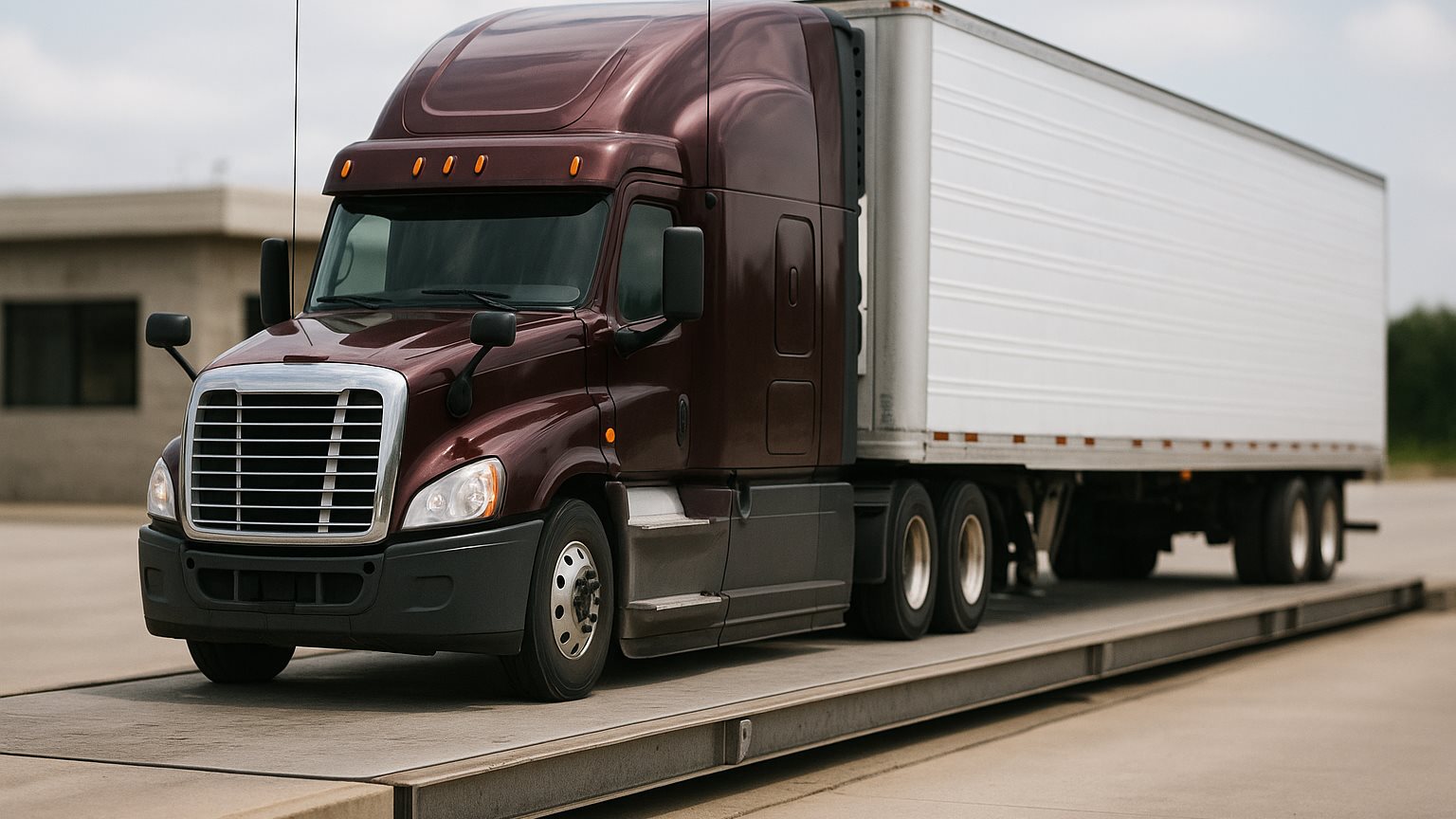
- Most trucks roll across in motion. Weigh-in-motion sensors read axles at low speed and wave compliant trucks through. Anomalies get the STOP light and a static scale.
- Bypass transponders change the game. PrePass and Drivewyze check your carrier's safety score as you approach; a green light means you pass at highway speed. Both live in our apps toolkit.
- The scale house sees more than weight. Officers can pull any truck in for a closer look, which becomes a DOT inspection: logs, license, equipment. A truck that looks maintained and a driver whose paperwork is in hand usually keep it at Level 3 speed.
Where overweight is caught, expect a fine (state-dependent, often hundreds to thousands of dollars for serious excess), and in many states the truck doesn't move until the load is legal: a rework or a partial offload you'll wait hours for. The pre-trip habit and a post-pickup scale stop make the whole category a non-issue.
The reefer note on fuel, ice and produce math
- The reefer unit and its fuel count. A full reefer tank is a few hundred pounds sitting behind the kingpin. Remember it when a load books at 44,000+ lbs.
- Produce is heavy and wet. Iced product sheds weight as it melts and drains, so what scaled borderline at pickup may read different later. Scale early, keep the ticket.
- Load position matters more with dense freight. A pallet pattern stacked toward the nose loads the drives; toward the doors, the tandems. If a shipper's pattern is clearly off, raise it before the doors close. Restacking at a dock beats restacking at a scale house.
Frequently asked questions
Do trucks have to stop at every weigh station?
When a station is open, commercial vehicles are required to enter per that state's signage and rules. Bypass systems like PrePass or Drivewyze can green-light vetted carriers past at highway speed; a red light or no transponder means you go in.
What are the federal truck weight limits?
On the interstate system: 80,000 lbs gross, 34,000 lbs per tandem axle group, 20,000 lbs per single axle, plus the bridge formula tying weight to axle spacing. States may allow more off-interstate or by permit.
How much weight does sliding tandems move per hole?
Roughly 250–500 lbs per hole depending on the rail's hole spacing. Close-spaced rails move about 250 lbs, 6-inch spacing closer to 400–500. Sliding shifts weight between drives and trailer tandems only; it never reduces gross weight.
How much does a CAT scale cost?
About $15 for a first weigh and about $5 for a reweigh of the same rig within 24 hours at the same location (2026 pricing). Weighing after every heavy pickup is the cheapest insurance in trucking after the pre-trip itself.
What happens if a truck is overweight at a weigh station?
Fines scale with the excess and the state, from hundreds to thousands of dollars, and many states hold the truck until the load is made legal, which can mean hours waiting for a rework. An axle overweight can often be fixed on the spot by sliding tandems; a gross overweight cannot.
Know your numbers. We'll keep the wheels under them.
ASTEL runs year-round reefer freight on maintained equipment, with dispatch on call 24/7 when a shipper loads you heavy and the plan needs to change. Drivers earn $90,000–$110,000 a year, paid weekly — and a clean DOT inspection pays a $50–$500 bonus.
Apply in 2 minutes →Federal weight limits and bridge formula per FMCSA/FHWA regulations (23 CFR 658); state rules, fines and kingpin limits vary — verify current requirements for the states on your lane. CAT scale pricing as published for 2026 and subject to change. This article is general information, not legal advice.