

🌪️ Truck Driving in High Winds and Severe Weather: A Driver's Survival Guide
Every driver respects ice. Far fewer respect wind — and it's wind, not snow, that flips trailers on clear, dry days. Add hurricane evacuations, flash floods, tornadoes and dust storms, and "severe weather" is a year-round subject. Here's what actually rolls trucks, the numbers that should make you park, and the federal rule that puts the shutdown decision in your hands. 🚛
💨 Why is wind the number-one trailer killer?
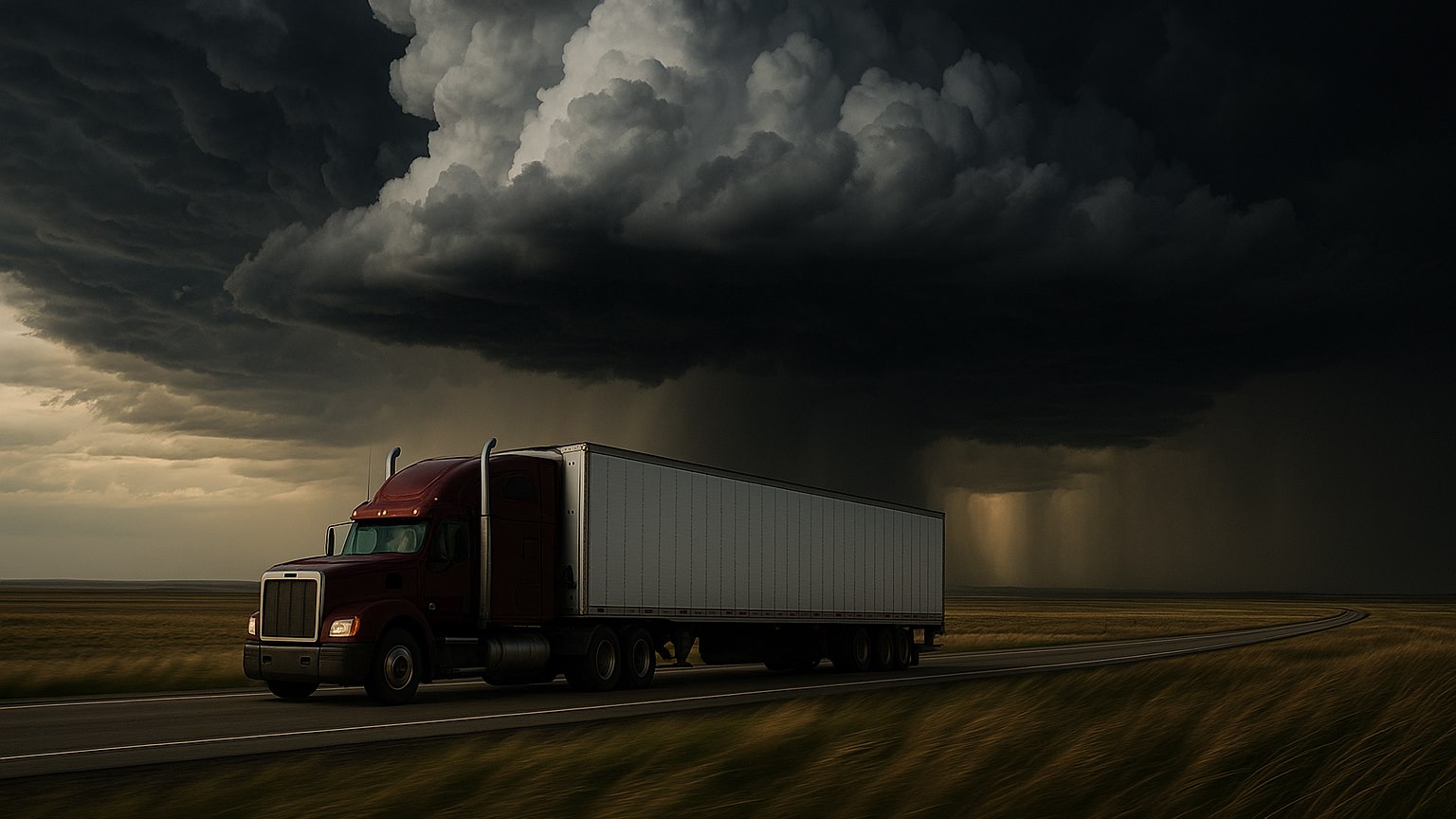
A 53-foot dry van or reefer shows the wind several hundred square feet of flat side — a sail taller than a house wall, riding on a track barely eight feet wide. Whether that sail stays upright comes down to what's behind it:
- Loaded heavy and low — 40,000+ lb on the floor — the trailer shrugs off gusts that flatten lighter traffic. Weight low in the box is ballast.
- Empty, you're the lightest thing on the interstate: the center of gravity is high, and a strong gust doesn't push you sideways — it lifts the upwind side.
- Light and tall is the trap. A reefer with a few pallets of chips is legally "loaded" and physically still a sail — judge by weight on the floor, not the word on the BOL.
Gusts matter more than sustained wind: a steady 30 mph crosswind you can steer against; a 50 mph gust arrives in half a second — usually where the terrain changes. Bridges, overpasses, canyon gaps and open plateaus on mountain and high-desert routes are where trailers go over. If the trailer starts to tip, don't yank the wheel against it — a violent counter-steer whips the trailer and finishes the rollover. Ease off the throttle, steer with small corrections, let speed bleed off, and leave the road at the first safe spot. The real fix happened ten minutes earlier, when you slowed down or didn't start the leg at all.
📏 At what wind speed should you park the truck?
There is no single federal number — which is why drivers get talked into driving when they shouldn't. The working thresholds, as of September 2026:
| Threat | Threshold to watch | Action |
|---|---|---|
| Crosswind, loaded heavy | Gusts 40–50 mph | Slow down, both hands on the wheel, extra caution on bridges |
| Crosswind, empty or light trailer | Gusts ~40–50 mph — many carriers' park-it point; some empty boxes get unstable from ~35 mph sustained | Park before the worst of it. No rate covers a trailer on its side |
| State wind closures (I-80 Wyoming etc.) | WYDOT typically restricts light, high-profile vehicles at gusts ~60 mph; weight cutoffs vary and may change | Obey signs and 511 — running a closure is on you |
| Flood water on the road | Any depth you can't verify; ~2 ft of moving water carries off most vehicles | Turn Around, Don't Drown — never around a barricade |
| Tornado warning in your area | Warning issued / funnel or debris visible | Leave the truck, get low in a ditch; never under an overpass |
| Dust storm (I-10 corridor) | Wall of dust visible ahead | Exit or pull far off before it hits — lights off, foot off the brake |
| Hurricane near your route | Watch/warning on the coast ahead | Reroute or stage inland early; don't drive into an evacuation zone |
Wyoming's I-80 is the classic example: when gusts on the summits climb toward 60 mph, WYDOT closes the road to light, high-profile vehicles — exactly what an empty or lightly loaded semi is. The cutoffs are posted by weight, differ by stretch and live on 511. Other windy corridors — I-25, I-40, the Columbia River Gorge — run the same playbook.
⚖️ Can anyone force you to drive in a storm?
No — and this is one of the few places where the regulation is completely on the driver's side. 49 CFR 392.14 — Hazardous conditions; extreme caution — says that when snow, ice, sleet, fog, mist, rain, dust or smoke adversely affect visibility or traction, you must use extreme caution and reduce speed; and if conditions become sufficiently dangerous, operation of the vehicle "shall be discontinued" until it can be safely resumed. FMCSA's interpretation adds the key sentence: the driver is responsible for the safe operation of the vehicle and for the decision to cease operation.
- "Shall" is not a suggestion. Shutting down in dangerous conditions is compliance with a federal safety regulation, not a favor.
- The judgment is yours — you're the one looking through the windshield. A dispatcher 800 miles away, a broker, a receiver with a dock appointment: none of them sees the wind sock bent flat at the rest area.
- Coercion is itself a violation. Under FMCSA's coercion rule, pressuring a driver to run in violation of the safety regulations — 392.14 included — can cost a carrier or shipper dearly.
That's the rulebook. Culture matters just as much: at ASTEL the owner is a former driver, the line to him is direct, and "I'm shutting down for wind" is a professional call, not a negotiation. A carrier's reaction to your first weather shutdown is the most honest thing you'll ever learn about it.
🌀 What does hurricane season mean for an OTR driver?
The Atlantic season runs June 1 to November 30, but the punch is concentrated: activity peaks around September 10, and the heart of the season is mid-August through mid-October — the same months reefer freight is running hard. If your lane touches the Gulf or the Southeast coast, a named storm changes your week even if you never see rain:
- Evacuation traffic comes first. When a mandatory evacuation starts, coastal interstates fill for days. States may run contraflow — reversing inbound lanes so everything runs away from the coast — and while it's up, you physically cannot drive toward the storm on that highway.
- Don't be the truck heading in. A delivery to a coastal DC two days before landfall is a delivery to a warehouse that's closing, on fuel that's selling out, toward a region about to lose power. Raise it with dispatch early.
- Interstates close after landfall too — flooding, downed lines and debris keep roads shut days after the wind drops.
- Stage smart with a reefer. Holding a temp-controlled load near a storm, park inland with the reefer fueled for days, not hours — power is the first thing a hurricane takes. Confirm the plan with dispatch.
The winter half — chains, black ice, whiteouts — is a separate guide: winter driving for truck drivers.
🌊 What does "Turn Around, Don't Drown" mean at 80,000 lb?
Drivers of heavy trucks make a fatal assumption: "cars float away, I don't." The National Weather Service numbers say otherwise. Six inches of fast water reaches a passenger car's floor; a foot floats many vehicles; roughly two feet of moving water carries off most — pickups and SUVs included. An empty trailer gives the water a huge hull and little weight, and flood water hides what decides the outcome: washed-out pavement, missing culverts, depth that doubles in a truck length. More than half of U.S. flood deaths happen in vehicles.
- Never cross water you can't verify. If you didn't just see a truck your size cross it, it's a wall.
- Never drive around a barricade. The crew that placed it knew something you don't — often that the road is no longer there under the surface.
- Flash floods don't need your rain. A storm miles upstream can send water across a dry-sky road, especially in the Southwest. A Flash Flood Warning on your route is a routing problem now.
🌪️ What is the tornado protocol for a truck driver?
A semi is one of the worst places on the road to meet a tornado — high, light relative to its sail area, and full of glass. The protocol, per NWS guidance, is short and worth memorizing before the season, because you'll have minutes at best:
- Tornado Warning for your county — get off the road early. A truck stop or a solid building beats any plan improvised at 60 mph. If you can drive away from the storm's path at right angles, do it — but never try to outrun a tornado down its own track.
- Never shelter under an overpass. It feels like cover and works like a wind tunnel: the narrowed space accelerates wind and funnels debris right where you're crouching.
- If it's on you — leave the truck. The cab is a glass box that rolls. Get well away from it and other vehicles, lie flat in a ditch or the lowest ground you can find, and cover your head and neck. Flying debris causes most tornado deaths — the point of being low is that it flies over you.
- Afterward — walk the truck, photograph any damage, call dispatch before you roll.
🌫️ Dust storms, hail and wildfire smoke — what else counts?
Dust storms (I-10 Arizona and New Mexico)
A haboob drops visibility to zero in seconds; chain collisions in dust kill people on I-10 every monsoon season (roughly June–September). Arizona DOT's Pull Aside, Stay Alive drill: see the dust wall ahead — exit or pull as far off the pavement as you can before it reaches you. Then, the counterintuitive part: turn off all lights, including flashers, set the parking brake and take your foot off the brake pedal. Blinded drivers steer toward any tail lights they see; dark and off the road, you're not a target. Stay belted and wait — these storms usually pass in minutes.
Hail
Quarter-size hail cracks windshields and mirrors; softball hail comes through. If a warning mentions large hail, get under something — a fuel canopy, an overpass only if you fully clear the traffic lanes (and never in a tornado situation) — or stop with your back to the storm. Note the time and photograph the damage — documented hail claims are routine paperwork.
Wildfire smoke
392.14 names smoke explicitly — it's a slow-down-or-shut-down condition like any other. Treat thick smoke like dense fog: a speed you can stop within what you actually see, and park if visibility collapses. Watch 511 for fire closures and plan fuel around detours in the hundreds of miles. At night every visibility problem doubles — our night driving guide covers that half of the job.
🧭 Which tools warn you before the weather hits?
- State 511 systems — closures, wind restrictions, chain laws, cameras. Check every state on your route before each shift; the wind closures above go live here first.
- NWS alerts (weather.gov) — free and official. A Watch means conditions are possible — plan; a Warning means it's happening — act.
- Wind-aware weather apps — several apps in our best apps for truck drivers roundup show forecast gusts along a route, hour by hour — the number that actually flips trailers.
- Trip planning around weather — leaving three hours earlier or taking the southern route is how professionals "drive" storms — the mechanics are in our trip planning guide.
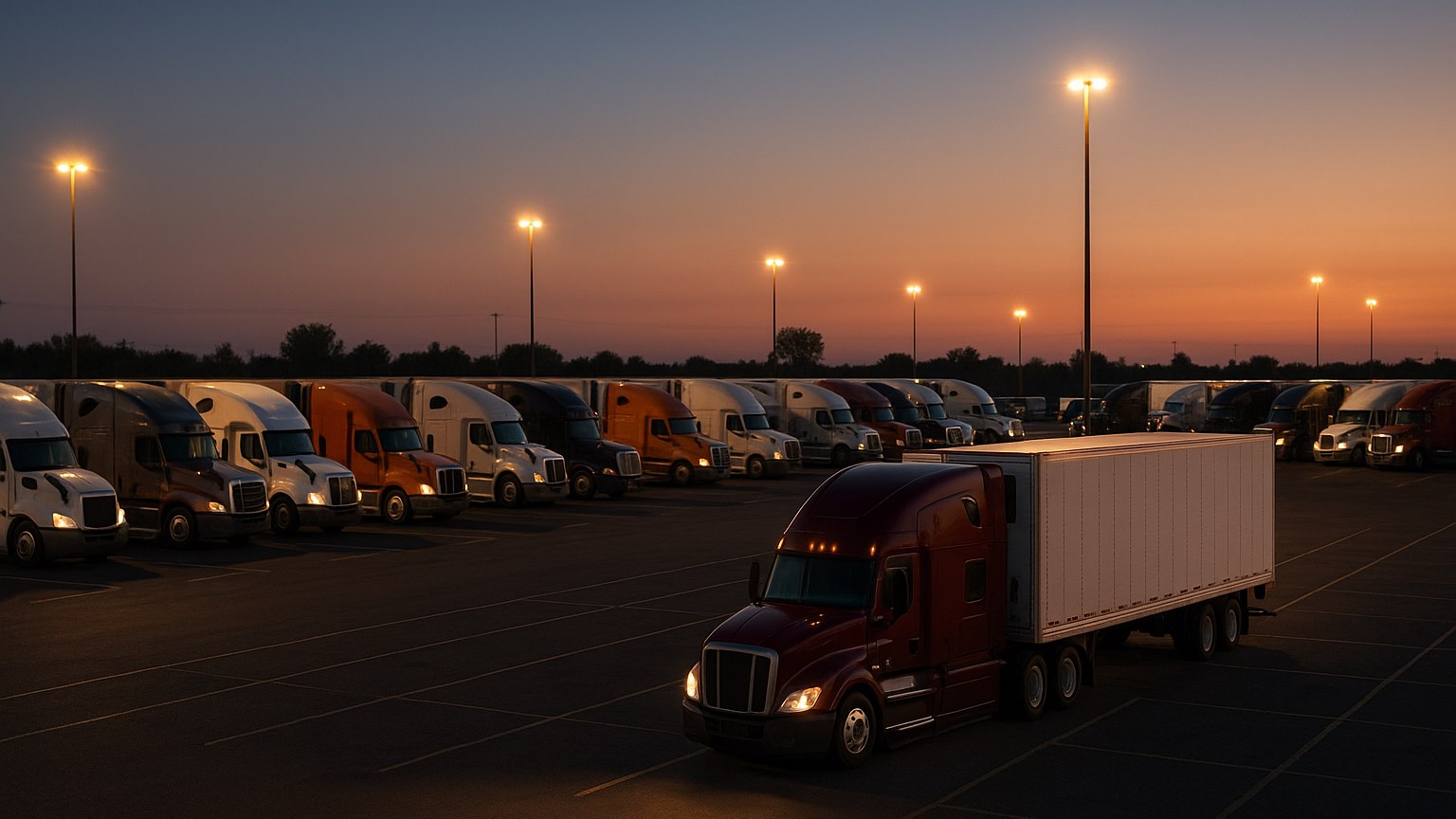
- A parking plan B — a shutdown is only as good as the parking behind it, and storms fill lots fast. Scout options in advance — see our truck parking guide — and park nose into the wind, away from trees, poles and other trucks' sail sides.
🗣️ How do you shut down properly — and what about the reefer?
A weather shutdown done right is three messages, not a debate:
- State the fact and the decision, in writing. On the ELD messaging or text, not just a call: "NWS High Wind Warning, gusts 55 mph, empty trailer. Shutting down at TA exit 214 per 392.14 until conditions improve." One sentence turns an argument into a documented safety decision.
- Give a plan, not just a no. "Wind drops below 30 after 21:00; I run then and still deliver by 06:00 with a split." A driver with a plan gets a "10-4"; drivers who go dark get phone calls. See how truck dispatch works for the planner's side of these calls.
- Protect the load while parked. A reefer holds temp on the lot all night if it has fuel. Before shutting down for a storm, top off the reefer tank, confirm setpoint and mode, note the temps. "I parked for the storm" is a good call; "I parked and the reefer ran dry" is a claim.
This is where a carrier's structure shows: ASTEL runs 24/7 dispatch, and if weather turns into a breakdown — a torn fairing, a hail-cracked windshield — our own shop and mechanics handle it, with a replacement truck rather than a stranded driver as the answer.
❓ Frequently asked questions
What wind speed is dangerous for a semi truck with an empty trailer?
There's no single legal number. Empty or lightly loaded trailers get risky from around 35-40 mph sustained crosswind, many carriers park empties at gusts of roughly 40-50 mph, and Wyoming closes I-80 to light, high-profile vehicles at gusts around 60 mph. A heavy trailer tolerates more, but bridges and open plateaus lower every threshold.
Can my dispatcher force me to drive in a storm?
No. Under 49 CFR 392.14, when conditions like snow, ice, rain, dust or smoke make driving dangerous enough, operation shall be discontinued - and FMCSA puts that judgment on the driver. Pressuring a driver to run in violation of the safety rules can itself be a coercion violation. Put your shutdown decision in writing.
Where should a truck driver shelter during a tornado?
In a solid building if you can reach one; otherwise leave the truck, move well away and lie flat in a ditch or the lowest ground available, covering your head and neck. Never shelter under an overpass - it acts as a wind tunnel - and never try to outrun a tornado along its own path.
How much water does it take to sweep a truck off the road?
About a foot of moving water floats many vehicles, and roughly two feet carries off most of them, pickups and SUVs included. An empty trailer makes a truck more buoyant, not less, and flood water hides washed-out pavement. Never cross water of unknown depth and never drive around a barricade - Turn Around, Don't Drown.
What should I do in a dust storm on I-10?
Don't drive into it. If you can't exit before it hits, pull as far off the pavement as possible, set the parking brake, take your foot off the pedal and turn off all lights including flashers, so blinded drivers don't steer toward your tail lights. Stay belted and wait - most dust storms pass in minutes.
🚛 Drive for a carrier that never argues with the weather
ASTEL is a family-owned carrier out of Chicago running refrigerated freight year-round on late-model Volvo trucks, with our own repair shop and mechanics, 24/7 dispatch and a direct line to the owner. Drivers earn $90,000–$110,000 a year — $2,400–2,700+ a week gross, a flat $0.80 per mile for drivers with 1+ year of experience, all miles paid ZIP-to-ZIP, weekly pay, plus $50/$200/$500 bonuses for clean DOT inspections.
Apply in 2 minutes →Sources as of September 2026: 49 CFR 392.14 and FMCSA guidance; WYDOT wind-closure practice on I-80 (thresholds and weight cutoffs vary by segment and may change — verify on 511); NWS "Turn Around Don't Drown" flood figures and tornado guidance; Arizona DOT "Pull Aside, Stay Alive"; NOAA/NHC hurricane climatology. Wind thresholds for parking are typical industry practice, not law. Pay and mileage figures describe ASTEL driver ranges, not guarantees. This article is general safety information, not legal advice and not a substitute for your company's procedures or official warnings.