

📹 Dash Cams for Truck Drivers: Why a Camera Is Career Insurance
A CDL is the most expensive document most drivers will ever hold, and in today's courtroom climate it can be put at risk by thirty seconds of traffic you didn't cause. A dash cam is the cheapest witness you will ever hire: it doesn't blink, doesn't panic and doesn't change its story. Here is what dash cams for truck drivers actually do for your record, how road-facing and driver-facing systems differ, what the law says, and how to pick and use your own camera. 🚛
🎭 Why has a camera become career insurance in the first place?
Two trends collided over the last decade. First, verdicts. Jury awards against motor carriers above $10 million got their own nickname — nuclear verdicts — and research by the American Transportation Research Institute (ATRI) documented the average size of large trucking verdicts growing from about $2.3 million in 2010 to over $22 million in 2018, with filings and premiums climbing since; as of September 2026 the climate has not cooled.
Second, the bias you already know from every parking-lot conversation: in a he-said-she-said crash between a four-wheeler and an 80,000-lb rig, the truck is guilty by default in a lot of eyes — sometimes including the officer writing the report. You can be the most careful driver on the interstate and still lose an argument you have no footage of.
Criminals know both trends, which is why staged accidents deliberately target commercial trucks: a big-fleet insurance policy is the jackpot. The classic schemes, as documented in insurance-industry and federal fraud cases:
- Swoop-and-squat. Two (sometimes three) cars work together: the "squat" car settles in front of your truck, the "swoop" car cuts it off hard, the squat driver slams the brakes — and you rear-end a car full of "injured" passengers who were braced for the hit.
- Drive-down (wave-in). A driver waves you into a lane, out of a dock or through a merge — then accelerates into your trailer and denies ever signaling.
- Sideswipe. In a dual left-turn or on a narrow city street, the scammer drifts into your lane, makes contact and claims you crossed the line.
- Panic stop. A car with disconnected brake lights sits in front of you and stops for nothing at all, while a crew "witness" appears instantly to back their story.
This is not internet folklore. Federal prosecutions in Louisiana (the "Operation Sideswipe" cases) produced dozens of convictions — including attorneys — for deliberately staging collisions with 18-wheelers. Again and again, what protected drivers was video. A road-facing camera turns a staged crash from a payday into evidence of a crime.
🎥 Road-facing vs. driver-facing cameras: what's the real difference?
"Dash cam" covers two very different things — whether you're buying your own or reading a carrier's orientation packet.
| Question | Road-facing only | Dual (road + driver-facing) |
|---|---|---|
| What it records | The road ahead: traffic, lane position, following distance, lights, signs, weather | Everything the road camera sees, plus a lens pointed at the driver's seat and part of the cab |
| How fleet systems record | Continuous loop on the device; most fleet units upload only short event clips (hard brake, collision, trigger) | Same event-based logic; the cab lens typically wakes on the same triggers, not as a livestream |
| What it's used for | Exoneration: proving what happened in front of the bumper | Exoneration plus AI coaching: alerts and clips for phone use, following distance, signs of fatigue, seat-belt and rolling stops |
| Privacy feel | Films the road, not you — few drivers object | The sore spot; reputable systems don't record the sleeper berth and stay off outside driving time, but ask exactly how it's configured |
| Who wins with it | The driver, almost purely | The carrier's safety scores and insurance rates — and the driver, when the clip clears him |
Industry surveys tell a consistent story: most company drivers dislike the idea of a lens pointed at them, and the same drivers overwhelmingly want video available when it can prove they did nothing wrong. The questions worth asking about any dual system are specific: event-based or continuous, does the cab lens record off-duty or in the sleeper, who can view clips, how long video is kept, and whether coaching is a conversation or an automatic scorecard. Carrier policies differ widely — which is exactly why cameras belong on your list of questions to ask a recruiter before orientation, not after.
⚖️ Are dash cams even legal in a commercial truck?
Broadly, yes — as of September 2026 dash cams are legal to use in commercial vehicles across the U.S. The details sit in two places, and both may change:
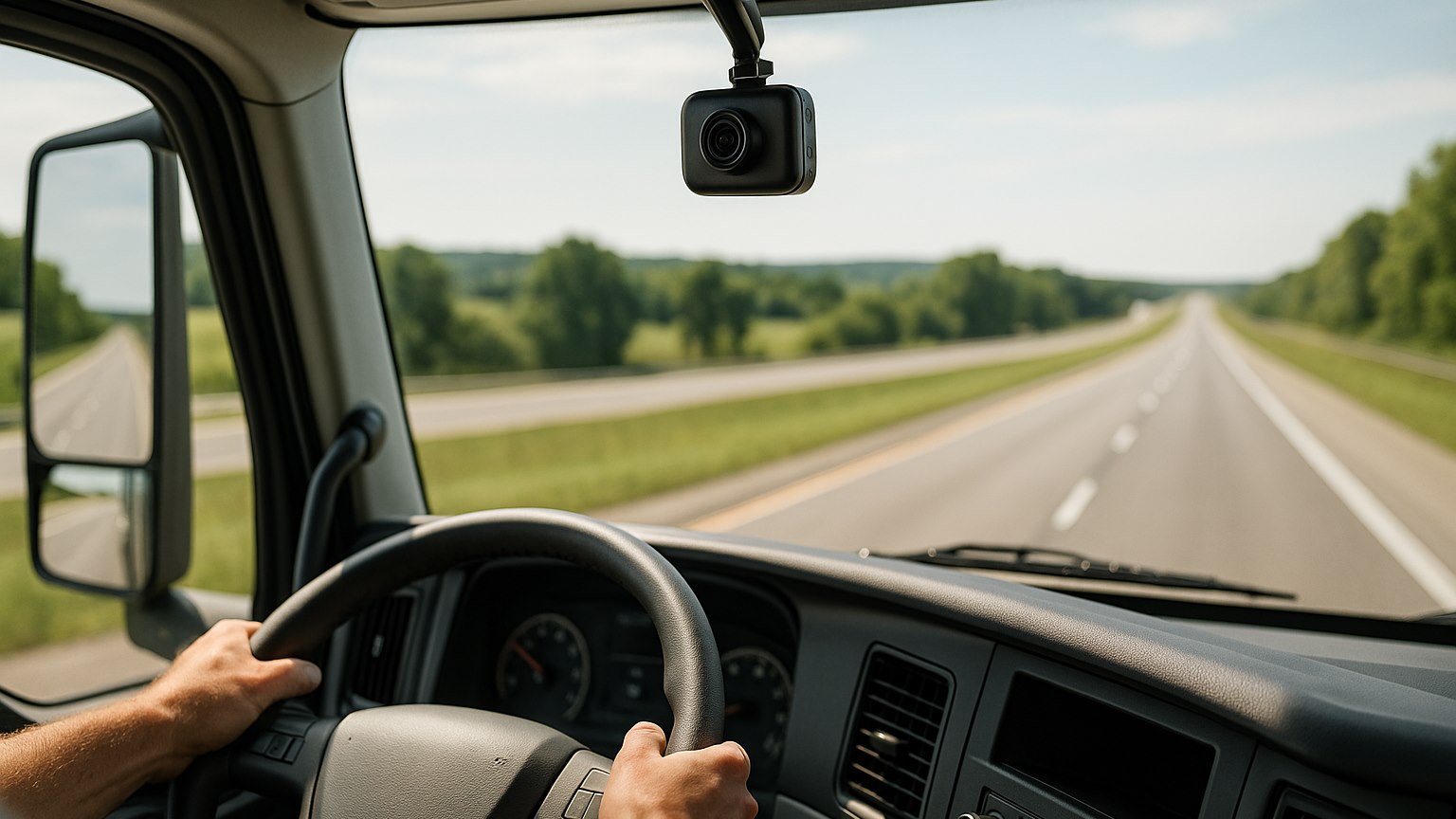
- Federal mounting rules. FMCSA treats cameras as "vehicle safety technology." Under 49 CFR 393.60(e), such devices may be mounted within the area swept by the wipers — no more than 8.5 inches below the top of the swept area or 7 inches above its bottom edge — and always outside the driver's sight lines to the road, signs and signals. The window was widened in 2022 — which is why fleet cameras sit high behind the mirror.
- State rules vary. Some states restrict what may be attached to the windshield of passenger vehicles or where; some regulate audio recording — in "two-party consent" states, recording a conversation in the cab without the other person's consent can be illegal, which matters if you run team or carry a trainee. Many drivers simply mute the microphone; if a state's rule matters to you, check it — the patchwork changes.
Practical takeaway: mount high, keep it out of your sight lines, keep the power cord tucked away from the airbag path, and know what your camera's mic is doing. A camera that gets flagged at a roadside inspection for blocking the wiper sweep is a self-inflicted violation from a device bought to prevent them.
🛡️ How exactly does footage save your record?
Three moments decide how a crash follows you around, and video changes all three.
1. At the scene
The officer writes the narrative that everyone else inherits. If your clip shows the car cutting across three lanes, show it (or tell the officer it exists) before the report is written — a "failure to control speed" citation that never gets issued is worth more than one you fight for a year. The full at-the-scene routine — triangles, photos, statements, what not to say — is in our guide on what to do after a semi-truck accident.
2. With the insurance company
Claims are decided on evidence. A time-stamped clip collapses the timeline: adjusters can close a clear not-at-fault claim in days instead of quarters, and a staged-accident crew that learns there is video tends to lose interest in the lawsuit entirely.
3. In the federal data
Every DOT-recordable crash lands in your carrier's federal record and in your own PSP history — initially regardless of fault. The fix is the Crash Preventability Determination Program (CPDP): the carrier submits a request through DataQs, and if FMCSA finds the crash not preventable, it stops counting against the carrier's Crash Indicator BASIC. As of September 2026 the program covers 21 crash types — expanded in December 2024, including a pathway built around exactly this situation: video showing the driver could not reasonably have avoided the crash. Struck while legally parked, hit by a wrong-way driver, rear-ended at a light, an animal strike — these reviews live or die on evidence, and video is the strongest there is. What those scores mean for your career — and why a clean PSP is worth protecting — is covered in our breakdown of CSA scores, PSP and MVR.
🛒 Can a company driver run his own dash cam — and which one?
Step zero: ask your company. Policies genuinely differ — some carriers welcome personal cameras, some allow road-facing only, some prohibit anything that records audio or the cab. Asking costs one message to your safety department; guessing wrong costs an argument. Get the answer in writing, and ask at the same time how the company wants footage handed over after an incident.
If the answer is yes, here's a spec sheet that survives life in a truck, not just a review video:
- Two channels, front first. A sharp road-facing lens (1080p minimum; 2K–4K reads plates much better) matters more than any gadget feature. A second channel — cab or side — is optional and subject to the company's rules.
- Loop recording with a G-sensor. The card overwrites itself continuously; the G-sensor locks the clip around an impact so the one recording that matters can't be overwritten an hour later.
- Parking mode. Motion- or impact-triggered recording while you sleep catches hit-and-runs on the fuel island, clipped mirrors and people around your rig at 3 a.m. — a natural companion to our cargo theft prevention guide, and a visible deterrent all by itself.
- GPS stamp. Position and time on the file tie the clip to the police report and the ELD record. Be aware it also stamps speed — the camera is an honest witness in both directions.
- Supercapacitor, not a battery. A truck cab parked in a Texas summer can pass 150°F inside; lithium batteries swell and die in that heat and sulk in a Chicago January. Supercapacitor units are built for exactly this duty cycle.
- High-endurance microSD card. Regular cards are not built for 24/7 rewriting and fail silently — often on the day you need the footage. Buy a card rated "high endurance," 128–256 GB, and reformat it in the camera every few weeks.
- An app you'll actually use. Wi-Fi download to your phone in two minutes beats digging out the card in the rain — park it next to the rest of your driver apps.
Typical money, as of September 2026: a solid single-channel unit runs roughly $100–200, a good two-channel supercapacitor setup with GPS roughly $200–400, plus a high-endurance card. Against one deductible — never mind one staged claim — it is the cheapest insurance a driver can buy.
📼 What do you do with the footage after an incident?
A clip only protects you if it survives the first hour. The order of operations:
- Handle the scene first. Safety, 911, triangles, required notifications — the camera changes none of your legal duties.
- Lock and back up the clip immediately. Confirm the event file is locked, then copy it to your phone via the app before you drive another mile. Loop recording is merciless: unlocked video can be gone by the next fuel stop.
- Tell dispatch you have video — and send it. The claims side can only use evidence it knows exists, and a CPDP submission needs the file intact, time stamp and all.
- Preserve the original. Keep the card or the untouched file. Don't trim, edit, compress or "clean up" anything — an edited clip invites questions an original never gets.
- Keep it off social media. Footage of a crash with injuries is evidence in a future lawsuit, and a driver's own upload is a gift to the other side's attorney. It goes to the police, your company and insurers, and nowhere else.
🧠 What are the biggest dash cam myths?
- "The company camera watches me all day." Most fleet systems are event-based: the device buffers continuously, but what leaves the truck is short clips around triggers, not a live feed. Ask how yours is configured — then you're arguing facts, not fears.
- "Footage is only ever used against drivers." The most common use of fleet video in practice is exoneration — proving the truck driver did nothing wrong. Coaching clips exist too, but exoneration is the headline use.
- "A driver-facing lens records the sleeper." Reputable systems are configured not to record the berth or off-duty time. The operative words are "reputable" and "configured" — a fair question for any safety department.
- "My own camera can be used against me." True — video is an honest witness, and it can be requested in litigation. That is an argument against driving dirty, not against cameras. For a driver who follows the rules, the clip is far more likely to save you than to sink you.
❓ Frequently asked questions
Are dash cams legal for truck drivers in all states?
Using a dash cam in a commercial truck is broadly legal across the U.S. as of September 2026. Federal rules treat cameras as vehicle safety technology and allow windshield mounting within limits (49 CFR 393.60(e)); some states restrict windshield placement or regulate audio recording, so mount it out of your sight lines and check audio consent rules for your routes.
What is the difference between road-facing and driver-facing dash cams?
A road-facing camera records only the road ahead and exists mainly to prove what happened in front of the truck. A dual or driver-facing system adds a lens pointed at the cab and usually AI event detection for coaching. Most fleet systems of both kinds are event-based: they upload short clips around triggers rather than streaming the whole shift.
Can dash cam footage remove a crash from my carrier's safety record?
Often, yes. Through DataQs, a carrier can submit an eligible crash to the FMCSA Crash Preventability Determination Program; as of September 2026 the program covers 21 crash types, including reviews built on video showing the driver could not reasonably have avoided the crash. A not-preventable finding keeps the crash from counting against the carrier's Crash Indicator BASIC.
Can I install my own dash cam in a company truck?
Only with your company's permission - policies range from "welcome" to "road-facing only" to "not in our trucks," especially where audio or a cab lens is involved. Ask the safety department in writing before mounting anything, and ask at the same time how they want footage delivered after an incident.
What should I do with dash cam footage right after an accident?
After the scene itself is handled, lock the event clip, copy it to your phone through the app, tell dispatch the video exists and send it in, and preserve the original file or card unedited. Do not post it on social media - crash footage is evidence, and it should go only to the police, your carrier and the insurers.
🚛 Drive protected — for a carrier that backs its drivers
ASTEL is a family-owned carrier out of Chicago running refrigerated freight year-round on late-model Volvo trucks, with our own repair shop and mechanics, 24/7 dispatch and a direct line to the owner. Drivers earn $90,000–$110,000 a year — $2,400–2,700+ a week gross, a flat $0.80 per mile for drivers with 1+ year of experience, all miles paid ZIP-to-ZIP, weekly pay, plus $50/$200/$500 bonuses for clean DOT inspections.
Apply in 2 minutes →Regulatory references (49 CFR 393.60(e) windshield-mounting limits; the FMCSA Crash Preventability Determination Program and DataQs, including the crash types added effective December 2024) and litigation figures from American Transportation Research Institute research are current as of September 2026 and may change; state windshield and audio-recording laws vary and this article is general information, not legal advice. Staged-accident scheme descriptions reflect insurance-industry fraud advisories and federal court cases. Camera policies differ by carrier — always confirm your company's rules before installing equipment. Pay and mileage figures describe ASTEL driver ranges, not guarantees.