

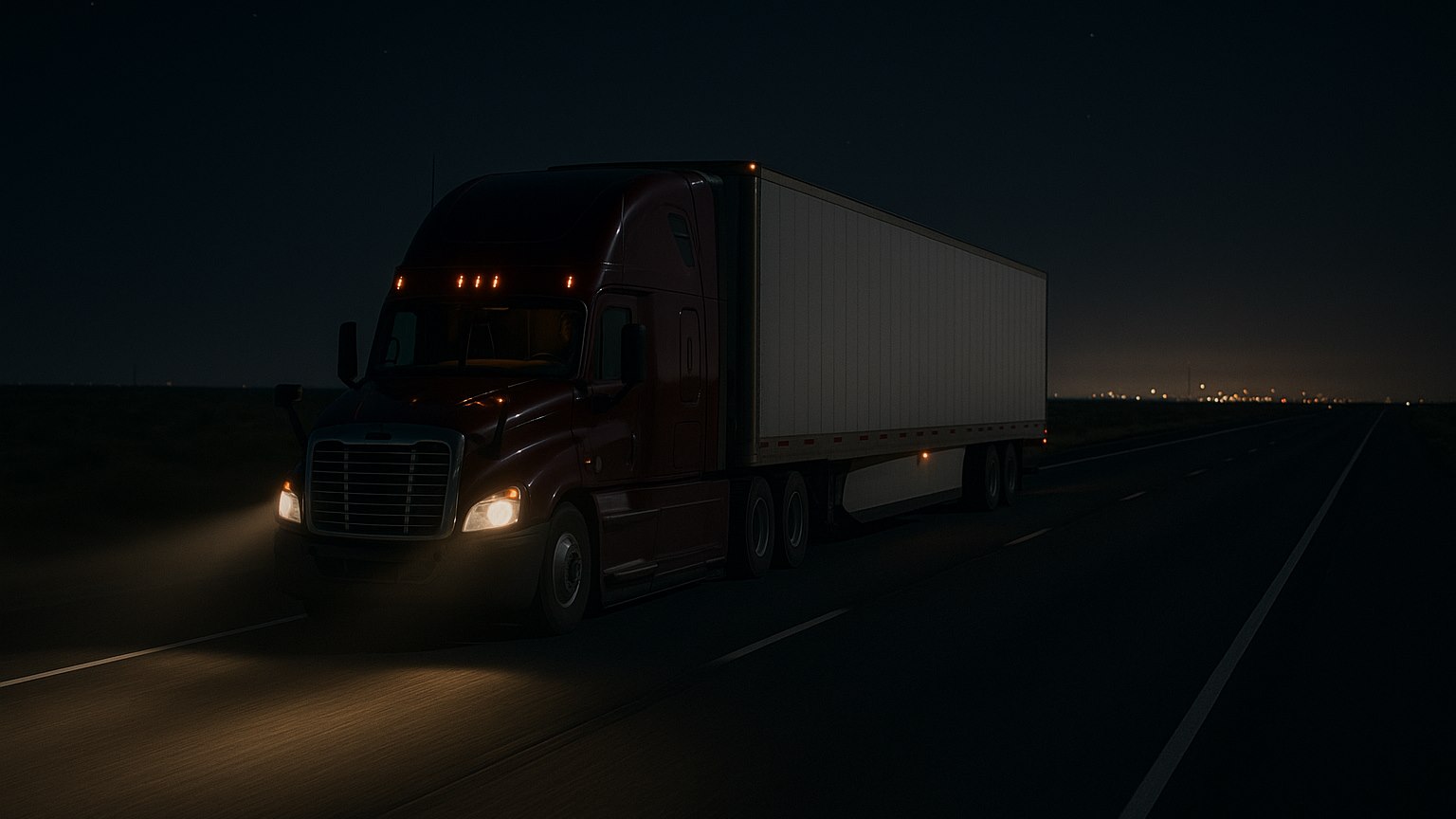
🌙 Night Driving Tips for Truck Drivers: A Practical Guide
Every OTR driver ends up running at night sooner or later: the appointment is at 5 a.m., the roads are empty, and the schedule says go. Night miles are real miles — often the smoothest of the week — but they play by different rules, because the biggest hazard out there isn't in your mirrors. It's behind your eyes. Here is how experienced drivers set up a night run: sleep, light, speed, wildlife, parking. 🚛
🌃 Why are night runs part of the OTR job?
Because the freight decides. Grocery distribution centers and cold-storage warehouses receive around the clock, and the appointments they hand a reefer driver are very often 3, 4 or 5 in the morning — back in at dawn, unload, roll out before the day shift clogs the gate. If you pull refrigerated freight, night legs aren't an exception; they're the rhythm of the work. How those grocery warehouse deliveries actually go is a separate article; this one is about getting there awake.
Night driving pays you back, too: no rush hour through Chicago or Atlanta, cooler air that's easier on the engine and the reefer, docks and fuel islands with no line. At ASTEL, where reefer loads with early-morning appointments are routine, dispatch is on the line 24/7 — a driver rolling through the dark at 3 a.m. is never rolling alone. But the advantages only cash out if you respect what night does to your body — so let's start there.
😴 What happens to your body between 2 and 6 a.m.?
Your circadian rhythm is a roughly 24-hour internal clock that decides when you're alert and when you're not — and it doesn't take requests. In the small hours it lowers your core temperature and reaction speed and pushes hard toward sleep, with the deepest trough typically between about 2 and 6 a.m. and a second, smaller dip in the mid-afternoon. NHTSA's drowsy-driving materials say exactly that: these crashes cluster between midnight and 6 a.m., and the typical one is a single vehicle drifting off the road with no brake marks.
The mechanism is microsleep: your brain switches off for 3–5 seconds whether you agree or not. At 65 mph a four-second microsleep covers about 380 feet — more than a football field — eyes closed. Know the warning signs and treat the first one as a red light:
- You can't remember the last few miles, or you miss your exit.
- The truck drifts to the rumble strip and the strip "surprises" you.
- Heavy eyelids, repeated yawning, head starting to nod.
- Thoughts wander; you catch yourself staring at one point of light.
The rule is simple and non-negotiable: first sign — next safe stop. Not "ten more miles," not "after this county line."
🛏️ How do you sleep for a night schedule?
Anchor sleep
Your body copes with night work far better when at least one block of sleep — say 4–5 hours — happens at the same clock hours every day, run or no run. That block is your anchor; naps float around it. Pick a window you can defend on the road (early afternoon works for many night runners), then protect it: blackout curtains in the sleeper, earplugs or white noise, cab cooled down, phone silenced. More on building rest, food and exercise around an OTR schedule is in our truck driver health guide.
The coffee nap
The single best trick before and during a night leg, backed by NIOSH fatigue guidance, works because caffeine needs about 20–30 minutes to kick in — the same length as a proper nap:
- Park somewhere safe — a rest area or truck stop, not a shoulder.
- Drink a cup of coffee (or equivalent) fairly quickly.
- Set an alarm for 20–30 minutes and sleep. Longer than that and you slide into deep sleep and wake up groggier than you started.
- Wake up as the caffeine lands. Give yourself a few minutes to shake off sleep inertia, then roll.
Two caveats: the lift typically holds 4–6 hours — time it for the stretch that matters, and cut caffeine at least 6 hours before your anchor sleep, or the cup that saved the night will wreck the morning. And no amount of coffee replaces actual sleep.
HOS and the split sleeper
The 14-hour window doesn't care that it's dark outside, but the hours-of-service rules give a night runner one useful tool: the split sleeper berth. Splitting your 10 hours 7/3 or 8/2 lets you keep the long piece anchored at the same clock time each day and spend the short piece as a real nap before the night leg. Plan the split before the run, not when the clock is already dying.
💡 What's the light and cab setup for night?
At night your headlights are your entire forward vision, and most drivers give away a big share of it for free. Before dark:
- Wipe the headlight lenses at every fuel stop — road grime films over the lenses and quietly eats their output.
- Clean the windshield inside, not just outside. The interior haze you never notice at noon turns every oncoming headlight into a starburst.
- Check wipers and washer fluid — streaks that are invisible by day are blinding against glare.
- Check headlight aim after shop visits or big load changes — lights aimed at the ditch help no one.
High beams reach roughly 350–500 feet against about 250 for low beams — at highway speed that difference is your whole safety margin, so run high beams whenever the road ahead is empty. Dim them for oncoming traffic and when you close on someone from behind — typically within about 500 feet; your state CDL manual gives the exact figure. And don't stare into oncoming lights: track the right edge of your lane, the fog line, until the vehicle passes.
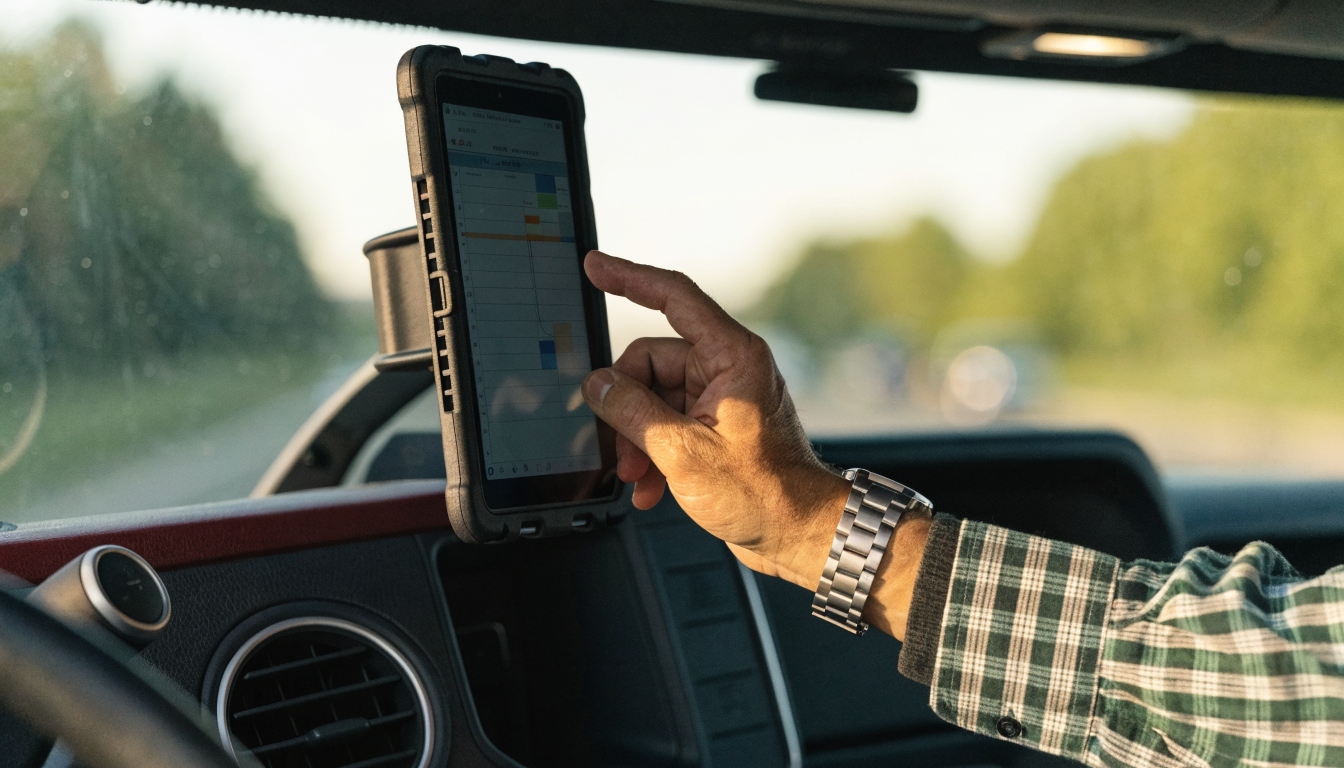
Inside the cab, darkness is a tool: dashboard brightness to the minimum you can read, dome light off, ELD and phone in night mode. Eyes need time to adapt to the dark, and one blast of white light — a gas station canopy, a phone at full brightness — resets that adaptation in a second. Keep the cab dark and the road gets brighter.
🚦 How fast is too fast at night?
The CDL manual has a phrase for the most common night mistake: overdriving your headlights — driving so fast that by the time something appears at the edge of your light, you can no longer stop before reaching it. For a loaded truck the math is brutal:
| Distance | Typical figure | What it means |
|---|---|---|
| Low beams reach | ~250 ft | Everything you can react to lives inside this cone |
| High beams reach | ~350–500 ft | Double the warning — when you can use them |
| Loaded truck, stop from 55 mph | ~419 ft (dry road) | CDL manual figure: perception + reaction + braking |
| Loaded truck, stop from 65 mph | ~525 ft | FMCSA: nearly two football fields |
| Passenger car, stop from 65 mph | ~316 ft | The four-wheelers around you stop in far less — you don't |
The conclusion writes itself: on low beams at 65 mph you are committed to hitting whatever appears at the edge of your light. You need around 525 feet; you can see 250. The gap closes only three ways — high beams when the road is empty, lower speed when it isn't, and more following distance always. Add a second or two to your daytime gap: at 3 a.m. your own reaction time is part of the problem. On wet pavement, add 25–40%, and in rain or fog slow until the distance you can see is longer than the distance you need to stop. That's the entire rule of night speed, and no schedule beats it.
🦌 What's the play when eyes light up on the shoulder?
Animal strikes are a night problem with a season. State Farm's claims data puts industry-wide animal-collision claims at over 1.7 million per year (July 2024 through June 2025), with deer the animal struck most often — and the peak months are November, October and December, in that order, when mating season and hunting pressure keep deer moving. Most strikes happen between dusk and dawn — exactly when you're out there. The playbook:
- Scan the shoulders, not just your lane. On high beams, deer eyes flash back long before the body is visible — twin points of light at the tree line are your early warning.
- One deer means more deer. They move in groups; the one that crossed is often not the last. Cover the brake and expect a second.
- If it's in your lane: brake hard, stay straight. Never swerve. A deer strike is bumper and grille damage; an 80,000-lb truck swerving at highway speed risks a rollover, a jackknife or the oncoming lane — all catastrophically worse.
- After a strike: get to the shoulder, flashers on, don't approach the animal, photograph the damage, call dispatch — and police where the damage or local law requires it.
- Skip the gadgets. Deer whistles are typically unproven; slower speed and earlier eyes are what actually work.
🅿️ Park by six or park at sunrise — which strategy fits?
Truck parking runs out early: at popular stops along the big corridors, spots are typically gone by early evening. A night schedule sidesteps the problem — if you commit to one of two clean strategies instead of improvising nightly:
| Day runner | Night runner | |
|---|---|---|
| Drive | Roll pre-dawn, run daylight | Leave 8–10 p.m., run the empty hours |
| Park | Grab a spot by 5–6 p.m., before the evening scramble | Park 8–10 a.m., as lots empty out — spots everywhere |
| Sleep | Dark hours, easy on the body | Daytime — harder; blackout curtains and earplugs are mandatory gear |
| Fits | Daytime appointments, no-touch freight | Early-morning DC appointments, reefer schedules |
Pick the strategy your appointments dictate and hold it for the week — your circadian rhythm punishes daily flip-flopping harder than either schedule. Build the parking stop into the plan like a fuel stop (our trip planning guide shows how), reserve a paid spot for the nights when arriving late is unavoidable, and never settle for a ramp shoulder — a dark truck on a ramp is how bad news starts. Apps, reservations and the etiquette of full lots are covered in the truck parking guide. If the plan says "deliver at 4 a.m., then sleep," confirm the receiver lets drivers stay after unloading — many DCs don't.
🌫️ Fog, rain and the sunrise trap
Fog breaks the one habit that serves you everywhere else: high beams. In fog they bounce off the water droplets and come straight back at you — stay on low beams, slow until the visible distance is longer than your stopping distance, and if visibility collapses entirely, leave the highway at an exit. Not the shoulder: a truck parked in fog on a shoulder is a target, not a refuge.
Rain at night doubles every glare and shows you every worn wiper blade you forgave last month. The first minutes of rain are the slickest — old oil floats before it washes off. And on clear cold nights, remember the temperature keeps falling toward dawn: a road that was fine at midnight can carry black ice on the bridges at 5 a.m. — the full cold-season playbook is in our winter driving guide.
Then comes the sunrise trap. After the 2–6 a.m. trough your body is at its lowest exactly when the sun clears the horizon — straight into your eyes if you're eastbound, off every mirror if you're not. Fatigue plus blinding light is the worst combination of the whole run. Keep sunglasses within reach, drop the visor early, and remember that a dirty windshield turns sunrise into a white wall. If the route allows it, time your break for dawn: coffee at sunrise beats squinting through it.
✅ What's on the night-run checklist?
- Anchor sleep protected today; sleep debt honestly assessed before departure.
- Coffee-nap plan for the 2–6 a.m. window; caffeine cut-off calculated for tomorrow's sleep.
- Headlight lenses and windshield cleaned — outside and inside; wipers checked.
- Dash at minimum brightness, dome light off, devices in night mode.
- Sunglasses in the door pocket for sunrise.
- Parking strategy chosen and the stop built into the trip plan.
- Deer season? Shoulders scanned, speed trimmed through wooded stretches.
- Speed matched to what the beams show, not to the limit sign.
- Dispatch knows the plan — at ASTEL the line answers at 3 a.m.
❓ Frequently asked questions
What time of night is most dangerous for truck drivers?
Between about 2 and 6 a.m., when the circadian rhythm is at its lowest — NHTSA data shows drowsy-driving crashes cluster between midnight and 6 a.m. A second, smaller dip hits in the mid-afternoon. Plan your hardest miles outside that window or protect it with a nap and caffeine.
How long should a nap be on a night run?
20–30 minutes. Longer naps drop you into deep sleep and you wake up groggy. For a stronger effect, drink a cup of coffee right before the nap: caffeine takes about 20–30 minutes to kick in, so it starts working just as you wake up.
When should I use high beams at night?
Whenever there's no one to blind: no oncoming traffic and no vehicle close ahead. High beams reach about 350–500 feet versus roughly 250 for low beams — at highway speed that difference is your whole margin. Dim them within about 500 feet of other vehicles; your state's CDL manual gives the exact rule.
What should I do if a deer jumps in front of my truck?
Brake hard, stay in your lane and keep the wheel straight — never swerve. A swerve at highway speed risks a rollover or the oncoming lane, which is far worse than striking the animal. Then get to the shoulder, turn on the flashers, report it to dispatch, and to police where damage or local law requires it.
How fast should I drive at night?
Slow enough to stop within the distance your headlights show. Low beams light about 250 feet, while a loaded truck at 65 mph typically needs around 525 feet to stop — so on low beams at highway speed the math doesn't work. Use high beams when the road is empty, add following distance and back the speed down.
🚛 Night miles are easier with a team behind you
ASTEL is a family-owned carrier out of Chicago running refrigerated freight year-round on late-model Volvo trucks, with our own repair shop and mechanics, 24/7 dispatch and a direct line to the owner. Drivers earn $90,000–$110,000 a year — $2,400–2,700+ a week gross, a flat $0.80 per mile for drivers with 1+ year of experience, all miles paid ZIP-to-ZIP, weekly pay, plus $50/$200/$500 bonuses for clean DOT inspections.
Apply in 2 minutes →Safety guidance reflects NHTSA drowsy-driving materials, NIOSH/CDC fatigue-management guidance, State Farm animal-collision claims data, FMCSA stopping-distance figures and standard CDL manual values as of September 2026; distances and time ranges are typical values, and rules and figures may change. Pay and mileage figures describe ASTEL driver ranges, not guarantees. This article is general information, not a substitute for your state CDL manual or your company's procedures.