


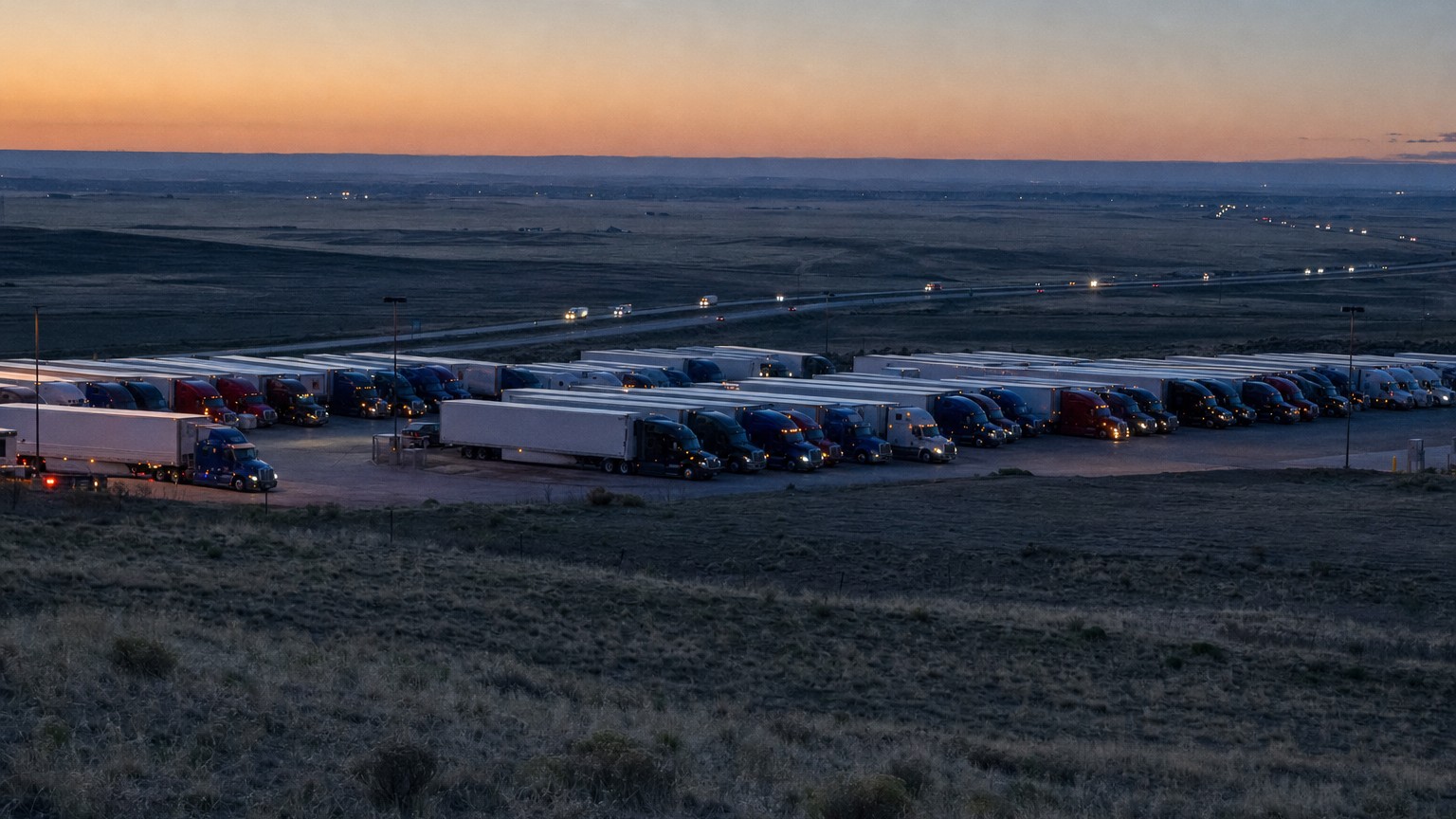
A Day in the Life of a Truck Driver on an OTR Reefer, Hour by Hour
"What does a truck driver actually do all day?" Drive, mostly, but the clock decides how much. A day in the life of a truck driver on an OTR reefer means up to 11 hours behind the wheel inside a 14-hour window, and the rest of that window goes to the truck and the freight: the pre-trip, fuel, hours at a dock and a look at the load temperature 2–3 times a day. ASTEL expects 600–700 miles from a full driving day.
From a dispatcher's desk the day is a row of times. A 6:00 a.m. delivery, a 1:00 p.m. pickup 220 miles away, a 14-hour window that closes at 6:45 p.m. Your job is to make those times meet without breaking a rule or warming up a load. The steering wheel is the easy part.
The sample day below is an example built on those times, not the diary of a real driver. Traffic and the receiver will move every number in it. The frame stays put, because the frame is 49 CFR Part 395, and it's the same for a rookie as for a twenty-year driver.
The 14-hour clock frames every day
Under 49 CFR 395.3 a shift can start only after 10 consecutive hours off duty. The moment you go on duty, a 14-hour window opens, and all your driving, up to 11 hours, has to fit inside it. The window doesn't pause for lunch or a slow dock. Go on duty at 4:45 a.m. and the wheels stop at 6:45 p.m., even if you've driven only seven hours.
The second limit is the break. Section 395.3(a)(3)(ii) bans driving once 8 hours of driving have passed without a consecutive 30-minute interruption. The count starts over after every break of 30 minutes or more. Since the change that took effect in September 2020, that half hour can be off duty, sleeper berth or on duty not driving, so 30 minutes at a fuel island or a dock counts.
Your ELD keeps the four statuses listed in 49 CFR 395.8: off duty, sleeper berth, driving and on duty not driving. It switches to driving by itself once the truck moves faster than a set threshold, which the ELD rule caps at 5 mph. Under the definition in 395.2, inspecting or servicing the truck is on duty, fueling included, and so is every minute you attend a truck while it's being loaded or unloaded.
FMCSA is testing more flexibility, but only on drivers who sign up. Its August 27, 2026 bulletin plans the full launch of two pilot programs for 2027, with 256 drivers each. The Split Duty Period pilot would let drivers pause the 14-hour window for up to 3 hours a day. The Flexible Sleeper Berth pilot would allow two rest periods totaling at least 10 hours, one of them at least 5 hours in the sleeper. Everyone else runs on the standard rules, laid out in our guide to hours of service rules for truck drivers.
A sample reefer day from a predawn alarm to lights out
Say your alarm goes off at 4:30 a.m. on a Wednesday in October. You're parked at a truck stop 20 miles from a grocery DC, with a load of dairy due at the door at 6:00. Dispatch has already sent the next load: frozen food, pickup at 1:00 p.m. at a plant about 220 miles away, delivery in Texas two days later.
| Time | What happens | ELD status |
|---|---|---|
| 4:30 a.m. | Alarm in the bunk, coffee, messages from dispatch | Sleeper berth |
| 4:45 a.m. | Walk-around with a headlamp, then the reefer unit check | On duty not driving; the 14-hour window opens |
| 5:05 a.m. | 20 miles to the grocery DC | Driving |
| 5:35 a.m. | Gate check-in, seal number, door assignment | On duty not driving |
| 6:00 a.m. | Lumpers unload, the receiver checks product temperatures, POD signed | On duty not driving |
| 8:15 a.m. | Empty, rolling toward the next shipper | Driving |
| 10:30 a.m. | Fuel and DEF at a truck stop on the route | On duty not driving |
| 11:00 a.m. | The rest of the 220 miles | Driving |
| 12:30 p.m. | Pre-cooled trailer into the door, loading, pulp temperatures on the BOL | On duty not driving |
| 3:00 p.m. | Loaded and heading south | Driving |
| 6:15 p.m. | Parked at the planned truck stop, reefer check and walk-around | On duty not driving |
| 6:30 p.m. | Shower, dinner, call home | Off duty |
| 8:30 p.m. | Lights out | Sleeper berth |
Add it up and the day holds 7.5 hours of driving, about 430 miles, and 6.25 hours of on-duty work that isn't driving. Together that's 13.75 hours, so the window closes with 15 minutes to spare. The longest stretch behind the wheel is 3 hours 15 minutes, so the 30-minute rule never comes into play.
At ASTEL all miles are paid, so the 220 empty ones to the frozen-food plant count along with the loaded ones. They're measured ZIP-to-ZIP by PC*Miler, which can differ from your odometer by up to 5%.
Pre-trip happens in the dark
Under 49 CFR 396.13, before you drive you have to be satisfied the truck is in safe operating condition. If the last inspection report listed a defect, you review it and sign that the repair was certified. At 4:45 a.m. that means a headlamp on the tires, air lines and fifth-wheel jaws, every light switched on, and a slow walk listening for air leaks.
On a reefer the trailer gets its own check. Look at the unit's fuel level, confirm the setpoint and mode match the BOL, compare return air with the setpoint, and deal with any alarm before you roll. The full routine is in our pre-trip inspection checklist, and the unit side is in how to run a reefer unit.
Evening paperwork is short. Under 396.11 you write a driver vehicle inspection report after the day's work only if you found a defect or someone reported one to you. An FMCSA rule published February 19, 2026, in force since March 23, spelled out that the report can be electronic. A carrier can still require a daily report as company policy, so ask what yours wants.
Mornings belong to the grocery DC
Many grocery DCs receive around the clock, so a 6:00 a.m. door is nothing unusual. At the gate you give the load number and the seal number, get a door, back in and hand over the paperwork. Lumpers break the load down. The receiver pulps product from the nose and the tail.
You aren't driving, but you're on duty. Section 395.2 counts time "attending a commercial motor vehicle being loaded or unloaded" as on-duty time, so 2 hours and 15 minutes at the door eat into the 14-hour window. Lumper receipts and OS&D notes are covered in our guide to grocery warehouse deliveries and lumper fees.
Fueling counts as work
Figure half an hour for fuel, the DEF top-off and a walk inside. It's on-duty time, and it also satisfies the 30-minute rule.
Some chains tie showers to fuel. As of September 2026, Pilot's FAQ says every commercial diesel purchase of 50 gallons or more earns a free shower credit, valid for up to 10 days and tracked in the Pilot app. Other chains set their own terms, and terms change.
The afternoon pickup sets up tomorrow
A reefer pickup starts before the dock. You pre-cool the empty trailer to the setpoint on the load information, back in, and the shipper loads. Before you sign the BOL, the pulp temperatures and the seal number go on it. If the setpoint on the BOL doesn't match the one dispatch sent, call before you sign, because a wrong setpoint is hard to fix once the doors close.
From here the load is yours until delivery. Check the load temperature and the unit 2–3 times a day. In the sample day the checks fall at the 4:45 pre-trip, right after loading and at the 6:15 stop. How dispatch plans these handoffs, and why the next load sometimes shows up before you're empty, is in how truck dispatch works.
Parking decides how the day ends
The last 2 hours of the window are about parking. FHWA's Jason's Law survey counted about 313,000 truck parking spaces in the country in 2019, roughly 273,000 of them at private truck stops and 40,000 at public rest areas. Drivers in that survey named the Chicago region as one of the worst places to find a spot.
With the window closing at 6:45 p.m., the spot gets picked before the 3:00 p.m. departure, with a backup 30–40 miles earlier on the route. Arriving at 6:15 leaves time to walk around the truck and look at the reefer before you go off duty. Reserved spots, rest areas and the places not to park are in our truck parking guide.
Shower, dinner, a call home and the bunk
Off duty at 6:30 p.m. and back on at 4:45 a.m. gives you 10 hours and 15 minutes. Take out a shower, dinner and a call home, and about 8 hours are left for sleep. The American Academy of Sleep Medicine and the Sleep Research Society recommend at least 7 hours a night for adults 18–60. The margin is one hour.
Most nights you sleep in the sleeper berth at a truck stop, with the reefer running on the trailer behind you. ASTEL drivers between loads in Chicago have another option: the company yard there has a rest area, showers, a sauna and a laundry, so you start the next run with a clean bag.
Days without docks are where the miles come from
The sample day ran 430 miles because two docks took almost 5 hours of the window. A day with no docks looks different. A 15-minute pre-trip, 11 hours of driving split by a 30-minute fuel stop, and a short check at night fill about 12 of the 14 hours.
That's the day where 600–700 miles happen. It takes an average of 55–64 mph over 11 hours, which means open interstate. Mountains, a metro rush hour or a line at the scale pull the number down, and no appointment is worth a speeding ticket.
Most long reefer runs mix both kinds. Say a 1,500-mile load: a dock day that covers 250 miles after the pickup, two straight days at about 600 each, then a short morning to the receiver on day four.
Night appointments break the pattern
A 2:00 a.m. appointment means the alarm at midnight, and the evening before turns into a nap. The legal tool is the sleeper berth split in 49 CFR 395.1(g). One period has to be at least 7 hours in the bunk and the other at least 2, so 7/3 and 8/2 both work. Neither period counts against the 14-hour window, which is recalculated from the end of the first one. The math is easy to get wrong, so check the hours your ELD shows before you roll.
A legal log doesn't mean you slept. After a week of night doors, the first day back on a daytime schedule is the one to watch for drowsiness at the wheel. Tell dispatch when overnight appointments stack up three or four in a row. Some can be moved. Dispatch can't move what it doesn't know about.
The week and the month on a 4+1 schedule
ASTEL runs a 4+1 schedule: about four weeks on the road, then a week at home, with dates agreed with dispatch in advance. From August through March the mileage is high, 3,500–3,700 miles a week. April through July brings shorter runs and extra stops, and the company pays extra for short miles to drivers who meet expectations.
The weekly limit is on-duty time. Carriers that run every day use 70 hours on duty in 8 days, and the other cycle is 60 hours in 7. At 650 miles a day, 3,600 miles is about 5.5 driving days, and with an hour and a half of other work each day the on-duty total comes close to 69 hours. That's why the 34-hour restart in 395.3(c) becomes part of the routine. Dock days burn hours without adding many miles, so a week full of them ends shorter.
What wears on drivers
Four weeks out is a long time. Birthdays and school events happen without you unless the home week is planned around them, which is why the dates get agreed early. If you need to be home every night, OTR isn't your job, and our explainer on what OTR trucking is compares it with regional and local work. How home time gets planned is in truck driver home time.
The job is also sedentary. The NIOSH survey of 1,670 long-haul drivers at 32 truck stops (2010 data, published in 2014) found obesity in 69% of them, against 31% of U.S. working adults, and smoking at 51% against 19%. A lap around the lot at every fuel stop and food from your own cooler are small habits, but over four weeks they add up.
A team truck lives a different day
On a team the truck almost never parks. One driver runs up to 11 hours while the other sleeps, then they swap, and each keeps a separate log under the same limits. Under 395.2, up to 3 hours in the passenger seat right before or after at least 7 hours in the sleeper isn't on-duty time, and 395.1(g) lets the two together count as the 10-hour break. You sleep while the truck moves, which takes some getting used to. The details are in team truck driving.
Frequently asked questions
What time do OTR truck drivers usually wake up?
There's no set hour. The alarm follows the first appointment of the day and the end of the 10-hour rest. With a 6:00 a.m. delivery 20 miles away, 4:30 a.m. is normal. With a 2:00 a.m. appointment you may be up at midnight, and on a straight driving day an early start gets you through cities before the morning rush.
How many hours a day does a truck driver work?
On a full day, about 12–14 hours. Under 49 CFR 395.3 your driving, up to 11 hours, has to fit inside a 14-hour window that opens after at least 10 hours off. Non-driving work after the 14th hour is allowed, but you can't drive again until the next 10-hour break. A day with a delivery and a pickup can use the whole window with only 7–8 hours of driving.
Do OTR drivers get days off while on the road?
Partly. Every shift ends with at least 10 hours off duty, and when the 70-hour cycle runs low you take a 34-hour restart, a day and a half off, usually at a truck stop. Real days off come as a block at home, and how often depends on the carrier. On a 4+1 schedule it's about a week at home after roughly four weeks out.
Where do truck drivers shower and do laundry on the road?
At truck stops. A shower is paid at the counter or with a credit earned by fueling, and at Pilot and Flying J one credit comes with every diesel purchase of 50 gallons or more. Many travel centers also have a laundry room. Some carriers keep showers and laundry at their own yard.
Reefer freight all year, with dispatch on the line 24/7
ASTEL is a family-owned carrier out of Chicago running refrigerated freight year-round on late-model Volvo trucks, with our own repair shop and mechanics, 24/7 dispatch and a direct line to the owner. Drivers earn $90,000–$110,000 a year — $2,400–2,700+ a week gross, a flat $0.80 per mile for drivers with 1+ year of experience, all miles paid ZIP-to-ZIP, weekly pay, plus $50/$200/$500 bonuses for clean DOT inspections.
Apply in 2 minutes →Sources: 49 CFR 395.3, maximum driving time; 49 CFR 395.2, on-duty time; 49 CFR 395.1(g), sleeper berth; 49 CFR 395.8 and Appendix A to Subpart B of Part 395, duty statuses and the ELD speed threshold; 49 CFR 396.11 and 396.13, driver vehicle inspection reports and pre-trip inspection, with the FMCSA electronic DVIR final rule published February 19, 2026 (91 FR 7893), effective March 23, 2026; FMCSA bulletin on the Flexible Sleeper Berth and Split Duty Period pilot programs, August 27, 2026; FHWA Jason's Law truck parking survey results, 2019 data, presented in December 2020; NIOSH National Survey of U.S. Long-Haul Truck Driver Health and Injury, 2014; American Academy of Sleep Medicine and Sleep Research Society adult sleep recommendation, 2015; Pilot Company FAQ on showers, September 2026. Current as of October 2026; federal rules and truck stop programs may change. The sample day is an illustration, not a promised schedule. Schedule, mileage and pay terms describe ASTEL driver conditions and are not guarantees. General information, not legal or medical advice.