


Trucking Terms Glossary — 40 Words Every New Driver Actually Needs
Your first week in trucking, everyone around you speaks a different language. Dispatch wants your ETA and PTA. The receiver mentions a lumper. The CB crackles about a bobtail on the shoulder. Nobody hands you a dictionary, so we built one covering the 40 terms that carry 90% of everyday conversations on this job, in plain English, with zero fluff.
Trucks, trailers and freight
| Term | What it means |
|---|---|
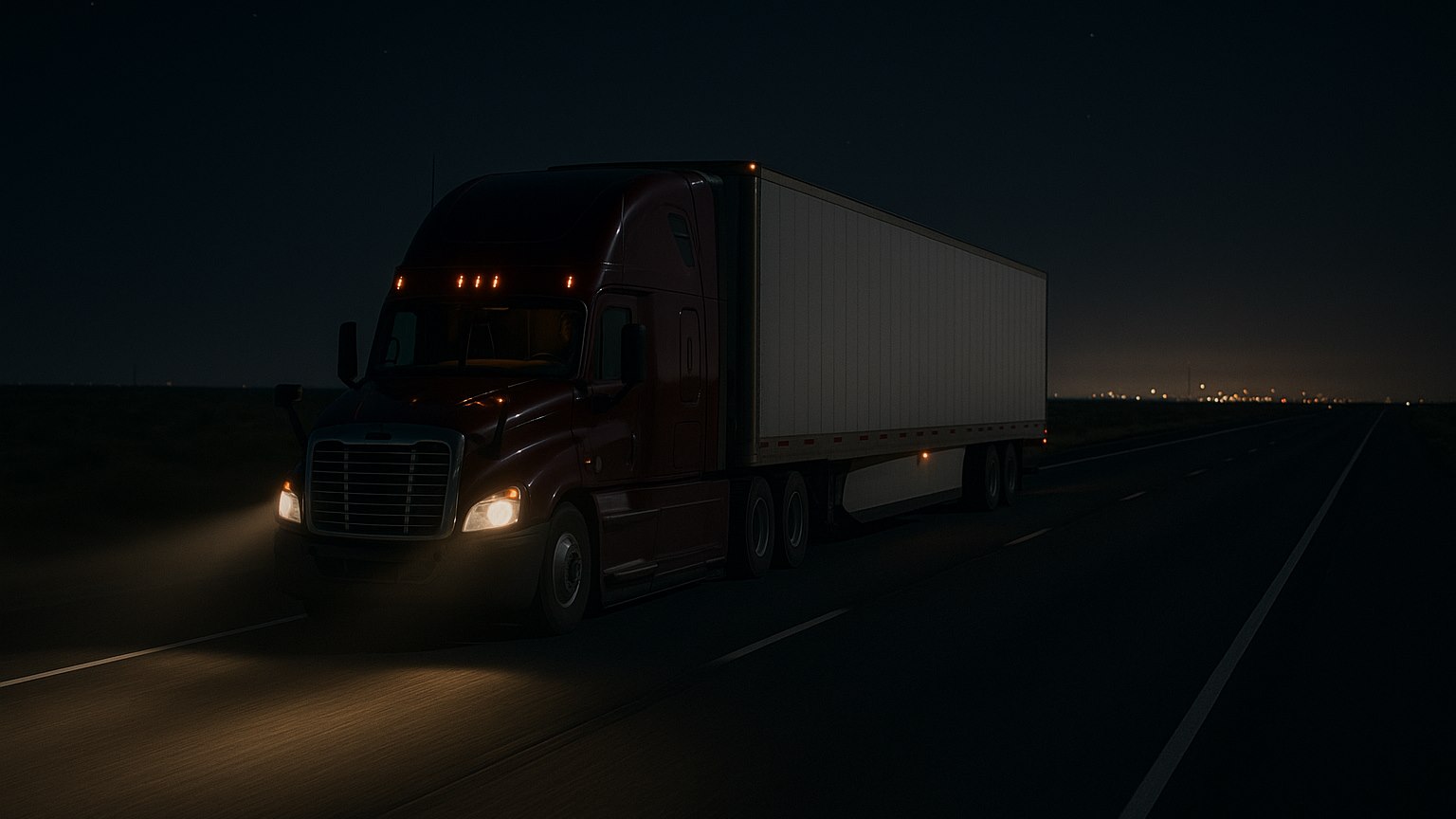
| Tractor / power unit | The truck itself, the part with the engine and your bed in it |
| Dry van | The standard enclosed box trailer, no temperature control |
| Reefer | Refrigerated trailer with its own cooling unit; hauls produce, meat, frozen goods. Our specialty, see reefer vs dry van |
| Bobtail | Driving the tractor without any trailer attached |
| Deadhead | Driving with an empty trailer to the next pickup; some companies pay these miles, some don't. Ask |
| Flatbed | Open platform trailer for machinery, steel, lumber; freight is strapped and tarped, not boxed |
| King pin / fifth wheel | The steel pin under the trailer nose and the coupling plate on the tractor it locks into |
| Landing gear | The trailer's crank-down legs that hold it up when dropped |
| FTL / LTL | Full truckload (one shipper fills your trailer) vs less-than-truckload (many small shipments, many stops) |
Docks and warehouses
| Term | What it means |
|---|---|
| Shipper / receiver | Where you pick freight up / where you deliver it |
| Live load / unload | You wait at the dock while freight is worked; the full picture is in live load vs drop and hook |
| Drop & hook | Leave your trailer, take a ready one, roll. The fast lane of freight |
| Lumper | Third-party unloading crew at some warehouses; the fee is the carrier's cost, never yours |
| Detention | Pay for excess waiting at a dock past the free window. How it works: detention & layover pay |
| Layover | Compensation when you're held over a longer period (usually overnight) between loads |
| FCFS | "First come, first served": a facility without appointments; arrive early or wait long |
| BOL | Bill of lading, the legal document describing the freight; what you sign is what happened |
| Rate Confirmation (RC, RateCon) | The load's paperwork from the broker: pickup/delivery numbers, temps, terms. Read it before the dock, not at it |
| Seal | Numbered lock on the trailer doors proving nobody opened them; record it, photograph it, guard it |
Hours, logs and compliance
| Term | What it means |
|---|---|
| HOS | Hours of service, the federal driving-time limits. The full rules: HOS explained |
| ELD (logbook) | Electronic logging device, records your driving time automatically; drivers still call it the logbook |
| 14-hour window | Once you start work, all driving must fit inside the next 14 hours, waiting included |
| 34-hour restart | A day and a half off duty that resets your weekly 60/70-hour cycle |
| Recap | Hours that return to your cycle daily once the oldest day rolls off; plan B when a restart doesn't fit |
| PTI | Pre-trip inspection, the walk-around before you roll. The checklist: PTI guide |
| DVIR | Driver vehicle inspection report, the defect report you file when something's wrong |
| DOT inspection | Roadside check of driver and equipment. Levels and tactics: DOT inspection guide |
| OOS | Out of service, a violation severe enough that you or the truck can't move until it's fixed |
| PC | Personal conveyance, off-duty driving for personal needs, logged as such |
Money words
| Term | What it means |
|---|---|
| CPM | Cents per mile, the classic driver pay unit. The full math: how driver pay works |
| Gross | Total revenue before deductions; for a load, the freight's full price |
| Settlement / pay statement | Your weekly earnings breakdown. Decode every line: reading your pay statement |
| ZIP-to-ZIP | Standard mileage calculation between origin and destination ZIP codes, verifiable by both sides |
| Accessorials | Extra pays beyond mileage: extra stops, layover, detention and similar |
| Escrow (deposit) | A refundable amount held by the company per contract terms, also called a deposit; read yours before signing |
| Fuel surcharge | A per-mile addition tied to diesel prices, matters mostly to owner-operators |
| Owner-operator | A driver who owns the truck and runs as a business. The comparison: company driver vs owner-operator |
Road slang you'll hear on day one
| Term | What it means |
|---|---|
| Four-wheeler | Any passenger car, usually said with a sigh |
| Granny lane / hammer lane | The right (slow) lane / the left (passing) lane |
| Chicken coop | A weigh station. Why they matter: weigh stations guide |
| Bear | Police, usually highway patrol; a "bear in the median" is exactly what it sounds like |
| Alligator | A shredded tire carcass on the road, hit one and it bites your bumper or hoses |
| Yard jockey / spotter | The terminal driver who shuffles trailers around a yard all day |
| Terminal / yard | A carrier's home base: parking, shop, dispatch office |
| OTR | Over-the-road, long-haul, weeks-out trucking. The lifestyle: what is OTR |
Frequently asked questions
What does deadhead mean in trucking?
Driving with an empty trailer, usually repositioning to the next pickup. Pay policies differ by company. Some pay all deadhead miles, some pay none. Always ask.
What is the difference between bobtail and deadhead?
Bobtail is driving the tractor with no trailer attached at all. Deadhead is pulling an empty trailer. Insurance and handling differ in both modes, because the truck brakes differently without trailer weight.
What is a lumper in trucking?
A third-party crew that unloads trailers at some warehouses, common at grocery distribution centers. The fee is paid by the carrier or broker. Drivers get a payment code or reimbursement.
What does PTA mean in trucking?
Projected time of availability, when a driver expects to be empty and ready for the next load. Not ETA. ETA is the estimated time of arrival at a pickup or delivery. Keeping your PTA accurate is the easiest way to get planned into better freight.
What is a chicken coop?
CB slang for a weigh station, where trucks are weighed and may be inspected. The name stuck from the long low buildings the scales used to occupy.
Learn the language on a real road
The fastest classroom is a good first company. ASTEL runs reefer freight year-round with 24/7 dispatch that explains, not just assigns — and drivers earn $90,000–$110,000 a year, paid weekly.
Apply in 2 minutes →Definitions reflect common U.S. trucking usage as of 2026; company policies (deadhead pay, detention terms, escrow) vary by contract. Regulatory terms per FMCSA regulations. This glossary is general information.