

🎓 CDL Road Test in 2026: How to Pass the Skills Test on Your First Try
The written exams are behind you, the permit is in your pocket — now comes the part everyone actually loses sleep over: the skills test. The good news: examiners fail people for a fairly short, predictable list of mistakes. Learn that list, and test day becomes routine instead of a lottery. 🚛
📋 What are the three parts of the CDL skills test?
| Part | What happens | What kills candidates |
|---|---|---|
| 1. Vehicle inspection | You walk around the truck and show the examiner components — brakes, steering, lights, coupling — explaining what you're checking and why | Memory blanks; naming a part without saying what "good" looks like |
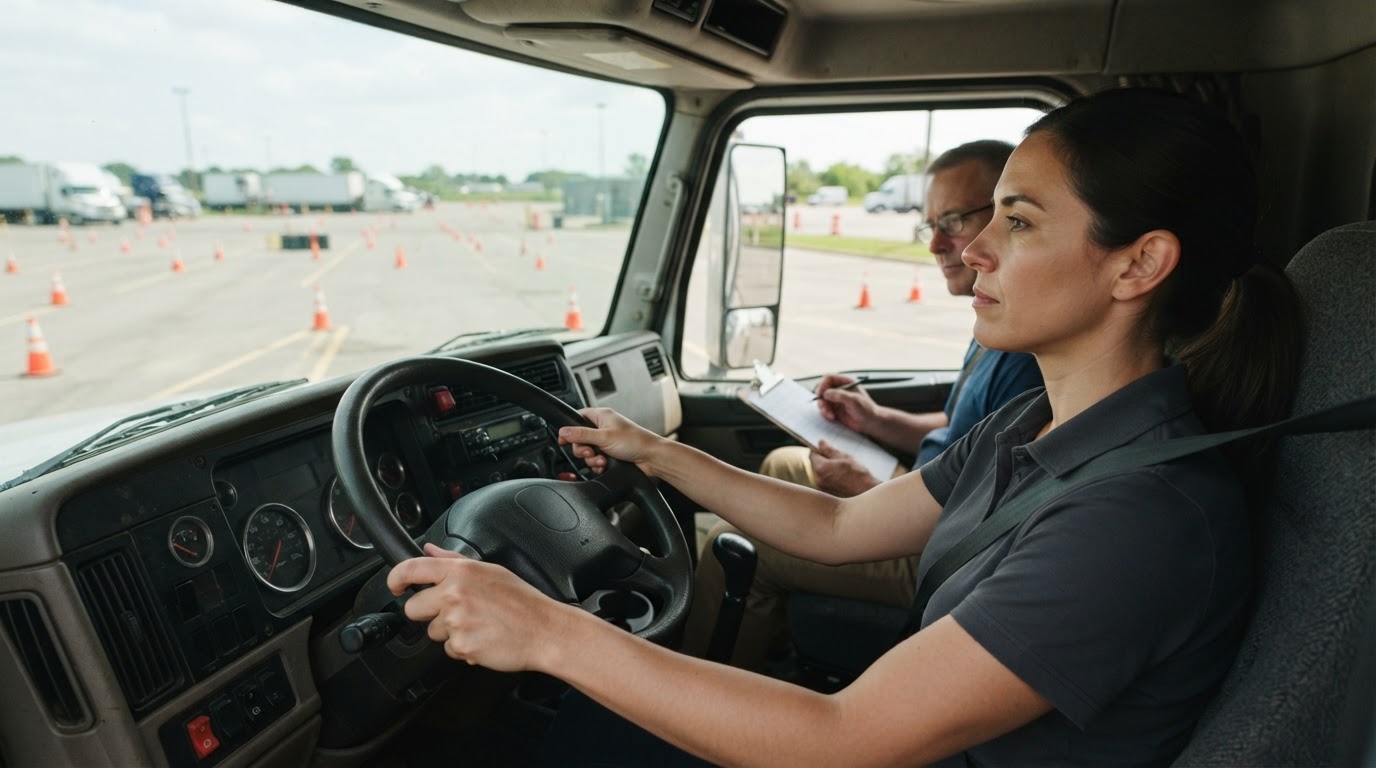
| 2. Basic control skills | Low-speed maneuvers on a marked pad: straight-line backing, offset backing, stops | Crossing boundary lines; too many pull-ups; not using GOAL (Get Out And Look) |
| 3. Road test | Real traffic: turns, lane changes, intersections, expressway section, railroad crossing procedure | Rolling stops, missed mirror/signal habits, curb strikes on right turns, following too close |
The order matters: fail the inspection and you don't get to show how well you back up. Prepare all three, but know that the inspection is pure memorization — it's the part you can bulletproof at the kitchen table.
🆕 What changed with the modernized test?
States are gradually adopting a modernized skills-test standard (some switched statewide in 2025–2026). What it changes for you:
- Vehicle inspection got shorter and more practical — fewer items, focused on what a working driver checks daily, and you're allowed to use the checklist from the CDL study guide for the order of inspection.
- Basic control skills run on a smaller pad with four maneuvers: forward stop, straight-line backing, forward offset tracking and reverse offset backing.
- The road test stays the same.
❌ Why do people actually fail?
Two ways to lose: an automatic fail or death by a thousand points. The automatic fails are the ones to respect:
- Examiner intervention — they grab the wheel or brake because you created a dangerous situation.
- Hitting something — a curb on a tight right turn, a cone or boundary on the pad.
- Rolling through a stop sign or red light. A stop means the truck is not moving. At all.
- Botching the railroad crossing procedure — it's scripted; learn the script.
The point-accumulation fails are quieter: not checking mirrors every few seconds, late or missing turn signals, drifting in the lane, following too close, forgetting to check the trailer in turns. Individually small, together fatal — and all of them are habits you can build in a week of deliberate practice.
📅 How to prepare in the last 7 days
- Run the inspection script out loud daily. Not in your head — out loud, walking around a real truck or a printed diagram. Say the component, the check, and what "good" means: "belt — no cracks or fraying, proper tension."
- Book pad time for backing. 30–45 focused minutes a day beats a single marathon. Use GOAL every time you're unsure — getting out to look costs a small deduction at most; guessing costs the test.
- Drive the test area if allowed. Examiners use a standard set of local routes; knowing the tricky intersections lowers the surprise factor.
- Narrate your driving. "Mirror, signal, mirror, lane change" — verbalizing builds the exact habits the score sheet tracks.
- The night before: sleep, documents, vehicle. Permit, medical certificate, ELDT completion on file, glasses if your license requires them — and a test truck that matches the class and transmission you want on your license.
✅ What happens after you pass?
The state upgrades your permit to a full CDL-A. Two details worth knowing in advance:
- Transmission matters: test in an automatic and your license carries restriction E (no manual trucks). For most modern fleets that changes nothing — but know what you're signing up for.
- The license is the entry ticket, not the finish line. Carriers hire fresh graduates — some, like ASTEL, take drivers with no experience — and your first year behind the wheel will teach you more than school did.
❓ Frequently asked questions
How many parts does the CDL skills test have?
Three: vehicle inspection, basic control skills (low-speed maneuvers) and the road test in traffic. You must pass each part to continue to the next.
What is an automatic fail on the CDL road test?
Examiner intervention, hitting a curb or boundary, rolling through a stop sign or red light, or a dangerous maneuver. Any of these ends the test regardless of your points.
Can I use a checklist during the vehicle inspection?
In states running the modernized test — yes, you may use the study-guide checklist for the order of inspection. In classic-test states you work from memory. Check your state's current rules.
What if I fail one part of the test?
You retake the failed part, not the whole exam. Waiting periods and retest fees vary by state — typically from a few days to two weeks between attempts.
Do I need ELDT before taking the skills test?
Yes. Since February 7, 2022, first-time CDL-A applicants must complete Entry-Level Driver Training with a provider listed in the federal Training Provider Registry before the state can administer the skills test.
🚛 Passed? Your first truck is waiting.
ASTEL hires CDL-A drivers including newcomers fresh out of school — with 24/7 road support and dispatchers who help you through the first months. Drivers earn $90,000–$110,000 a year, paid weekly.
Apply in 2 minutes →Test structure follows federal CDL standards; scoring details, retest rules and adoption of the modernized version vary by state and change over time — always verify with your state's current CDL manual. ELDT requirement per FMCSA regulations in force since February 2022.