


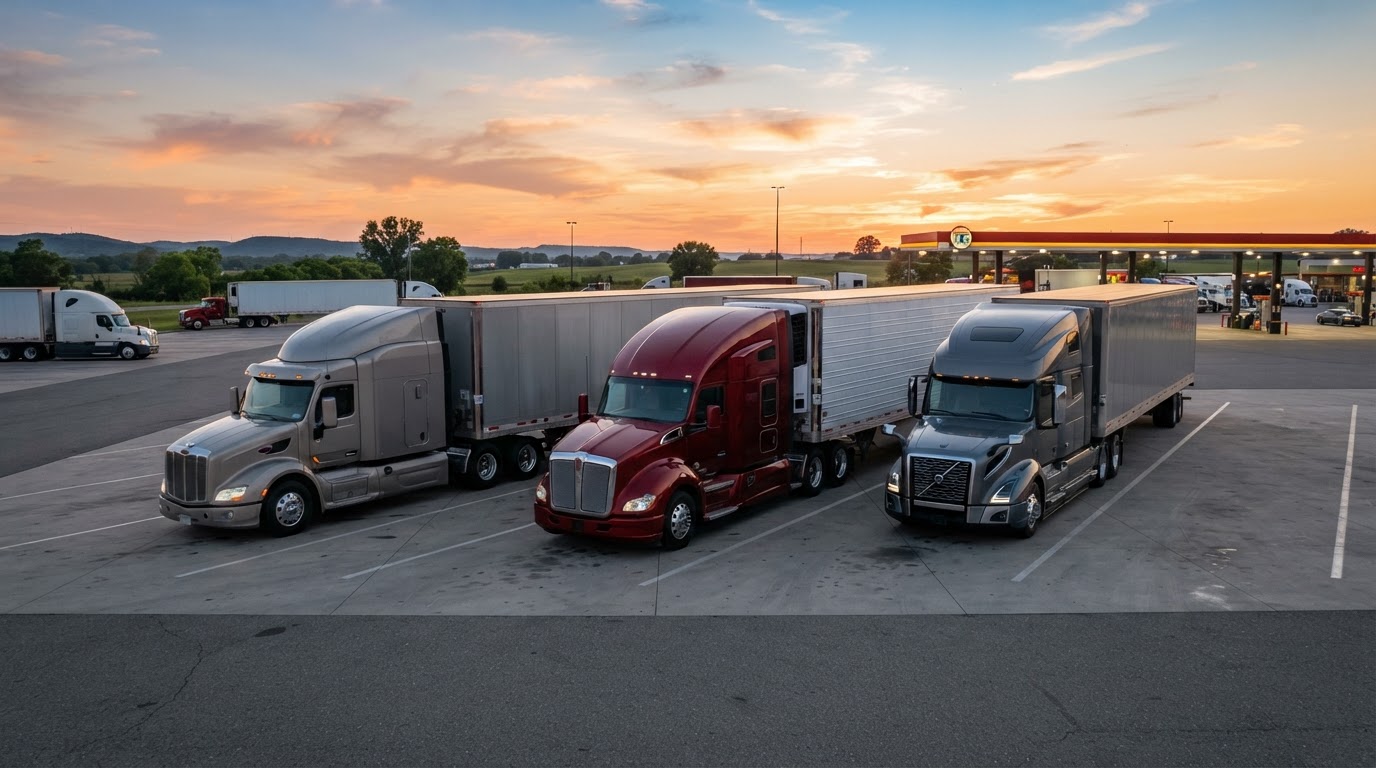
🚛 Volvo VNL vs Freightliner Cascadia vs Kenworth T680: Which Truck Is Best for OTR in 2026?
Ask three drivers which truck is best and you'll get three religions. Strip away the brand loyalty, though, and each of the big three wins a different category. If you're choosing a truck — or choosing a company by what it runs — here's the honest scorecard. 🔧
📊 The big three at a glance
| Factor | Volvo VNL | Freightliner Cascadia | Kenworth T680 |
|---|---|---|---|
| Engine / transmission | Volvo D13 (up to ~600 hp in top spec) + I-Shift | Detroit DD15/DD16 + DT12 | PACCAR MX-13 or Cummins + PACCAR/Eaton automated |
| Real-world fuel economy | Strong — redesigned aero cab | Class leader (~8.5 mpg reported in OTR use) | Good (~7.5–8 mpg reported) |
| Sleeper comfort | Largest options (up to ~79"), quiet, flat floor layouts | Functional, well-organized (up to 72") | Premium materials, best noise insulation (up to 76") |
| Dealer network | Good, growing uptime centers | Largest in North America | Solid, strong parts availability |
| Known for | Safety tech, driver comfort | Lowest cost per mile, easy maintenance | Build quality, resale value |
| Typical buyer | Comfort-focused fleets | Large fleets | Owner-operators |
🛏️ Which is most comfortable to live in?
You spend more waking hours in the cab than most people spend in their living room — for OTR, comfort is not a luxury metric.
- Volvo VNL: the redesigned VNL is the space champion — sleeper options up to ~79 inches, a genuinely quiet cab, and a ride quality drivers consistently rank at the top. Ergonomics feel car-like, which matters at hour ten of a driving day.
- Kenworth T680: the counterargument — the best interior materials of the three and superb noise insulation. If your measure of comfort is "feels expensive and sleeps silent," the T680 makes its case.
- Freightliner Cascadia: nothing wrong with it — it's just built to a fleet spec first. Comfortable, practical, but rarely anyone's dream cab.
⛽ Which is cheapest to run?
The Cascadia. Industry testing and fleet reporting put a current-generation Cascadia with the Detroit DD15 and DT12 around 8.5 mpg in real OTR conditions, against roughly 7.5–8 mpg for comparable competitors. Reviewers' math: over ~120,000 miles a year, one mpg-class gap can mean on the order of a thousand gallons of diesel — several thousand dollars. That's why the interstate is full of Cascadias: at fleet scale the fuel line item decides.
For a company driver this matters indirectly: a fuel-efficient fleet is a fleet with healthier margins — and some carriers (ASTEL included) share the benefit through fuel-efficiency bonuses per mile.
🔧 Reliability and the dealer network
Spec sheets don't carry loads — uptime does. A breakdown's real cost is the days you sit, and that's where dealer coverage becomes the hidden spec:
- Freightliner has the largest dealer and service network in North America — you're rarely far from parts and a bay.
- Kenworth / PACCAR quality control is the industry benchmark, and the trucks hold value best at resale.
- Volvo has invested heavily in uptime services and remote diagnostics; the network is smaller than Freightliner's but well-run.
🗣️ What do drivers actually say?
Read the forums long enough and a pattern emerges: fleet drivers respect the Cascadia ("it just works and there's always a dealer"), owner-operators defend the T680 with their wallets ("resale and build quality"), and comfort-first drivers keep landing on the Volvo ("best place to live on the road"). All three positions are correct — they're just optimizing different things.
Our fleet made its own choice years ago: ASTEL runs Volvo. If you want the long version of why — read our honest 2026 Volvo VNL review from behind the wheel.
🎯 Choosing a company? Read the truck line in the offer
- Ask what they run and how old. "Late-model" should come with a number.
- Ask what happens at a breakdown. Own shop? Road service? Spare trucks while yours is in the bay?
- Ask who pays for what. Maintenance policy tells you more about a carrier's culture than its slogan does.
- Sit in the truck at orientation. Five minutes in the driver's seat beats fifty brochure pages.
❓ Frequently asked questions
Which semi truck is the most fuel-efficient in 2026?
Among the big three, the Freightliner Cascadia leads real-world OTR reporting at around 8.5 mpg with the Detroit DD15/DT12 powertrain; comparable Volvo and Kenworth setups typically report in the 7.5–8 mpg range.
Which truck has the most comfortable sleeper?
The redesigned Volvo VNL offers the largest sleeper options (up to ~79 inches) and a very quiet ride; the Kenworth T680 counters with premium interior materials and top noise insulation.
Which truck do owner-operators prefer?
Kenworth T680 is the classic owner-operator pick: PACCAR build quality, strong resale value and wide parts availability balance the higher purchase price.
Does the truck brand affect a company driver's pay?
Not directly — pay is set by miles, freight and experience. Indirectly it can: efficient trucks support fuel bonuses, and a comfortable, reliable truck means more completed miles and less unpaid downtime.
What matters more than the brand?
The specific truck's age and maintenance history, the carrier's breakdown policy and whether spare trucks exist. A cared-for truck of any brand beats a neglected one of your favorite brand.
🚛 We picked Volvo — come see why.
ASTEL runs late-model Volvo tractors, maintained by our own mechanics, with replacement trucks so a breakdown doesn't kill your week. CDL-A drivers earn $90,000–$110,000 a year, paid weekly.
Apply in 2 minutes →Fuel-economy and spec figures are manufacturer data and industry-press test reporting for 2025–2026 model years; real-world results vary with load, terrain, weather and driving style. This is an editorial comparison, not sponsored by any manufacturer.