

Diesel Gelling in Winter and the Temperatures That Stop a Truck
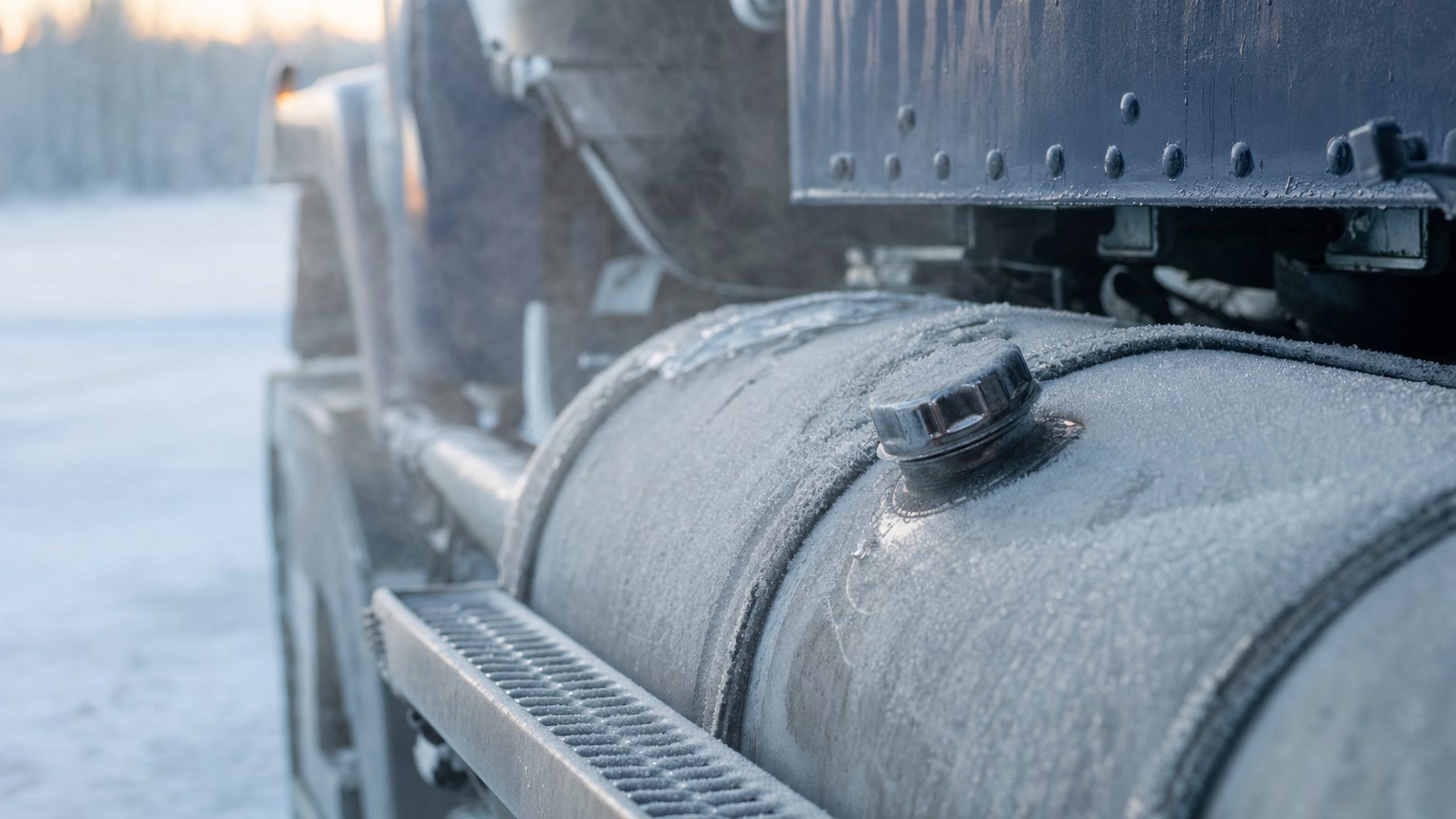
Diesel gelling starts well above 0°F. Untreated No. 2 diesel begins to cloud with wax at about 6–14°F, according to Minnesota-based fuel supplier CHS, and water in the fuel can ice up a filter at 32°F. On October 1, Minnesota's minimum biodiesel blend drops from B20 to B5, because B20 clouds at a higher temperature. If you run north this winter, take that date as the start of wax season.
Diesel gelling follows the thermometer step by step
| Temperature | What happens to the fuel | What you do |
|---|---|---|
| About 32°F (0°C) | Water in the fuel and in the fuel-water separator can freeze; ice can plug a filter before any wax shows | Drain the separator; CHS advises switching to a winter blend when nights get near 32°F |
| Below 30°F (−1°C) | Untreated No. 2 is still clear, but the margin is shrinking | CHS suggests about 70% No. 2 and 30% No. 1; add anti-gel at the pump, before the fuel |
| About 6–14°F (−14 to −10°C) | Cloud point of untreated No. 2: wax crystals appear and the fuel turns hazy | Too late to treat that fuel; anti-gel had to go in while it was warmer |
| 12°F (−11°C) | DEF starts to freeze; the diesel itself is not affected | Leave the DEF alone; the heated system thaws it after start-up |
| Below the cloud point, at the CFPP | Wax mats on the filter; the engine loses power on a grade or stalls | Heat and a fresh filter; an emergency additive only as its label directs |
| Near 0°F (−18°C) | Only a well-blended winter fuel stays reliable | CHS suggests about 30% No. 2 and 70% No. 1 |
| At the pour point | Diesel is a gel in the tank and lines and no longer flows | Heated shop or tow |
| Below −30°F (−34°C) | Even heavy blends are at risk | CHS recommends straight No. 1 |
The numbers move with every load of fuel. Cloud point depends on the crude and the refinery, which is why CHS quotes a range, and its Cenex brand works with about 14°F for No. 2. Read the table as an order of events: water first, wax second, and DEF somewhere in between without touching your diesel.
Cloud point, CFPP and pour point mark three different failures
Cloud point is the temperature where the first wax crystals show up as a haze. ASTM measures it with test method D2500. Above it, the fuel forms no wax at all.
CFPP, the cold filter plugging point, is where fuel stops passing a standard filter fast enough. In the ASTM D6371 lab test, that means 20 ml of fuel failing to get through a 45-micron wire mesh within 60 seconds. On the road, the truck idles fine in the lot, then starves on the first long grade, because a loaded engine pulls more fuel than a waxed filter lets through.
Pour point is the lowest temperature at which fuel still pours. By then diesel sits as a gel in the tank, the lines and the filter housing, and no roadside trick will move it.
ASTM D975, the U.S. diesel specification, sets no national cold-weather limit. It lists tenth-percentile low temperatures by state and month, the low an area beats on roughly one day in ten, and leaves cold-flow properties to the supplier and the buyer. So fuel bought for a Dallas January can be fine in Dallas and wrong in Fargo two days later.
Winter blend is No. 1 mixed into No. 2
No. 1 diesel carries much less wax, so it stays liquid far colder, and suppliers in cold states cut it into No. 2 for the winter. CHS gives rule-of-thumb blends: about 30% No. 1 below 30°F, about 70% near 0°F, straight No. 1 below −30°F.
Cenex, the CHS fuel brand, puts the effect at roughly 3°F lower cloud point for every 10% of No. 1 in the mix. Blending late doesn't undo the damage, though. CHS warns that crystals formed before the switch won't melt and will linger and plug the filter, so a truck that ran fine on a cold Friday can quit on a warm Monday.
The trade-off is energy. EIA's conversion tables put kerosene, which is close to No. 1 diesel, at about 135,000 Btu per gallon, against about 137,400 for ultra-low sulfur No. 2. That is under 2% per gallon for straight No. 1, and a 30% blend costs about half a percent.
If your winter MPG falls further than that, look at idle hours first. Good habits from fuel-efficient truck driving still pay in January, and at ASTEL the Fuel bonus adds up to $0.02 a mile for good MPG and fueling by the rules.
Biodiesel pushes the cloud point up. Clean Fuels Alliance America puts a B20 blend about 2–7°F above straight No. 2, while B5 clouds at about the same temperature as No. 2. That's why Minnesota law (Minn. Stat. § 239.77) requires at least B20 from mid-April through September and lets the minimum fall to B5 from October 1 through March 31. Other states set their own blends, so read the pump label when you fuel in the North in winter.
Anti-gel goes in first and only into warm fuel
Anti-gel, the cold flow improver sold at truck stop counters, barely moves the cloud point. DieselNet's technical summary says these additives usually have little impact on cloud point. What they do is keep wax crystals small and separate, so the crystals slip through the filter instead of matting on it.
Timing decides whether that works. Pour the dose into the tank before the diesel, and the pump flow does the mixing for you. Treat fuel that is still above its cloud point, because anti-gel won't dissolve crystals that already exist.
Follow the ratio on the bottle, since it differs from product to product. DAT's November 2023 winter guide puts the math simply: the right fuel and additives cost much less than a tow and recovery bill.
Water freezes at 32°F, long before wax shows
Ice is the gel-up nobody expects. Condensation collects in half-empty tanks on cold nights, drops to the bottom and ends up in the fuel-water separator. DAT notes that ice can plug a filter at temperatures as high as 32°F, while the diesel itself is still perfectly clear.
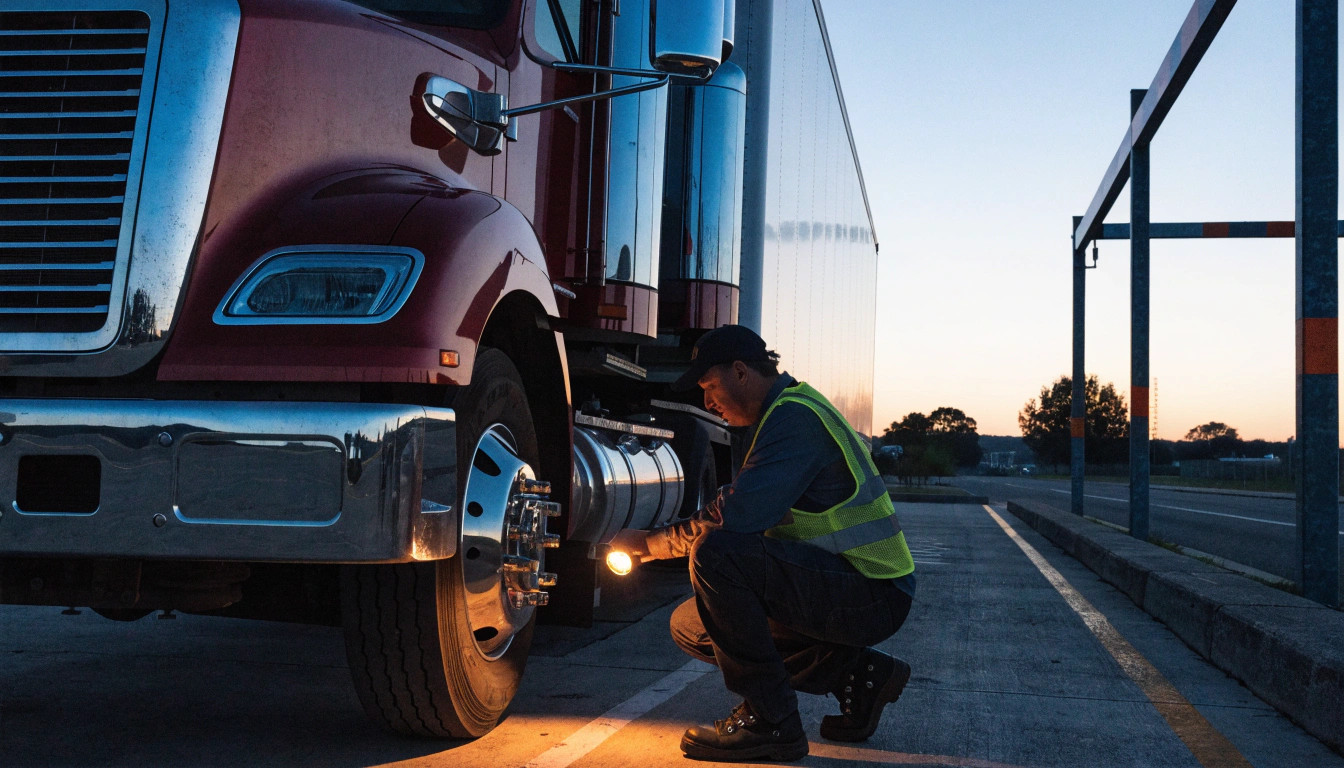
Drain the separator when the forecast drops toward freezing, and keep the tanks topped up overnight so there is less air inside to sweat. From October on, make the drain part of your pre-trip inspection, right next to the fuel level check.
Buy cold-weather fuel where the cold is
The classic gel-up story starts with full tanks bought down south. A truck fills in Texas in January and runs north on I-35 into a cold snap, still carrying No. 2 blended for a Dallas winter. DAT's guide notes that most truck stop chains treat their fuel for their own region, so that fuel was right for Texas. At 0°F in Minnesota it is out of its depth.
The fix is a fuel plan. Arrive at the last stop before the cold with the tanks low, pour in anti-gel, then fill with the local winter blend. Trip planning for a winter load should put fuel stops on the map next to parking and chain-up areas, and the chain routine itself is in how to chain up a semi truck. At ASTEL drivers fuel at Pilot / Flying J or where the dispatcher agrees, so that stop gets planned together with dispatch.
For ASTEL, winter sits inside the busy season. The peak runs from August through March at 3,500–3,700 miles a week, so a day lost to gelled fuel in those months costs more than it would in spring.
The reefer tank gels too, and the load pays for it
A trailer reefer burns diesel from its own tank, usually mounted under the trailer. FreightWaves Ratings puts most reefer tanks at about 50 gallons, or roughly 2–4 days of running. That tank rides in the wind at highway speed and gets its own fill, usually dyed off-road diesel from the reefer pump. Treat the tractor and forget the reefer, and the reefer is the part that quits.
In deep cold a reefer often runs in heat mode to keep produce and beverages from freezing. A gelled reefer at −10°F stops the heat, and a frozen load of lettuce is a claim just like a warm one. How the unit switches between cooling and heating is covered in how to run a reefer unit.
ASTEL drivers check the load temperature and the reefer 2–3 times a day. In winter, add the reefer fuel gauge and any unit alarms to each of those checks, and winterize the reefer tank the way the unit maker's manual says.
DEF freezes at 12°F and the truck is built for it
Diesel exhaust fluid is 32.5% urea in deionized water, and it starts to freeze at 12°F (−11°C). The urea and the water freeze together, so freezing doesn't change its strength. It doesn't stop the engine from starting either.
Most trucks with SCR warm the DEF tank with engine coolant and heat the lines electrically, so a frozen tank thaws after start-up, slowly on a hard cold soak. Never pour anything into DEF to keep it liquid. Anti-gel, alcohol or any other additive contaminates the fluid and can damage the SCR system.
A heater fault that leaves DEF frozen shows up as a DEF warning and, depending on the software, reduced power. EPA's August 2025 guidance replaced the old 5 mph derate with a staged schedule for model year 2027 trucks and urged software updates for trucks already running. A July 2026 EPA proposal would swap derates on new engines for warnings, and as of September 2026 it is not final. Report the warning to the shop instead of hoping it clears.
Gelled fuel comes back with heat and a fresh filter
The signs come in order: the engine loses power under load, won't pull a grade, then stalls and cranks without firing. If the thermometer reads below about 15°F and a fuel sample from the filter looks cloudy or waxy, treat it as a gel-up.
- Stop cranking. Gelled fuel won't clear by grinding the starter, and long cranking cycles overheat it and drain the batteries you'll need later.
- If you're stopped on the shoulder, turn on the flashers and set out your triangles. Under 49 CFR 392.22 the warning devices have to be out within 10 minutes.
- Call dispatch with your location, the outside temperature and what the truck did before it stalled. If the cab is losing heat, say that first, because your own safety comes before the load.
- Get heat to the filter and the fuel lines, ideally in a heated shop or from a road service truck. Never use an open flame or a torch near the fuel system.
- Replace the fuel filter with your spare, following your engine maker's procedure for filling and priming.
- If you use an emergency additive made for gelled fuel, follow its label exactly, including whether any goes into the filter. Regular anti-gel does nothing at this point.
- Start the engine and let it run before you pull a load, watching for power loss on the first grade.
ASTEL has its own mechanics and a replacement truck for breakdowns, and dispatch answers 24/7, including 3 a.m. at a North Dakota truck stop. The full roadside playbook is in what to do when your truck breaks down.
An idling hour costs about $5 in fuel
Idling keeps fuel warm, and it costs money. Argonne National Laboratory puts a heavy truck's idle burn at about 0.8 gallon an hour. At EIA's September 28, 2026 average of $6.38 a gallon, that is about $5 an hour, and a 10-hour break comes to roughly $51. The weekly trend is in our look at diesel prices for truck drivers.
Idling rules are local. Illinois, where the ASTEL yard sits in Chicago, limits diesel idling to 10 minutes in any 60 in the Chicago area and the Metro East counties near St. Louis (625 ILCS 5/11-1429). The limit doesn't apply below 32°F or above 80°F, or while a driver rests in the sleeper and needs heat or air conditioning. The same law doesn't restrict an APU or a generator set.
One exception ignores the weather. At paid parking lots without fuel pumps in Cook County outside Chicago, a truck within 200 feet of homes gets 10 minutes an hour in every season. A first ticket under the law is $90, and a second within 12 months is $500. Other states and cities write their own rules.
Nose the truck away from the wind so the grille isn't taking the blast all night. Wind can't cool a filter below the air temperature, but it gets it there much faster. If the lot has plug-ins and your truck has a block heater, use them. More cold-weather habits are in our guide to winter driving for truck drivers.
Frequently asked questions
At what temperature does diesel fuel gel?
It depends on the fuel. Untreated No. 2 diesel starts to cloud with wax at about 6–14°F, according to fuel supplier CHS, and plugs filters as the temperature keeps dropping. Winter blends with No. 1 and anti-gel stay liquid much colder, and CHS recommends straight No. 1 below −30°F.
Can you add anti-gel to diesel that has already gelled?
No. Anti-gel works only when it is mixed into fuel above its cloud point, and it won't dissolve wax that has already formed. Gelled fuel needs heat and a new fuel filter, or a heated shop. Emergency additives for gelled fuel exist, but use them only as the label directs.
Does DEF freeze in a semi truck?
Yes. DEF starts to freeze at 12°F (−11°C), but the truck still starts, and the heated DEF tank and lines thaw it after start-up. Freezing doesn't damage the fluid. Never add anti-gel or anything else to DEF.
Does winter blend diesel lower your MPG?
A little. EIA's tables put kerosene, which is close to No. 1 diesel, at about 135,000 Btu per gallon against about 137,400 for ultra-low sulfur No. 2, so even straight No. 1 costs under 2% of energy per gallon. Idling burns about 0.8 gallon an hour, so idle time usually moves your winter MPG more than the blend does.
Should I idle my truck overnight to keep diesel from gelling?
Idling keeps fuel warm, but it burns about 0.8 gallon an hour, and some states limit it. Illinois, for example, caps diesel idling at 10 minutes an hour in the Chicago and Metro East areas but exempts temperatures below 32°F. Treated winter fuel is the real protection, and idling only buys time.
Winter miles run easier with a shop and dispatch behind you
ASTEL is a family-owned carrier out of Chicago running refrigerated freight year-round on late-model Volvo trucks, with our own repair shop and mechanics, 24/7 dispatch and a direct line to the owner. Drivers earn $90,000–$110,000 a year — $2,400–2,700+ a week gross, a flat $0.80 per mile for drivers with 1+ year of experience, all miles paid ZIP-to-ZIP, weekly pay, plus $50/$200/$500 bonuses for clean DOT inspections.
Apply in 2 minutes →Sources: CHS winter diesel guidance (January 2025) and Cenex cold-weather diesel articles; DAT winter fuel guide (November 2023); DieselNet, low-temperature operability of diesel fuel; ASTM D975, D2500 and D6371; Clean Fuels Alliance America cold flow fact sheet (2023); Minnesota Statutes § 239.77; EIA Monthly Energy Review, Appendix A heat content factors; EIA Gasoline and Diesel Fuel Update, U.S. on-highway diesel for September 28, 2026; Argonne National Laboratory idling estimate via the DOE Alternative Fuels Data Center; FreightWaves Ratings on reefer fuel (January 2023); Illinois Vehicle Code, 625 ILCS 5/11-1429; 49 CFR 392.22; EPA guidance on DEF inducements (August 2025) and EPA proposed rule on heavy-duty engines and DEF inducements (July 2026). Current as of September 2026; fuel blends, prices, idling rules and DEF rules may change. Pay and mileage figures describe ASTEL driver ranges, not guarantees. General information, not mechanical or legal advice; follow your engine and reefer manufacturer's procedures.