

Fuel Efficient Truck Driving — How OTR Drivers Turn MPG Into Money
Two drivers, same Volvo, same lane, same 44,000-pound reefer load. One finishes the year at 6.4 mpg, the other at 7.3. The truck didn't change. The right foot did. Fuel is the single biggest line on a carrier's cost sheet, which is exactly why fleets watch your mpg and pay you for it. This page covers what actually moves the number, driver to driver, with real figures.
Fuel is a company driver's business too
Fair point. You don't pay for the diesel. But three things make fuel your business:
- Fuel bonus programs. Most decent carriers pay a per-mile bonus for hitting an mpg target, because a driver who saves 1,500 gallons a year saves the company far more than the bonus costs. At ASTEL the fuel bonus is up to +$0.02 per mile, plus a safety bonus of another +$0.02, so on 100,000 miles that's a spare $2,000 a year for driving the way you should anyway.
- Fleets track it anyway. The ECM in a modern truck logs speed, idle hours, brake applications and mpg per driver. When dispatch decides who gets the good freight, the driver with 7.2 mpg and zero hard-brake events sits higher on the list than the 6.1-mpg guy with a heavy foot.
- It's the same skill as safe driving. Every technique below (looking far ahead, leaving space, smooth inputs) is exactly what keeps you off the accident report. Fuel economy is just safe driving with a scoreboard.
Go owner-operator someday and this skill becomes the difference between a business and a hobby. The rest of what a driver spends on the road is in our breakdown of truck driver road expenses.
What half a mile per gallon is worth over 100,000 miles
Do the math once, honestly, so the rest of the article has stakes:
- At 7.0 mpg, 100,000 miles burns 100,000 ÷ 7.0 ≈ 14,286 gallons.
- At 7.5 mpg, the same miles burn 100,000 ÷ 7.5 ≈ 13,333 gallons.
- Difference: ≈ 950 gallons. At roughly $5 a gallon (the 2026 national on-highway diesel average has been running above that), that's about $4,750 a year, from half a mile per gallon.
That's why the fuel bonus exists, and it's not charity. It's a slice of real money you personally created.
The levers that move mpg the most
| Lever | Typical effect on mpg | Driver's control |
|---|---|---|
| Cruising speed | ≈ 0.1 mpg per 1 mph above ~60; 65 vs 75 mph ≈ 25% less fuel | Full |
| Idling | 0.8–1.0 gal/hour main engine vs ~0.2 gal/hour on an APU | Full |
| Anticipation & following distance | Fewer brake applications, 3–5% typical | Full |
| Progressive shifting / RPM | 2–5% on manuals; on automatics, don't fight the Eco mode | Partial |
| Cruise control on flat terrain | 1–3% vs a "human" throttle foot | Full |
| Tire pressure | −10 psi on all tires ≈ 0.5–1% more fuel; −20 psi ≈ 8–10% | Full (pre-trip) |
| Tractor–trailer gap | Sliding the fifth wheel to close the gap ≈ 1–2% | Partial |
| Fuel weight | Every 1,000 lb ≈ 0.5% more fuel; 100 extra gallons ≈ 700 lb | Full |
| Winter | 5–10% worse on the highway; winter blend alone costs up to 0.5 mpg | Mitigate only |
The ranges above come from NACFE, ATRI and Department of Energy figures for Class 8 tractors. Your truck, load and terrain will land you somewhere inside them, not exactly on one number. The order is the useful part: speed and idle first, everything else after.
Speed beats every other lever on this list
Aerodynamic drag grows with the square of speed, and at highway speed roughly 65% of a truck's fuel goes into pushing air out of the way. That's where the rule of thumb comes from: each mph above about 60 costs roughly 0.1 mpg. Run 70 instead of 62 and you've thrown away close to a full mile per gallon before touching anything else.
The counter-argument every driver makes: "but I make fewer miles." Check it against the clock. On a 500-mile day, 62 mph instead of 68 adds about 40 minutes of driving. Under the hours-of-service rules most days aren't limited by the 11-hour drive clock. They're limited by the shipper's dock, the receiver's appointment and the 14-hour window. Good trip planning recovers those 40 minutes far cheaper than the fuel does; see how to plan a truck trip.
RPM, progressive shifting and the automated transmission
On a manual, progressive shifting means upshifting early at low RPM through the bottom gears and only using higher revs when the load demands it. On the automated transmissions almost every late-model fleet truck runs today (Volvo's I-Shift, for example), the box already does that math. Your job is different:
- Stay in Economy mode. Performance mode holds gears longer and revs higher. It feels good on a grade; it costs fuel everywhere else.
- Roll onto the throttle. Floor it from a stop and the transmission will hold lower gears to give you what you asked for. Ease in and it short-shifts on its own.
- Watch the coach display. Volvo's driver display can show fuel economy, instant and trip, and rate your driving on braking, anticipation, speed adaptation and engine use. Use it as a scoreboard on a boring stretch. It's surprisingly addictive. We covered the cab and the electronics in our Volvo semi-truck review.
- Let the engine brake work. Descending on the engine brake burns no fuel and keeps the service brakes cool.
Cruise control and adaptive cruise, when to use them
On flat and gently rolling terrain, cruise beats a human foot. It doesn't creep up 3 mph while you're thinking about lunch. Newer trucks add predictive cruise (Volvo calls it I-See) that reads the road ahead and coasts over crests rather than accelerating into them. Let it.
Where cruise hurts: steep hills and dense traffic. A dumb cruise will try to hold 65 all the way up a 6% grade, dumping fuel in for no gain, then brake on the way down. Adaptive cruise in heavy traffic will brake and re-accelerate constantly to hold its gap. In both cases take over. Ease off before the crest, let speed bleed 5–8 mph on the climb, recover it on the descent.
Idling burns a silent gallon per hour
A Class 8 diesel at idle burns roughly 0.8–1 gallon per hour. Ten hours of overnight idle in a hot July parking lot is about $50 of diesel and a whole hour of engine wear for zero miles. Over a 300-night year that's more than 2,500 gallons, larger than any other lever on this page.
- Use the APU. An auxiliary power unit keeps the bunk cool or warm on about 0.2 gallons per hour, a fifth of the main engine. If the truck has one, that's what it's for.
- Know the idle laws. California, New York, Massachusetts, several other states and many cities limit idling to 3–5 minutes with fines that can exceed $1,000. Rules and exemptions vary; check before you park.
- Shut down at docks. A 90-minute live unload with the engine running is a gallon and a half gone. Turn the key.
- Watch your idle percentage. The truck logs it, and fuel bonus programs often gate on it. An idle time above 15–20% can quietly zero out your bonus even with great highway mpg.
Following distance and anticipation save fuel before they save a crash
Every time you touch the brakes you convert diesel into heat, then buy the speed back with more diesel. The cheapest fuel is the momentum you never gave away. Practically:
- Leave 6–8 seconds at highway speed, enough to react to traffic ahead by lifting off, not braking. Tailgating burns fuel long before it causes a crash.
- Read the road a quarter mile out. Brake lights three cars ahead, a merge lane filling up, a crest that hides a slowdown. Lift early and coast.
- Cheat the light. Approaching a red in town, let the truck roll down early so you arrive as it turns green, still moving. Getting 80,000 pounds rolling from a dead stop is the single most expensive thing you do all day.
The ECM counts hard-brake events, and so does the safety bonus. Not a coincidence: the driving that scores well on both is the same driving.
Tires, trailer gap and the pre-trip that actually pays
Rolling resistance is the second-biggest energy eater after air. NACFE field testing puts all tires 10 psi low at about 0.5–1% more fuel, and 20 psi low at 8–10%, and FMCSA data says more than half of trucks on the road have at least one tire 10 psi down. A gauge at every pre-trip inspection is the highest-return two minutes of your day, and it beats the thumper every time.
Aero matters too. Close the tractor–trailer gap where the fifth-wheel position and your axle weights allow. A tighter gap is worth a percent or two. Keep the trailer skirts and the cab fairing intact; report damaged aero pieces instead of driving around with a broken skirt for a month. A carrier with its own shop, like ASTEL, fixes those the same day. Fleets without one tend to let them slide.
Planned fueling, fuel weight and the reefer tank
Diesel weighs about 7 pounds a gallon. Two full 150-gallon tanks are over 2,000 pounds, the fuel equivalent of two extra pallets of frozen chicken. Every 1,000 pounds costs roughly half a percent in fuel, so running full tanks across the country when you'll fuel again in 500 miles is a small, constant leak. Buy what the next leg needs plus a safety margin, not what the tanks will hold.
That's easier when fueling is planned, not improvised. With a fuel card on a major network like Pilot / Flying J, your dispatch can route you to stops where the company's negotiated price applies. The fuel is cheaper for the carrier, and you stop chasing the sign price. Fuel-price and route apps help here too; our picks are in the best apps for truck drivers.
One reefer note: the reefer unit has its own tank and burns its own diesel, typically 0.5–1 gallon an hour depending on setpoint and mode. It doesn't count against your tractor mpg, but it still matters to the company. Cycle-Sentry (start-stop) instead of Continuous when the commodity allows, doors closed at the dock and a pre-cooled box before loading all cut reefer fuel, and keep that tank fueled separately so you're never explaining a warm load.
Why mpg falls off a cliff in winter
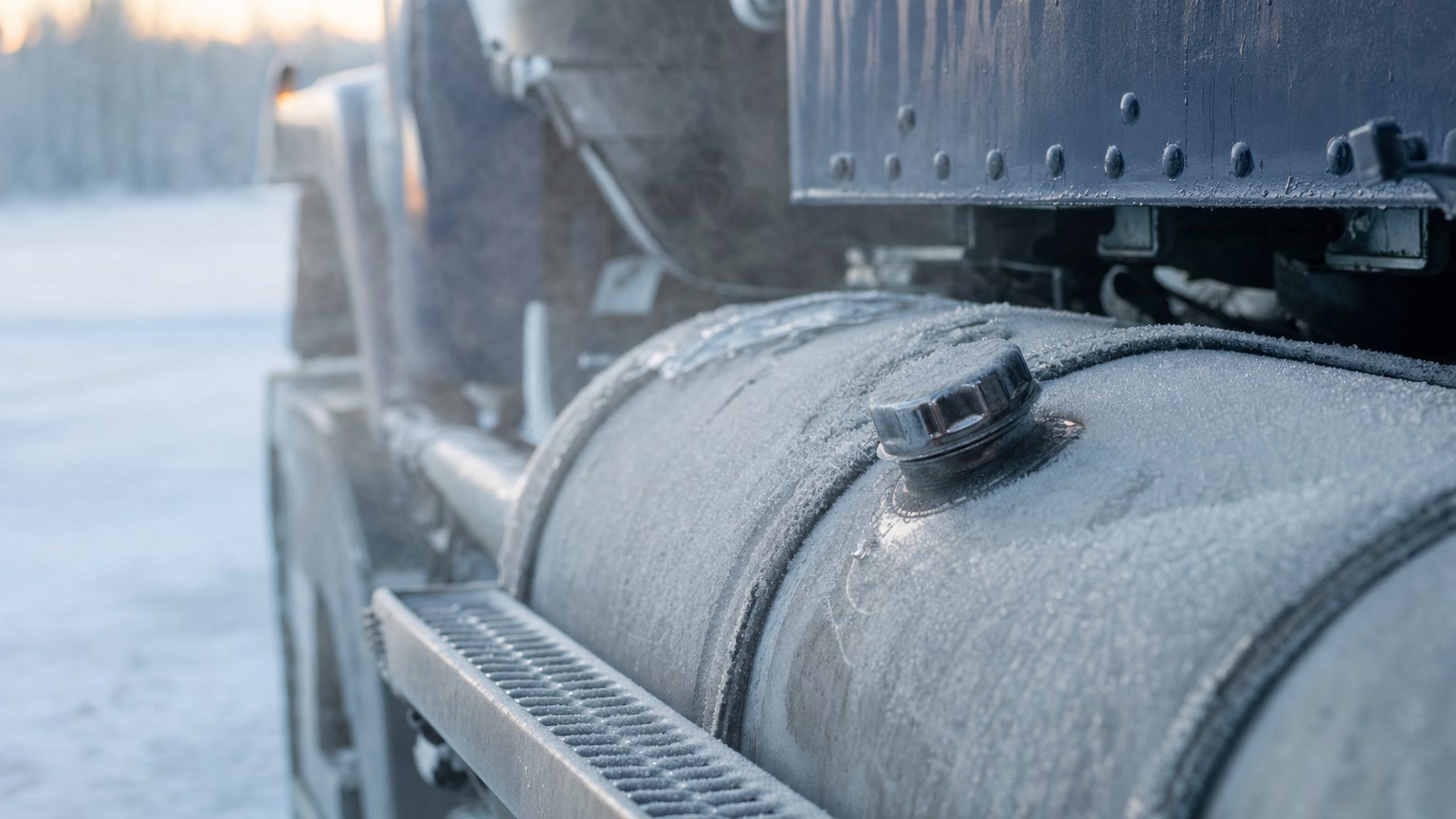
Expect a 5–10% drop in highway mpg in serious cold, and more if you idle for heat. The causes stack: winter-blend diesel carries less energy per gallon (that alone can cost up to 0.5 mpg), cold dense air adds drag, cold tires and gear oil add rolling resistance, and the engine spends longer below operating temperature. You can't undo physics, but you can stop making it worse: use the APU or bunk heater instead of the main engine, plug in the block heater where there's shore power, check tire pressure more often (pressure drops about 1 psi per 10°F), and don't let idle hours run away. The full cold-weather playbook is in winter driving for truck drivers.
The truck matters less than the driver, more than people think
A late-model aero tractor with an automated transmission, predictive cruise and an APU gives a good driver 7–8 mpg to work with; a tired ten-year-old tractor with no aero package tops out lower whoever is driving it. Ask what the fleet runs before you sign; Volvo, Freightliner and Kenworth compared shows what each brand does well. ASTEL runs late-model Volvo automatics, which is also why we're comfortable paying a fuel bonus. The equipment lets a careful driver actually hit the number. Unfamiliar terms are in the trucking glossary.
Frequently asked questions
How much fuel does a semi truck save by slowing down?
Roughly 0.1 mpg for every mph you take off above 60. Dropping from 70 to 62 mph is worth close to 0.8 mpg, which on a truck averaging 7 mpg is about 10–12% less fuel over the year.
What is a good mpg for a semi truck?
Fleet averages sit around 6.5–7.5 mpg for a loaded late-model aero tractor. Disciplined drivers in good equipment see 7.5–8.5 on flat lanes; anything under 6 mpg with modern equipment usually points to speed and idle habits.
How much fuel does a truck use idling?
A Class 8 diesel burns about 0.8–1 gallon per hour at idle. An APU keeps the bunk comfortable on about 0.2 gallons per hour, so a full night on the APU instead of the engine saves 6–8 gallons.
Do fuel bonus programs actually pay?
Yes, if you meet the target. A typical program pays $0.01–$0.03 per mile for hitting an mpg or idle-time threshold; at $0.02 per mile on 100,000 miles a year that is $2,000 on top of base pay.
Does cruise control save fuel in a truck?
On flat and rolling terrain, yes, typically 1–3%, because it holds a steadier speed than a human foot. On steep grades and in dense traffic switch it off and manage speed yourself so the truck is not fighting the hill or braking constantly.
Drive smart. Get paid for it.
ASTEL pays a fuel bonus of up to +$0.02 per mile and a safety bonus of another +$0.02 per mile on top of the flat $0.80/mile (1+ year of experience) — every mile paid ZIP-to-ZIP, weekly. Late-model Volvo automatics, fuel cards on the Pilot / Flying J network, our own repair shop in Chicago, 24/7 dispatch and a direct line to the owner. Drivers earn $90,000–$110,000 a year. See what else is included on our page for drivers.
Apply in 2 minutes →Figures reflect published Class 8 research and industry practice as of August 2026: speed and idle rules of thumb from NACFE and ATRI; idle and APU consumption from U.S. DOE / Argonne National Laboratory; tire-pressure effects from NACFE field tests; diesel prices from the EIA weekly on-highway survey. Real-world results vary by truck, load, terrain and weather. Anti-idle laws change — verify current state and city rules. This article is general information, not employment or legal advice.