

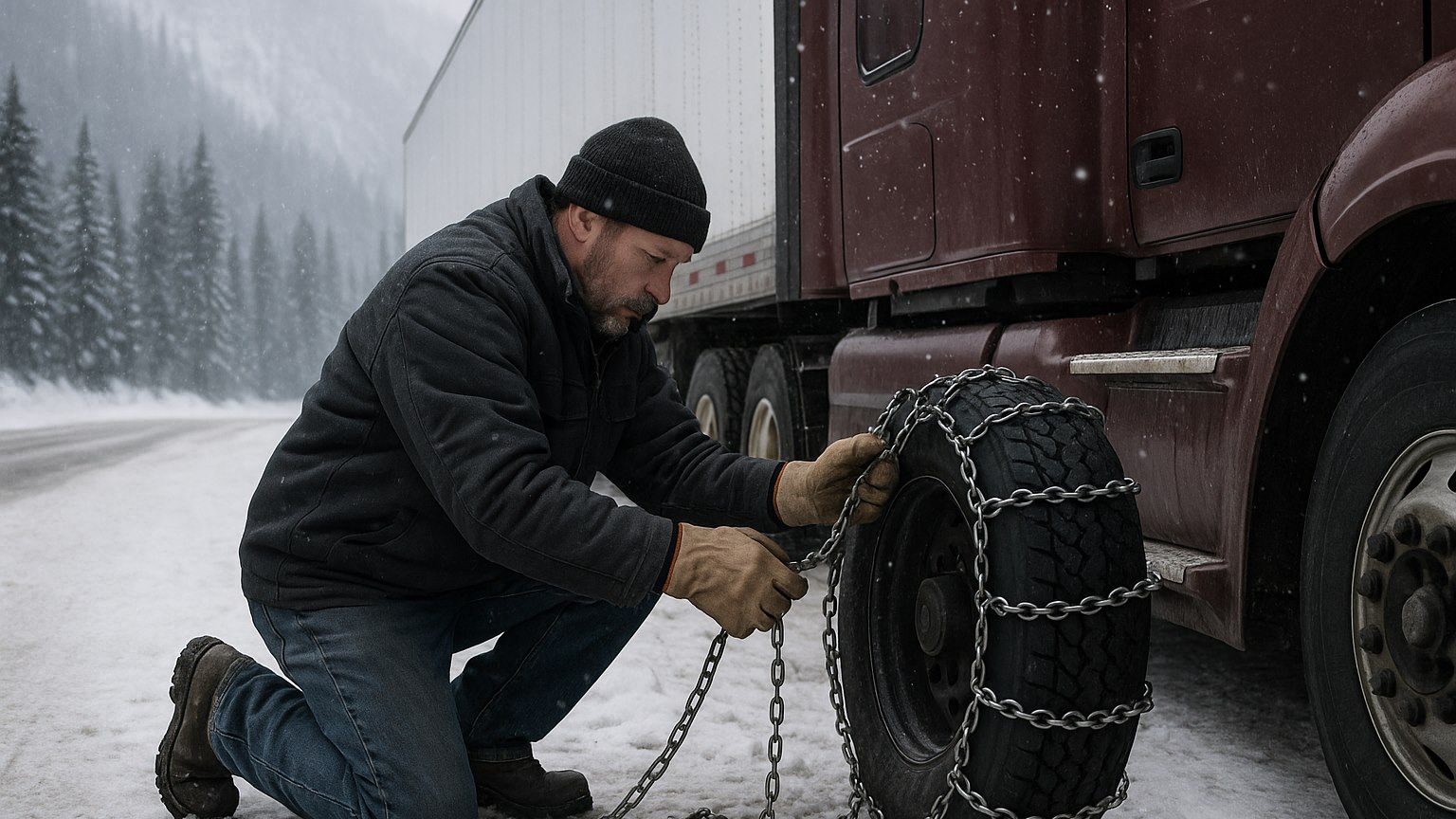
⛓️ How to Chain Up a Semi Truck: A Driver's Winter Guide
Every driver who runs the West learns this sooner or later: the chain law sign lights up, the checkpoint is a mile ahead, and the only question that matters is whether you've done this before. Chaining up is not hard — it's a 15-minute job once your hands know it. But the place to learn is a dry yard in October, not a slush-covered shoulder on I-70 in the dark. Here's the whole skill: the laws, the hardware, the install, and the judgment calls around it.
🗺️ When are chains required — and which states will check?
Chain laws are state law, not federal, so every mountain state writes its own. Two ideas repeat everywhere: a carry requirement (chains must be in the truck during a set season or on set corridors, used or not) and an active chain law (signs are lit, and you either chain up or get off the road). Mixing those up is how drivers collect tickets on dry pavement.
The one every reefer driver should tattoo on the sun visor is Colorado. Since the SB24-100 expansion, commercial vehicles with a declared gross weight over 16,000 lbs must carry four chains or approved alternative traction devices from September 1 through May 31 — nine months of the year — on I-70 west of Morrison and six more mountain corridors (US 40, US 50, US 160, US 550, CO 9 among them). Not carrying costs up to $500; blocking the road because you spun out without chains runs over $1,000 with surcharges. When the CMV chain law goes active, Colorado wants chains on four drive wheels.
| State | Carry requirement | Typical minimum when the law is active |
|---|---|---|
| Colorado | Sep 1 – May 31, CMVs over 16,000 lbs on designated mountain corridors: four chains or approved ATDs on board | Chains on four drive wheels |
| California | No fixed season — chain controls (R-1/R-2) posted by Caltrans as storms hit; about a mile of warning before the checkpoint | Link-type chains on at least four drive-axle tires plus two tires on a braked trailer axle |
| Washington | Nov 1 – Apr 1 on designated pass routes; a typical five-axle combination needs at least five chains on board | Chains on drives plus a trailer axle per WSP diagrams; cables mostly not accepted for trucks |
| Oregon | Signs designate zones; vehicles over 10,000 lbs must carry whenever use may be required — six chains minimum for a tandem-drive tractor with trailer | Four tires of the primary drive axle plus two tires of one trailer axle; fines start around $880 |
| Nevada | Posted controls, mainly I-80 and US 395 corridors | At least two tires of the primary drive axle plus the braking wheels of the trailer |
| Utah | Oct 1 – Apr 30 on designated routes for CMVs with four or more drive wheels | Chains on at least four drive-wheel tires |
| Wyoming | No carry season — two closure levels by conditions, famous on I-80 around Elk Mountain | Level 1: chains, adequate snow tires or AWD; Level 2: chains (or AWD) only |
| Montana | Posted by MDT when conditions demand | Chains on the driving wheels when signs say so |
Treat this table as a September 2026 snapshot: thresholds, corridors and fines change, and the sign on the road always beats the blog post. The physics behind the laws — grades, runaway ramps, brake fade and why the pass punishes improvisation — is covered in our mountain driving guide, which pairs with this one.
🔗 Singles, doubles, cables — what kind of chains do you actually need?
Walk into a truck stop chain aisle and you'll see half a dozen shapes. The differences matter, because some of them don't count as "chains" everywhere:
| Type | What it is | What a driver should know |
|---|---|---|
| Singles | One chain covers one tire | The standard unit chain laws count in; easiest to handle and to replace one at a time |
| Doubles / triples | One assembly blankets both tires of a dual (triples add a side section) | Heavier and bulkier, but faster than hanging two singles; common on tandem drives |
| Cam chains | Link chains with built-in tightening cams on the side chain | What you want: a half-turn of the cam tool takes up slack that plain chains leave to bungees alone |
| Cable chains | Steel cables with rollers instead of links | Light and easy — but not recognized for trucks in some places; Washington largely doesn't accept them for CMVs, and California controls typically call for link-type chain on trucks |
| ATDs (AutoSock etc.) | Textile "socks" and other alternative traction devices | Accepted in many states — Colorado and Washington name approved ATDs — but verify the specific device and your carrier's policy before relying on one |
The safe buy for an OTR tractor is link-type cam singles sized to your tires — they satisfy every state on the table above. Check the size on the bag against your actual tires — wide-base singles included: a chain half a size long never tensions right, and a short one won't close at all.
🎒 What belongs in the chain kit — and when do you check it?
Chaining up is miserable exactly in proportion to how bad your kit is. The chains are maybe half of it:
- Waterproof insulated gloves — bare hands on wet steel at 20°F end the job in five minutes. Carry two pairs; the first one gets soaked.
- A kneeling mat or piece of tarp — you'll be on your knees in slush at least twice per tire.
- A headlamp — chain law hits at night more often than not, and you need both hands.
- Cam tool and spare bungees — bungee tensioners tear and fly; carry more than you think you need.
- Spare cross links and repair links — one broken cross chain doesn't have to end the set.
- WD-40 or similar — cams and hooks that sat rusty since March will not turn with cold fingers.
- High-visibility vest and your triangles nearby — you're a pedestrian on a highway shoulder; act like one.
Before the season — call it late September, right when Colorado's carry window has already opened — pull the chains out and lay every one flat. You're looking for stretched, cracked or missing cross links, bent hooks, cams that won't turn. Hang the bad ones on the shop wall, not on your tires. Fold this into a habit the way you run a pre-trip inspection: a chain you can't trust is cheap to catch in the yard and expensive to discover on the pass. And if a chain does let go on the road and wraps something it shouldn't, treat it like any other roadside breakdown: get safe, get visible, get on the phone.
🧰 How do you chain up a semi truck, step by step?
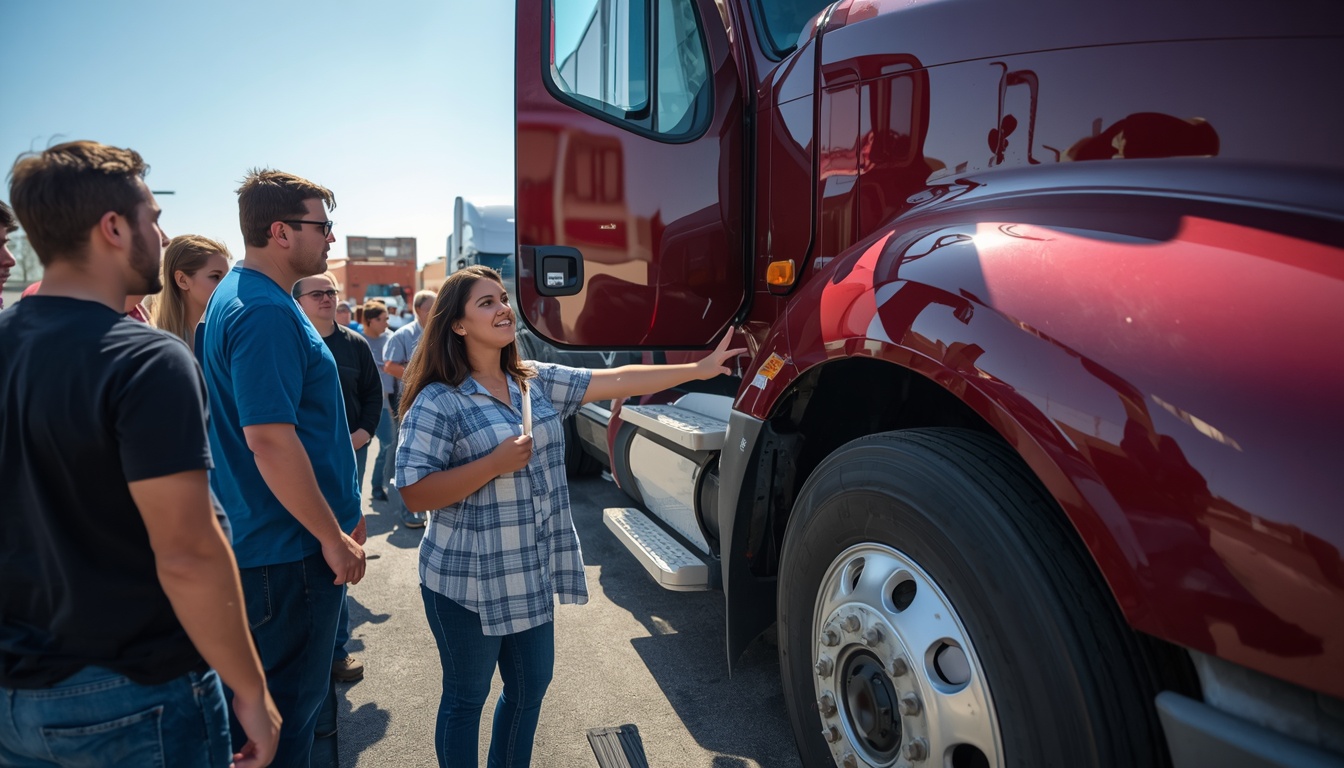
This is the drape method — no driving onto laid-out chains, no guessing. Ten steps, and after a few reps it's 15 minutes for a pair:
- Pick your spot. A designated chain-up area or a level, straight pull-out completely clear of the travel lane. Parking brake set, flashers on, vest on. Never chain on a grade or a curve if you can avoid it.
- Know where the chains go. Default for most trucks: the outside tires of the drive axles — that's where traction and the law usually meet. In Colorado plan on four drive wheels; in California and Oregon expect a trailer axle too. Match what the state requires that day.
- Lay each chain flat beside its tire and untangle it completely. Cams face out, away from the tire; cross-chain hooks face up, so they won't chew the rubber later. A twisted chain installed is a chain installed twice.
- Drape the chain over the tire, centered, with roughly equal length hanging on both sides and the inside end hanging slightly lower — you'll need that reach behind the tire.
- Tuck the front edge under the face of the tire as far as it goes, then pull forward about half a tire rotation (a couple of feet) so the tire rolls onto the chain and the two ends come up to meet each other. Get out and look — don't guess from the seat.
- Connect the inside first. Reach behind the tire, pull the inner side chain snug and hook it. Doing the hidden side first means the easy, visible side gets whatever slack is left.
- Connect the outside hook as tight as you can get it by hand, taking up links, not leaving them.
- Work the cams. Turn each cam with the tool a half-turn until the chain sits tight against the tire, evenly, cross chains square across the tread. No cams? Take up slack at the hooks and let the tensioners do more work.
- Stretch the bungees across the wheel face — spider-style or at minimum a triangle — so the side chain is pulled evenly toward the hub. Bungees are for keeping tension, not for creating it: a chain that's loose before bungees is a chain about to slap your fender off.
- Roll a quarter to half a mile and re-check. Chains seat and loosen after the first few hundred yards — every time. Pull over somewhere safe, re-tighten cams and hooks, re-set the bungees; this step is the difference between chains that work and chains in pieces on the shoulder.
🐌 How fast can you drive with chains — and when do they come off?
Chains change the truck. The rules once they're on:
- 25–30 mph, tops. That's the practical ceiling and what states post; above it, centrifugal force and slap will destroy the chains, the fender, the brake lines or all three. If the pass takes an hour at 25 mph, it takes an hour.
- Smooth everything. No wheel spin, no jake brake on the slick stuff, gentle throttle, long following distance. Chains multiply grip; they don't repeal winter.
- Listen. A rhythmic slap or metallic bang means slack or a broken cross link — stop and fix it now, before it wraps an air line.
- Off at bare pavement. Running chains on dry asphalt grinds them down in a handful of miles and rides like a paint shaker. When the surface is clear past the control zone, take them off at the next safe pull-out.
Removal is the install in reverse, with one rule that saves transmissions: unhook the cams and both hooks, drop the chain flat, and pull the truck forward off the chain — never drive in circles or back and forth trying to "shake it off," and never leave an end connected. A chain wrapped around an axle or caught in the brake hardware turns a five-minute job into a service call. Drag the chains clear, shake the ice out, and hang or spread them to dry when you can — chains stored wet in a bag come out in spring as one rusted knot.
🛑 When are chains not the answer?
Chains solve one problem: compacted snow and moderate ice on a road that is otherwise driveable. They do not fix freezing rain glazing the surface faster than traffic can polish it, whiteout visibility, or a closed pass. And the regulation is on your side here: 49 CFR 392.14 says that when conditions are hazardous, the driver uses extreme caution — and discontinues the trip when it's dangerous to continue. "Chain up or shut it down" is a decision that belongs to the person holding the wheel, and no load, broker or clock outranks it.
Practically, that means working the decision early instead of at the checkpoint: watch the pass forecasts and 511 while planning the trip, know where the last good parking before the grade is, and give dispatch your call with a reason — "chain law active, freezing rain on top, I'm holding at the bottom until sanding trucks run" is a professional message, not an excuse. The broader cold-weather craft lives in our winter driving guide; chains are one chapter of that skill, not the whole book.
🏔️ Why does chain season matter double in a reefer?
Produce and protein don't stop moving in January: the reefer freight peak runs August through March — straight through chain season, and the weeks that light up the signs on I-70 and Donner are the weeks a reefer driver runs hardest. At ASTEL that's how we plan it: drivers in the peak run 3,500–3,700 miles a week, so before the season our own mechanics go through the trucks — and the chain kits in them — the way you go through your pre-trip. The skill is small, the season is long, and the driver who owns the skill owns the season.
❓ Frequently asked questions
How many chains does a semi truck need to carry?
It depends on the state: Colorado requires four chains or approved ATDs on board for its Sep 1 - May 31 season, Washington expects about five chains for a typical five-axle combination, and Oregon's minimum for a tandem-drive tractor with a trailer is six. Carry enough to satisfy the strictest state on your route.
How fast can you drive a semi truck with chains on?
Keep it to 25-30 mph maximum. Above that, the chains whip, slap and break, taking fenders and brake lines with them. Drive smoothly, avoid wheel spin, and take the chains off as soon as you're back on bare pavement.
Which tires do the chains go on?
The default is the outside tires of the drive axles, because that's where power meets the road. Colorado's active chain law calls for four drive wheels; California and Oregon typically add two tires on a trailer axle. The posted requirement on the day always controls.
Are cable chains legal for semi trucks?
Not everywhere. Washington largely does not accept cables for commercial vehicles, and California chain controls typically call for link-type chain on trucks. Link-type cam chains sized to your tires satisfy every western chain law, which is why most OTR drivers carry them instead.
Do AutoSock or automatic chains count as tire chains?
In many states yes - Colorado and Washington, for example, recognize approved alternative traction devices, and AutoSock is the best-known one. But approval varies by state and device, so verify the specific product against the states you run and against your carrier's policy before you rely on it as your only equipment.
🚛 Winter miles, with a shop that has your back
ASTEL is a family-owned carrier out of Chicago running refrigerated freight year-round on late-model Volvo trucks, with our own repair shop and mechanics, 24/7 dispatch and a direct line to the owner. Drivers earn $90,000–$110,000 a year — $2,400–2,700+ a week gross, a flat $0.80 per mile for drivers with 1+ year of experience, all miles paid ZIP-to-ZIP, weekly pay, plus $50/$200/$500 bonuses for clean DOT inspections.
Apply in 2 minutes →Chain law details reflect state DOT and state police publications (CDOT and SB24-100 for Colorado, Caltrans chain control requirements, WSDOT/WSP, ODOT TripCheck, NDOT, UDOT, WYDOT, MDT) and FMCSA regulation 49 CFR 392.14 as of September 2026; seasons, corridors, minimums and fines change, and posted signage always takes precedence. Installation guidance follows common carrier training practice. Pay and mileage figures describe ASTEL driver ranges, not guarantees. This article is general information, not legal advice or a substitute for your company's procedures.