

Driving a Truck in Fog Means Driving at a Speed You Can Stop In
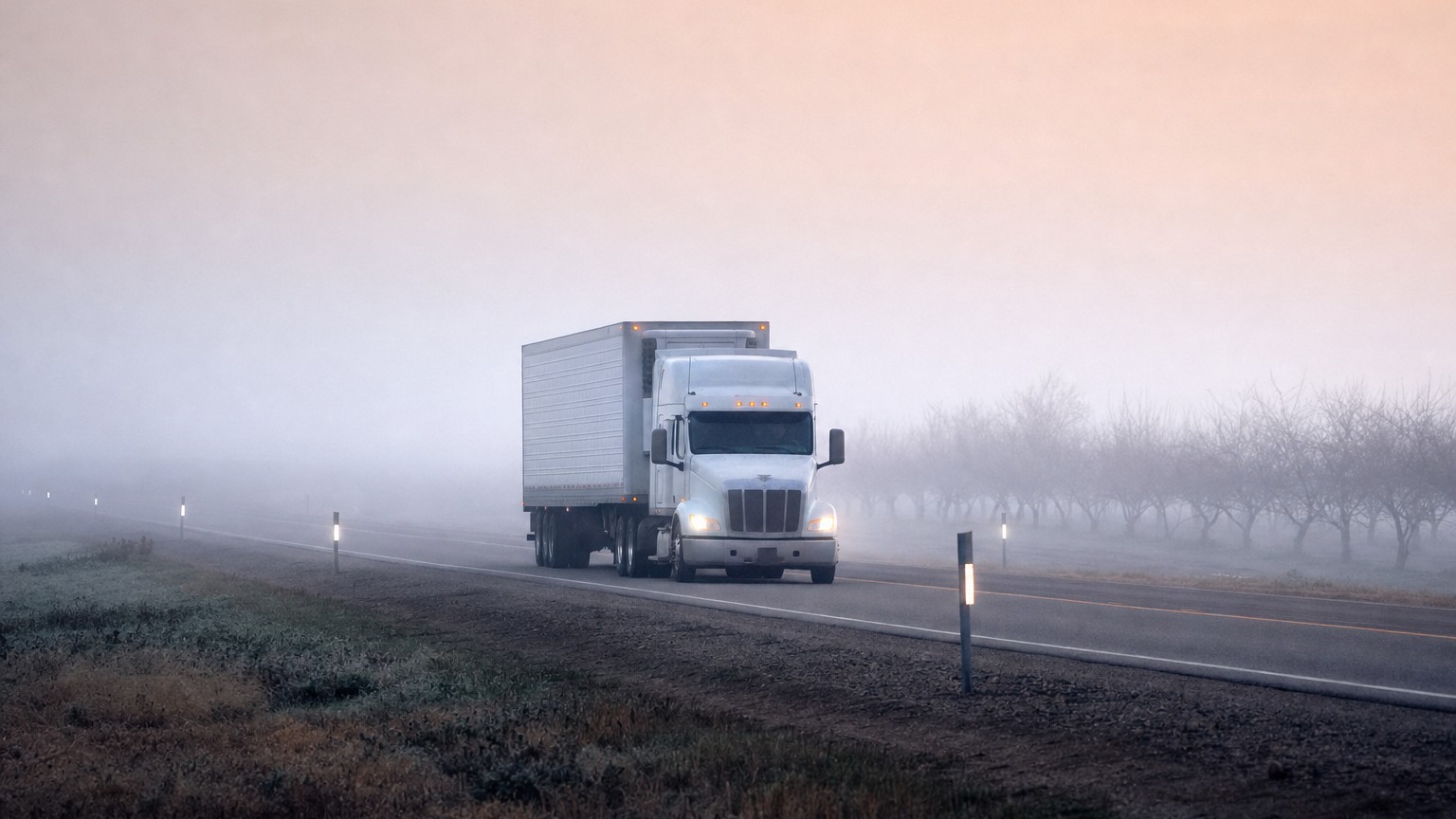
The mistake behind most fog pileups is simple: a driver holds highway speed because the taillights ahead are still visible. Driving a truck in fog at 55 mph means you need at least 419 feet to stop on dry pavement, by the figures in state CDL manuals. When the fog lets you see 200 feet, that truck becomes the next link in a chain reaction. On January 31, 2026, 59 vehicles piled up in both directions of Highway 99 near Earlimart, California, in dense fog.
Six habits that turn fog into a pileup
- Holding speed because you can see taillights. The Georgia CDL manual, section 2.12, warns that the lights in front of you may not show where the road is, and the vehicle may not be on the road at all.
- Switching to high beams. In fog the light bounces back off the water droplets and you see less. The manual says low beams and fog lights, even in daytime.
- Slowing down only after the fog closes in. The manual says to slow before you enter it and not to assume it will thin out ahead.
- Passing. A lane change into a gray wall is a bet that nobody is stopped in it.
- Tailgating another truck to use its lights as a guide. If that truck hits something, you are next.
- Stopping on the shoulder to wait it out. Drivers behind you follow the shoulder's edge line and your taillights straight into your trailer.
Each feels reasonable in the moment. That is why fog crashes so often involve many vehicles at once, and a 2014 report by the AAA Foundation for Traffic Safety found fog or smoke was a factor in nearly one in five serious multi-vehicle crashes. A truck that can't stop is the hardest link in that chain to absorb.
Your stopping distance has to fit inside what you can see
CDL manuals split stopping into three parts. At 55 mph, an alert driver covers 142 feet before the brain recognizes a hazard and another 61 feet before the foot reaches the brake. Braking adds about 216 feet on dry pavement with good brakes, for a total of at least 419 feet before the truck stands still, and the manual is clear that those are ideal conditions.
Fog rarely comes with ideal conditions. The pavement is usually damp, and the same manual says wet roads can double stopping distance. It also says braking distance grows with the square of speed, so halving your speed cuts braking distance to a quarter. Run the manual's numbers at 30 mph and a truck needs about 175 feet to stop on dry pavement. Too much if you see 150.
The rule that comes out of this is in section 2.6 of the manual: you should always be able to stop within the distance you can see ahead, and fog may require that you slow down to do it. Here is a field test. Pick a reflector post or a sign right at the edge of what you can see, and if the truck reaches it sooner than you could have stopped, you are going too fast for that fog. For comparison, low beams light about 250 feet at night on a clear road. Our night driving guide covers that math.
Low beams, fog lights and flashers are how other drivers find you
The same section 2.12 lists what helps when you must drive. Obey the fog warning signs and the reduced speed limits that some states post on their variable signs. Use low-beam headlights and fog lights for the best view, even at noon, and watch for drivers who forgot to turn theirs on. Turn on the four-way flashers so traffic behind you sees you sooner. Laws on flashers while moving differ by state, so check the rules where you are.
Use the roadside reflectors to read how the road curves ahead of you. Crack a window at slow speed and listen for traffic you can't see. Keep the defroster and wipers working, because a fogged windshield turns 200 feet into 100. A clean set of lights helps too, since dirty headlights can put out half the light they should.
Your trailer matters too. Clean the rear lights and reflective tape at the fuel stop before a foggy run. That bright rectangle is what a car closing at 70 sees first.
Get off at an exit, not on the shoulder
The manual's best advice on fog is blunt. Don't drive in it. It prefers that you pull off the road into a rest area or truck stop until visibility improves, and it says not to stop along the side of the road unless absolutely necessary. Federal rule 49 CFR 392.14 makes the same point in regulatory language. When fog affects visibility, you must use extreme caution and reduce speed, and if conditions become sufficiently dangerous, you must stop driving until the truck can be operated safely. If the next exit is far, rolling slowly in the right lane with flashers on beats sitting on the shoulder.
If you do end up stopped on the shoulder, 49 CFR 392.22 starts the clock. The flashers go on right away, and three reflective triangles go out within 10 minutes. In fog, put them at the full distances the rule sets and walk with the triangle held between you and traffic. Then get yourself away from the lanes. The full roadside routine is in our truck breakdown plan.
Fog usually burns off by mid-morning. A truck stop and a two-hour wait costs you a phone call to dispatch. A pileup costs much more, as described in what to do after a semi-truck accident.
Fog has its seasons and its usual roads
California's Central Valley is the best-known fog country in trucking. Tule fog forms on cold, still nights after the first rains, usually from November through February and sometimes into March, and sits over I-5 and Highway 99 for days. When it gets thick, the California Highway Patrol sometimes paces traffic through it, holding everyone behind a patrol car at a speed the fog allows. The Earlimart pileup on January 31, 2026, came during one of the longest fog seasons the valley had seen in years.
Mountains make their own fog. On March 31, 2013, near the base of Fancy Gap Mountain on I-77 in southern Virginia, 95 vehicles crashed in 17 separate collisions within about a mile, and three people died. Virginia State Police blamed heavy fog with near-zero visibility.
That season lines up with the busiest reefer months. At ASTEL the peak runs August through March, when drivers put in 3,500–3,700 miles a week, and much of that winter produce comes out of California and Arizona. Expect to meet tule fog on a Central Valley pickup.
Smoke and fog together make superfog
Federal rule 392.14 names smoke next to fog for a reason. On the morning of October 23, 2023, smoke from marsh fires in south Louisiana mixed with dense fog on I-55 near Manchac. Visibility dropped to a few feet, and a series of crashes involved 158 vehicles. Eight people died.
Superfog forms when damp vegetation smolders on a calm, humid night. Watch for burn advisories and fire smoke on the forecast, especially in the Southeast during burn season. If you smell smoke and see fog, treat it as zero visibility and get off at the next exit.
Fog can give you two extra hours under the HOS rules
The federal definition of adverse driving conditions in 49 CFR 395.2 names fog directly. Under 395.1(b)(1), a driver who runs into adverse conditions and can't safely finish the run within the normal limits may drive up to two extra hours. Since 2020 that extension applies to both the 11-hour driving limit and the 14-hour window.
There is a condition. The fog must not have been known, or reasonably knowable, before you started your duty day or your last qualifying break. Forecast fog doesn't count. A fog bank that wasn't forecast does. Annotate the extension in your ELD so an inspector can see why. The rest of the clock is in our hours-of-service guide.
Call dispatch the moment you decide to wait, because ASTEL's dispatch answers 24/7 and a call at 3 a.m. reaches a dispatcher who can start working on the appointment while you sit. Federal rule 49 CFR 390.6 bars a carrier from coercing a driver to keep driving in violation of the safety rules, and 392.14 is one of them. While you wait, the reefer keeps working. Check the load temperature and the unit, the same check ASTEL drivers make 2–3 times a day anyway. Weather calls in general are covered in our guide to high wind and severe weather.
Frequently asked questions
Should you use high beams in fog in a semi truck?
No. High beams reflect off the water droplets and cut what you can see. State CDL manuals tell drivers to use low beams and fog lights in fog, even in daytime.
Should I turn on my hazard lights when driving in fog?
The CDL manual says to turn on four-way flashers so traffic behind you notices your truck sooner. Some states restrict flashers on a moving vehicle, so check the law where you are driving. Once you stop on a shoulder, 49 CFR 392.22 requires flashers until your triangles are out.
How fast should a truck drive in fog?
Slow enough to stop within the distance you can see. At 55 mph a truck needs at least 419 feet on dry pavement, and wet roads can double that. If you can see only a few car lengths, the right speed is a crawl or a stop at the next exit.
Does fog count as an adverse driving condition for hours of service?
Yes, if it was not known or reasonably knowable when you started your duty day or your last qualifying break. 49 CFR 395.2 lists fog by name, and 395.1(b)(1) then allows up to two extra hours on both the 11-hour limit and the 14-hour window. Forecast fog does not qualify.
What is tule fog?
Dense ground fog that forms in California's Central Valley on cold, still nights after the first rains, usually from November through February. It can drop visibility to near zero on I-5 and Highway 99 and last for days.
Dispatch that answers at 3 a.m. when the fog rolls in
ASTEL is a family-owned carrier out of Chicago running refrigerated freight year-round on late-model Volvo trucks, with our own repair shop and mechanics, 24/7 dispatch and a direct line to the owner. Drivers earn $90,000–$110,000 a year — $2,400–2,700+ a week gross, a flat $0.80 per mile for drivers with 1+ year of experience, all miles paid ZIP-to-ZIP, weekly pay, plus $50/$200/$500 bonuses for clean DOT inspections.
Apply in 2 minutes →Sources: Georgia Department of Driver Services, Commercial Driver's Manual, sections 2.6, 2.6.1, 2.11.4 and 2.12; 49 CFR 390.6, 392.14, 392.22, 395.1 and 395.2 (eCFR, October 2026); AAA Foundation for Traffic Safety, "Hidden Highways: Fog and Traffic Crashes on America's Roads" (November 2014); ABC30 Fresno and FOX 11 Los Angeles on the Highway 99 crash near Earlimart (January 31–February 1, 2026); Associated Press and Virginia State Police reports on the I-77 crash near Fancy Gap (March 31–April 1, 2013); Louisiana State Police, WBRZ and the Associated Press on the I-55 superfog crashes (October 23–24, 2023). The 30 mph stopping figure is a calculation from the manual's numbers, not a test result. Current as of October 2026; state laws on flashers and posted fog limits may change. General information, not legal advice.