


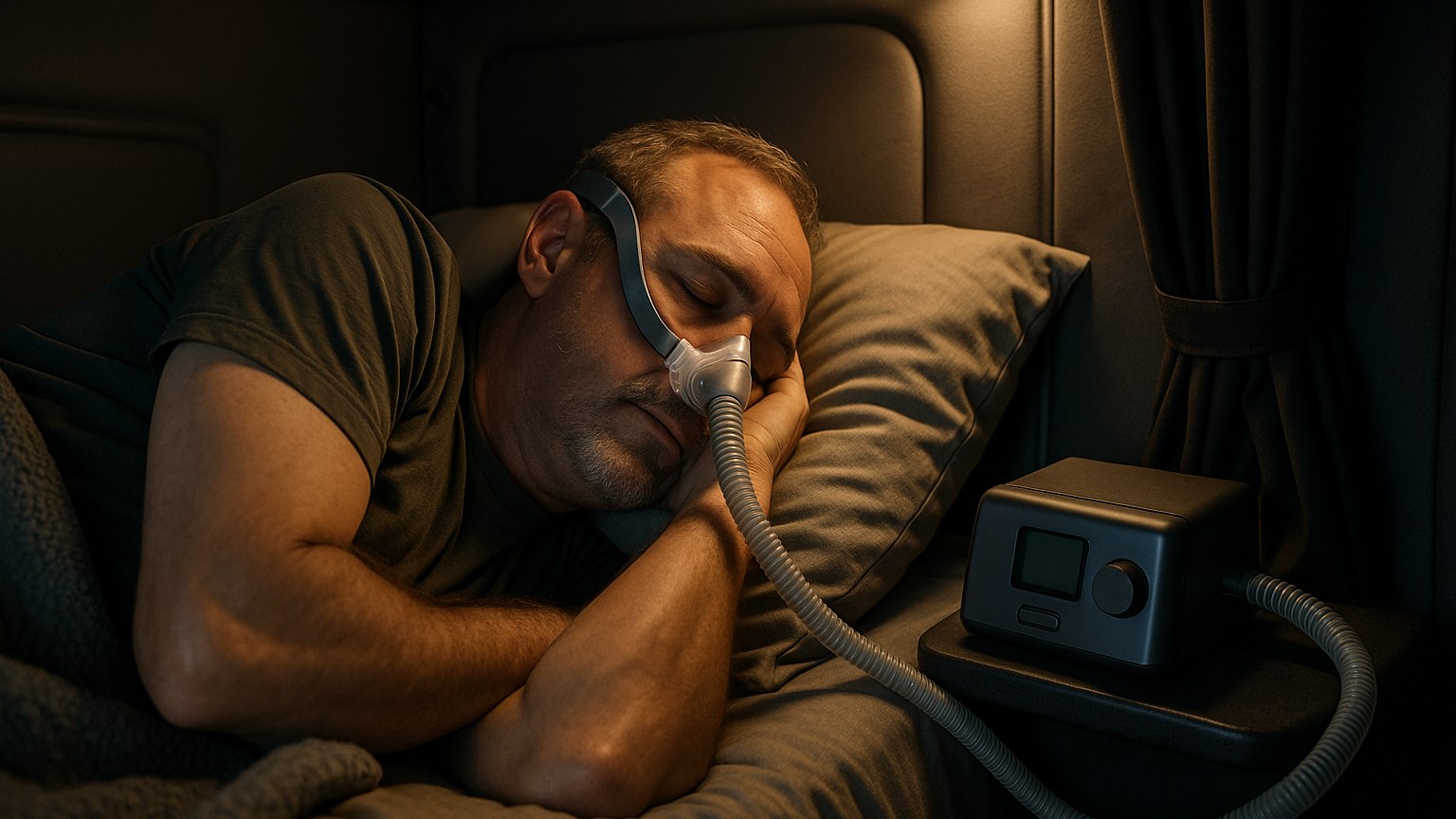
😴 Sleep Apnea and the DOT Physical: The Truck Driver's No-Panic Guide
Ask ten drivers what scares them most about the medical exam and eight will say the same two words: sleep apnea. The stories travel fast — somebody's buddy walked into a clinic with a valid card and walked out with a 90-day paper and a bill for a sleep study. Most of those stories are half true, and the half that's missing is the part that would let you sleep at night. Here's how sleep apnea and the DOT physical actually work — what triggers a referral, what the 90-day certificate really means, and why a diagnosis almost never ends a driving career. 🚛
🏛️ Is there an official FMCSA sleep apnea rule?
No — and that surprises a lot of drivers. FMCSA and the Federal Railroad Administration published an advance notice of proposed rulemaking on obstructive sleep apnea (OSA) in March 2016, collected comments, and then formally withdrew the rulemaking in August 2017, saying the agencies did not have enough data to justify a rule. As of September 2026, nothing has replaced it: there is no federal regulation that says "BMI over X means a mandatory sleep study" or "apnea means disqualification."
What exists instead is the general standard from the medical certification rules: a driver must have no condition likely to interfere with the ability to control and drive a commercial vehicle safely. Untreated moderate-to-severe OSA — a condition where your airway collapses during sleep, cutting off breathing dozens of times an hour and wrecking the quality of your rest — can clearly interfere with alertness. So the certified medical examiner makes a judgment call at your DOT physical: certify you as-is, certify you for a shorter period, or ask for a sleep evaluation before going further.
Two practical consequences follow from "no rule, examiner's judgment":
- Criteria differ between examiners. One clinic screens hard at BMI 33 with other risk factors; another only flags drivers who report symptoms. Neither is breaking the rules, because the rule that would standardize this was never issued.
- The examiner's decision is about function, not labels. A driver with diagnosed apnea who treats it and shows the data is routinely certified. A driver who refuses evaluation when the examiner has documented concerns usually is not.
🚩 What makes an examiner send you for a sleep study?
Since there's no federal checklist, examiners lean on common medical guidance and their own protocols. The usual flags — and again, thresholds vary from examiner to examiner — look like this:
| Flag | Commonly cited threshold | Why it matters |
|---|---|---|
| BMI | Around 33–40+; many examiners treat 40+ as a referral on its own, 33+ as a flag when combined with other factors | Extra weight around the airway is the single strongest predictor of OSA |
| Neck circumference | Often quoted as over 17 inches for men, over 16 for women | A thick neck narrows the airway that collapses during sleep |
| Blood pressure | Hypertension, especially hard-to-control or on multiple medications | Untreated apnea and high blood pressure feed each other |
| Daytime sleepiness | Dozing at lights or on breaks; a high score on the Epworth Sleepiness Scale questionnaire | Sleepiness behind the wheel is the exact risk the exam exists to catch |
| Snoring and witnessed apneas | Loud snoring plus a partner reporting you stop breathing or gasp at night | The classic textbook picture of OSA |
| History | A prior OSA diagnosis, a fatigue-related crash, morning headaches, type 2 diabetes | Raises the pre-test probability enough that examiners want data |
One flag alone — say, BMI 34 with normal blood pressure, no symptoms and no snoring — often results in nothing more than a conversation. Several flags stacked together are what typically triggers a referral. The honest way to think about it: the examiner isn't hunting for a reason to park you; they're signing a federal form that says you're safe to share the road with, and untreated OSA is one of the few invisible conditions that genuinely isn't.
⏳ How does the 90-day conditional certificate actually work?
Here's the part the truck-stop horror stories always leave out: a sleep-study referral is almost never a denial. The standard move is a short-term certificate — commonly 90 days, sometimes less — that keeps you legally driving and earning while you get evaluated. The typical sequence:
- The examiner issues a conditional certificate and documents what they need: a sleep evaluation, and treatment if the test is positive.
- You schedule the sleep test fast. Ninety days sounds like plenty; between dispatch, home time and clinic scheduling it isn't. Book it the same week.
- You do the test — most drivers qualify for a home test (next section) and can even run it in the sleeper or during home time.
- Negative result? You bring the report back and typically get your normal certificate. Done.
- Positive result? You start treatment — usually a CPAP machine — and generate compliance data. Many examiners will extend certification in steps (for example another short card once treatment starts, then longer once the data shows consistent use).
- With documented, effective treatment, drivers commonly return to an ordinary one-year certificate, renewed annually with a fresh compliance report.
The drivers who lose in this process are almost always the ones who stall: they sit on the referral for ten weeks, can't get a test appointment in time, and let the conditional certificate expire. That's not the apnea taking your card — that's the calendar.
🛏️ Home sleep test or lab polysomnography — what's the difference?
Two ways to get the answer, and the price gap is enormous:
| Home sleep apnea test (HSAT) | In-lab polysomnography (PSG) | |
|---|---|---|
| Where | Your own bed — or your sleeper berth. A small kit: finger sensor, chest belt, nasal cannula | A sleep center, overnight, wired to a full sensor array with a technologist watching |
| Typical cash cost | Often in the low hundreds of dollars without insurance | Commonly quoted in the low thousands of dollars without insurance |
| What it measures | Breathing, oxygen, effort — enough to diagnose most obstructive apnea | Everything, including brain waves and sleep stages; catches subtler cases |
| Good for a trucker because | No extra night off the road, ships to you, results in days | The gold standard when a home test is negative but symptoms persist, or other sleep disorders are suspected |
For a working OTR driver the home test is usually the sensible first step, and most examiners accept it. Ask two questions before you book anything: "Will my examiner accept this specific test?" and "What does my insurance actually cover?" — the answers vary, and a five-minute phone call beats an argument later. If you're budgeting the year, a sleep test belongs on the same list as tires-for-the-house and everything else in our breakdown of real road expenses: not fun, but cheaper than losing weeks of settlements to an expired card.
💨 Diagnosed with sleep apnea — is your CDL career over?
No. This is the single most important sentence in this article: a sleep apnea diagnosis, treated, is fully compatible with a long driving career. Plenty of drivers you passed today are running a CPAP in the bunk every night and holding ordinary one-year cards.
CPAP and the compliance numbers
The standard treatment is CPAP — continuous positive airway pressure, a quiet pump and a mask that keeps your airway open with gentle air pressure. Modern machines record every hour of use on a chip and upload it to the cloud, and that data is your friend: the widely used compliance benchmark — you'll hear it called the "70/4 rule" — is at least 4 hours of use per night on roughly 70% of nights, usually measured over a 30- to 90-day window. That's not a federal regulation; it's the requirement most examiners and carriers apply in practice, borrowed from insurance and clinical standards. Meet it, bring the report, and recertification is normally routine.
If CPAP isn't your answer
- APAP / BiPAP — auto-adjusting or bilevel machines for drivers who can't tolerate fixed pressure; same compliance data, same acceptance.
- Oral appliances — dentist-fitted mouthpieces for some mild-to-moderate cases; check what documentation your examiner wants, since there's no usage chip.
- Weight loss — the one fix that attacks the cause. Real drivers have dropped enough weight to retest below the diagnostic threshold. Slow, but it also improves the blood pressure and diabetes numbers on the same exam — more on that in our driver health guide.
- Surgery or positional therapy — options in specific cases; a sleep physician's territory, not a forum's.
Living with a CPAP in the truck
The practical side is easier than it used to be. Most machines run happily on 12V with the right cable or a small inverter; on a 34-hour reset, plan power the way you plan parking. Carry distilled water for the humidifier — a gallon jug rides fine behind the seat, and in a pinch you can run most machines dry for a night. Rinse the mask and hose on a schedule like any other piece of equipment. And here's the underrated part: drivers who stick with treatment usually report they feel the difference in two or three weeks — real sleep in the bunk, no more fighting your eyelids at 2 p.m. That's not just comfort; alertness is the whole game in night driving.
⚠️ What happens if you just ignore it?
Short version: the problem doesn't stay ignored.
- Medically: untreated OSA means your body never gets real rest — research consistently links it to higher crash risk, plus hypertension, heart disease and worsening diabetes. Your 10-hour break stops doing its job, no matter how carefully you run your hours of service — legal rest and actual rest quietly stop being the same thing.
- Administratively: an examiner who documents OSA risk and gets no cooperation can decline to certify you. A referral you ignore doesn't disappear at the next exam — it's in your file, and the next examiner starts where the last one stopped.
- Legally: after a serious crash, a documented-but-untreated sleep disorder is exactly what plaintiff attorneys go looking for. That's a bad day for the driver and the carrier both.
Compare that with the treated path: one test, one machine, one annual report. It's the rare DOT problem with a genuinely clean solution.
🧠 Myths vs. reality
- "A big neck means automatic disqualification." False. There is no automatic anything — no rule exists. Flags lead to evaluation, not to a verdict.
- "The 90-day card means I basically failed." False. It's a bridge that keeps you driving while you get data. Failing is letting it expire.
- "I'll just keep it quiet." Doesn't work. BMI, neck and blood pressure are measured in the room, and lying on the form is a bigger problem than apnea.
- "CPAP means the company watches me sleep." The machine records usage hours and therapy quality for your medical certification — it's not a camera, and the point of the report is to get you a longer card, not a shorter leash.
- "Every examiner treats this the same." No — criteria genuinely differ. If you're between jobs or clinics, it's fair to ask up front how an examiner handles OSA screening.
❓ Frequently asked questions
Does FMCSA require a sleep apnea test for the DOT physical?
No. There is no federal sleep apnea rule as of September 2026 - the proposed rulemaking was withdrawn in 2017. Whether you're referred for a sleep study is the certified medical examiner's judgment, based on risk factors like BMI, neck size, blood pressure and reported sleepiness, and screening criteria differ between examiners.
Can I still drive while I complete a sleep study?
Usually yes. The typical outcome of a referral is a conditional certificate - commonly 90 days - that keeps you legally driving while you get tested and, if needed, start treatment. Schedule the test immediately: drivers lose their cards to expired conditional certificates far more often than to the apnea itself.
How much does a sleep study cost for a truck driver?
A home sleep apnea test (HSAT) typically runs in the low hundreds of dollars without insurance, while an in-lab polysomnography is commonly quoted in the low thousands. Most examiners accept a home test for straightforward cases, so confirm acceptance with your examiner and check your insurance before booking.
What CPAP compliance do examiners expect for recertification?
The benchmark most examiners and carriers use is at least 4 hours of use per night on about 70% of nights, measured over a recent 30- to 90-day window - often called the 70/4 rule. It's a common practice standard rather than a federal regulation. Modern machines log this automatically, and the printed or cloud report is what you bring to the exam.
Will a sleep apnea diagnosis end my CDL career?
No. Diagnosed and treated sleep apnea is routinely certified - many drivers run a CPAP in the sleeper every night and hold ordinary one-year medical cards. The careers that end are the ones where a driver ignores a documented referral or quits treatment; treated drivers usually just feel better and drive more alert.
🚛 Drive rested, get paid for every mile
ASTEL is a family-owned carrier out of Chicago running refrigerated freight year-round on late-model Volvo trucks, with our own repair shop and mechanics, 24/7 dispatch and a direct line to the owner. Drivers earn $90,000–$110,000 a year — $2,400–2,700+ a week gross, a flat $0.80 per mile for drivers with 1+ year of experience, all miles paid ZIP-to-ZIP, weekly pay, plus $50/$200/$500 bonuses for clean DOT inspections.
Apply in 2 minutes →Regulatory status reflects FMCSA's 2017 withdrawal of the obstructive sleep apnea rulemaking (Federal Register, Aug 8, 2017) and FMCSA medical certification guidance as of September 2026; screening thresholds, certificate lengths and compliance benchmarks describe common examiner and carrier practice, which varies and may change. Cost figures are typical published ranges, not quotes. This article is general information for drivers, not medical advice — diagnosis and treatment decisions belong to your medical examiner and your own physician. Pay and mileage figures describe ASTEL driver ranges, not guarantees.