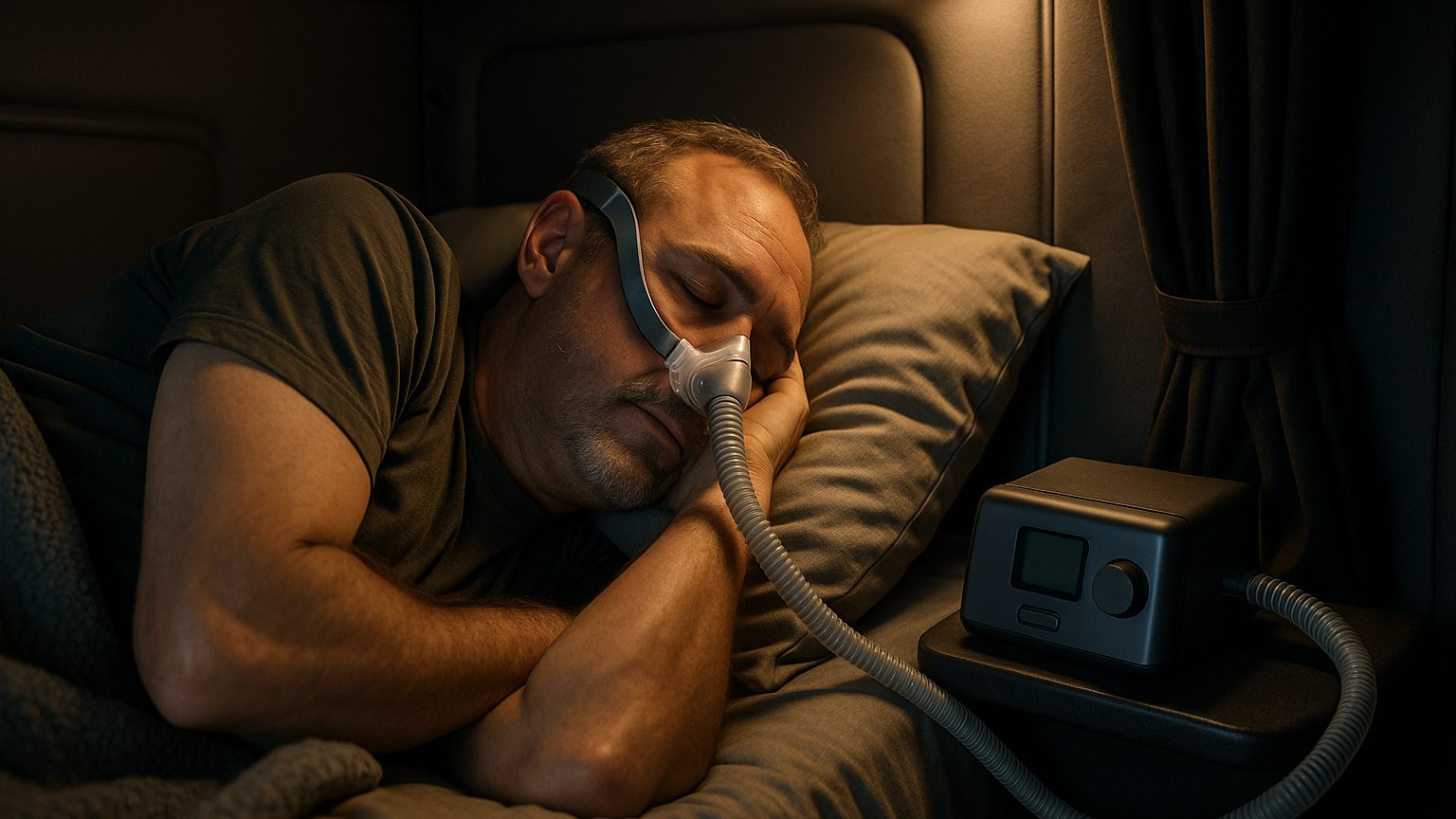



Sick on the Road With a Loaded Reefer and a Delivery Clock Running
Say you wake up in the sleeper at a truck stop on I-80 in Nebraska and the thermometer reads 101°F (38.3°C). There's a loaded reefer behind you and a delivery 30 hours out. Being sick on the road changes the order of the day. First you decide whether you can legally drive at all, then you call dispatch, and only after that do you worry about the appointment. If the fever has you foggy or shaky, federal rule 49 CFR 392.3 makes the first decision for you.
Seven moves for the first hour
- Stay parked, or leave the highway at the next safe exit. Rule 392.3 covers starting a trip and continuing one.
- Message or call dispatch now. Send your location, your symptoms, the hours left on your clock and the reefer reading.
- Put the ELD in the right status: sleeper berth while you rest in the bunk, off duty for other rest.
- Pick the level of care. Telehealth or urgent care handles flu-type symptoms; emergency signs mean 911.
- Plan the trip to the clinic before you start the engine.
- Read the label before you take anything. "May cause drowsiness" is a driving decision.
- Agree on the load plan with dispatch, then go back to bed.
Rule 392.3 puts the call on you and on the carrier
The rule is two sentences long. The first says no driver may operate a CMV while illness, fatigue or any other cause has impaired their ability or alertness so much that it's unsafe to begin or continue driving. The same sentence covers a driver who is only likely to become impaired. A fever that feels manageable at 6 a.m. and keeps climbing by noon fits the rule before you feel truly bad.
The second sentence is the exception, and it's narrow. In a grave emergency, where stopping would put people in the truck or on the highway in more danger, you may keep driving to the nearest place where that hazard is gone. A late load isn't a grave emergency. A dizzy spell on a two-lane road with no shoulder might justify rolling to the next wide spot. Not the next 400 miles.
The rule binds the carrier too, which "shall not require or permit" a sick driver to drive. Under 49 CFR 390.6, carriers and brokers, as well as shippers and receivers, may not coerce a driver into breaking the safety rules, and 49 CFR 386.12(c) gives the driver 90 days to file a written complaint with FMCSA. Most sick days never get near a complaint.
Your ELD keeps counting while you're in bed
Being sick doesn't pause the HOS clocks. Under 49 CFR 395.8 there are four duty statuses: off duty, sleeper berth, driving and on duty not driving. Resting in the bunk is sleeper berth time. Lying across the seat of a parked truck, or sitting in a clinic waiting room after dispatch has released you, is off duty.
The 14-hour window is the one that catches sick drivers. It runs in consecutive hours from the moment you come on duty, under 395.3(a)(2). Start at 6 a.m., lie down at 9 feeling awful, and it still closes at 8 p.m. Only 10 consecutive hours off duty, in the sleeper or a mix of both, starts a new one. The exception is a split under 395.1(g): a sleeper period of at least 7 hours paired with another break of at least 2, and those qualifying breaks don't count against the 14 hours.
| What you're doing | What to log | Effect on your clocks |
|---|---|---|
| Sleeping it off in the bunk | Sleeper berth | Counts toward the 10-hour reset; 7 hours or more can start a split |
| Resting in the cab or a motel after dispatch releases you | Off duty | Counts toward the 10-hour reset and a 34-hour restart |
| Waiting at urgent care, relieved from work | Off duty | Same as resting |
| Driving the truck to a clinic | Driving, or personal conveyance if the carrier allows it | Driving uses your 11 hours; 392.3 applies either way |
| Pre-trip inspection or fueling | On duty not driving | Uses the 14-hour window and the 60/70 cycle |
A long sick spell can even help one clock. The cycle limit is 60 hours on duty in 7 days or 70 hours in 8 days, and 34 or more consecutive hours off duty restarts it under 395.3(c). A driver who spends a day and a half off duty with a fever can come back to a fresh 60 or 70. The math is in our guide to hours of service rules.
Flu goes to urgent care and a stroke goes to 911
CDC lists the flu picture as fever or chills, cough, sore throat, a runny nose, body aches and headaches. Fatigue is on the list too. Not everyone with flu runs a fever, and CDC says most people who get flu recover in a few days to less than two weeks.
Telehealth suits a sick driver because you can do the visit from the bunk. One catch matters for a CDL holder. The rule on controlled prescriptions, covered below, turns on a prescriber who knows your medical history. A doctor on a 10-minute video call knows only what you say, so start with the fact that you drive a commercial truck and list everything you already take.
Some symptoms skip urgent care entirely. CDC's emergency warning signs for flu in adults include trouble breathing, persistent pain or pressure in the chest, persistent dizziness or confusion, seizures, and a fever or cough that improves and then comes back worse. For a stroke, CDC uses the BE FAST check: balance loss, eyesight changes, a drooping face, arm weakness, slurred speech, and time to call 911. Heart attack signs include chest pain, pain in one or both arms, shortness of breath, and feeling weak or faint.
CDC says flu warning signs need medical care right away and stroke or heart attack signs mean 911. Alone in a parked truck, 911 from the cab is how you get that care, so give the mile marker or the exit. CDC asks you to note when stroke symptoms started, because doctors use that time to pick a treatment. Don't drive the truck to the ER. That's exactly the driving 392.3 rules out.
A clinic lot won't take a tractor and a 53-foot trailer
A tractor pulling a 53-foot reefer doesn't fit a lot striped for cars. The cleanest fix is to leave the truck where it's parked and take a rideshare or a cab. Where you can leave the rig for a few hours is covered in our truck parking guide.
Bobtailing is the second option, and it has a cost. A dropped reefer sits unattended with someone else's freight on board and the unit burning its own fuel, so it's a call for dispatch, and some customers won't accept it.
Personal conveyance is the third option, and it's narrower than it sounds. FMCSA's 2018 guidance (83 FR 26377) lets you log a move as off duty only when the carrier has relieved you from work and all responsibility for performing work, and it allows PC with a loaded trailer. Its examples include driving from a truck stop to restaurants. Medical visits aren't on that list, and while it's "not limited to" those uses, that doesn't make a clinic run PC on your own say-so. Carriers can ban PC or cap the distance, so ask dispatch first. The limits are laid out in personal conveyance rules.
The same guidance says personal conveyance does not reduce a driver's responsibility to operate a CMV safely. PC changes the line on your log. It doesn't change 392.3. If you're too foggy to drive for a paycheck, you're too foggy to drive to the pharmacy.
Read the label before the cold medicine goes down
FDA sets the warning text for over-the-counter antihistamines in 21 CFR 341.72. Products with diphenhydramine or doxylamine must say "May cause marked drowsiness," products with chlorpheniramine "May cause drowsiness," and both versions add "Use caution when driving a motor vehicle." Nighttime cold products often contain one of these antihistamines. Which product is safe for you is a question for the pharmacist at the counter or the doctor on the telehealth call, not for dispatch.
The driver rule doesn't stop at prescriptions. 49 CFR 392.4(a)(4) bars you from being on duty under the influence of any substance to a degree that makes you unable to drive safely. A drowsy pill from the truck stop shelf counts. If the label warns about drowsiness, ask the pharmacist how long the effect lasts and don't plan a shift inside that time.
Controlled prescriptions have their own rule. Under 382.213(b), a cough syrup with codeine or a hydrocodone painkiller is allowed only when the prescriber knows your history and has told you it won't affect your driving. Keep the pharmacy label.
If a random test comes back positive for hydrocodone, 49 CFR 40.137 says the medical review officer must give you a chance to show a legitimate medical explanation, and a valid prescription can turn the result negative. The burden of proof is yours. A negative result isn't always the end of it. Under 49 CFR 40.327 the MRO must tell your employer if the medicine is likely to make you medically unqualified or to pose a significant safety risk. More on the process is in our DOT drug test guide.
The loaded reefer still needs you, even from the bunk
The reefer doesn't care that you're sick. It keeps running on its own tank, and the receiver will still check product temperature at the door. ASTEL drivers check load temperature and the unit 2–3 times a day, and the load needs those checks whether you feel fine or not. If you can't do them, say so to dispatch. Look at the setpoint and the return-air reading when you wake up, check reefer fuel and send dispatch a photo of the display. The readings are explained in how to run a reefer unit.
The load plan belongs to you and dispatch together. The usual choices are a later appointment, a relay to another driver or holding the load while you recover. Which one works depends on the customer and the freight, and nobody can promise one in advance. Your part is calling early. A call at 6 a.m. gives dispatch a full business day to reach the receiver, and by 10 p.m. that day is gone. The dispatch side is described in how truck dispatch works.
At ASTEL, dispatch is on the line 24/7, and you have a direct line to the owner, who is always at the yard. A 3 a.m. fever gets a live person on the phone. What happens next still depends on the load and the customer.
You drive again when you're alert, and sometimes after a new physical
No federal rule sets a number of fever-free hours before you drive. The test is still 392.3. Fever reducers make that harder to judge, because they can hide a fever that's still there.
CDC's guidance on respiratory viruses gives a yardstick for going back around people: at least 24 hours with symptoms improving overall and no fever without fever-reducing medicine, then 5 days of extra precautions. That counts at a dock where you hand the BOL to a receiver or work next to a lumper.
A serious illness brings in the medical card. Under 49 CFR 391.45(g), a driver whose ability to perform normal duties has been impaired by an injury or disease must be examined and certified again. FMCSA guidance on 391.45, issued in 1997 and still posted, says the exam isn't required unless the illness impaired your ability to do your normal duties. The same answer lets a carrier require one after any illness and makes the carrier decide whether an illness left you medically unqualified. After a hospital stay or a heart problem, talk to your carrier before you take a load. What the exam checks is in our guide to DOT physical exam requirements.
Flu season overlaps the busiest reefer months
CDC says US flu season usually runs through fall and winter, and activity most often peaks between December and February. That sits in the middle of the reefer peak, and at ASTEL August through March means 3,500–3,700 miles a week. A week in the bunk hurts most when the freight is there.
CDC's interim guidance for the 2026–27 season, dated September 1, 2026, says vaccination should ideally be offered in September or October and should continue after October through the season. Mid-October is still inside that window. CDC's flu vaccine fact page adds that antibodies take about two weeks to develop after the shot.
On a 4+1 schedule the home week is where routine doctor visits fit, because ASTEL drivers agree on home dates with dispatch in advance. Book the checkup, the refills and the flu shot for that week.
A small sick kit saves a 2 a.m. walk across a truck stop. Pack a digital thermometer, electrolyte packets and a written list of your medications with doses, because every clinic and telehealth doctor will ask for it. Any over-the-counter medicine you keep in the truck is better picked at home with a pharmacist than grabbed half-asleep off the shelf. The full list is in what to pack for OTR, and the habits that keep drivers out of urgent care are in truck driver health.
Frequently asked questions
Can my trucking company make me drive when I'm sick?
No. Under 49 CFR 392.3 a motor carrier may not require or permit you to drive while illness or fatigue makes it unsafe to begin or continue. 49 CFR 390.6 also bars coercing a driver to break the safety rules, and a coercion complaint goes to FMCSA in writing within 90 days.
How do I log a sick day on my ELD?
Log rest in the bunk as sleeper berth, and other rest or clinic time as off duty once you're relieved from work. The 14-hour window keeps running until you get 10 consecutive hours off duty or in the sleeper. A pre-trip inspection or fueling stays on duty not driving.
Is it legal to drive a truck after taking nighttime cold medicine?
Only if it doesn't impair you, and a drowsiness warning on the box is a red flag. Under 21 CFR 341.72, products with the antihistamines diphenhydramine or doxylamine must carry an FDA warning about marked drowsiness and a caution about driving. Under 49 CFR 392.4 you can't be on duty under the influence of any substance that makes you unable to drive safely. Ask a pharmacist or doctor before you take anything you'll drive on.
Do I need a new DOT physical after being sick?
The federal rules require one only if the illness impaired your ability to do your normal duties, under 49 CFR 391.45(g) and FMCSA guidance. Your carrier can still require an exam after any illness, and it has to decide whether an illness left you medically unqualified. After a hospital stay or a serious heart or lung problem, ask your carrier before you take a load.
Can I use personal conveyance to drive to urgent care?
Not on your own call. FMCSA's 2018 guidance doesn't list medical visits among its examples, though the list isn't closed, and you must be relieved from work first. Your carrier can ban or limit personal conveyance, so ask dispatch. If you're too sick to drive safely, PC doesn't help, because 392.3 still applies.
Dispatch on the line 24/7, including the 3 a.m. call with a fever
ASTEL is a family-owned carrier out of Chicago running refrigerated freight year-round on late-model Volvo trucks, with our own repair shop and mechanics, 24/7 dispatch and a direct line to the owner. Drivers earn $90,000–$110,000 a year — $2,400–2,700+ a week gross, a flat $0.80 per mile for drivers with 1+ year of experience, all miles paid ZIP-to-ZIP, weekly pay, plus $50/$200/$500 bonuses for clean DOT inspections.
Apply in 2 minutes →Sources: 49 CFR 392.3, ill or fatigued operator; 49 CFR 390.6 and 386.12(c), coercion and complaints; 49 CFR 395.1(g), 395.2, 395.3 and 395.8, hours of service; FMCSA regulatory guidance on personal conveyance, 83 FR 26377 (June 7, 2018); 49 CFR 392.4 and 382.213, drugs and controlled substances; 49 CFR 40.137 and 40.327, MRO verification and safety concerns; 49 CFR 391.45(g) and FMCSA guidance Q&A 3 on 391.45 (April 4, 1997), re-examination after illness or injury; 21 CFR 341.72, antihistamine labeling; CDC pages on flu symptoms, flu season, stroke and heart attack signs; CDC interim clinical considerations for 2026–27 influenza vaccines (September 1, 2026); CDC key facts about seasonal flu vaccine (updated September 1, 2026); CDC guidance on preventing the spread of respiratory viruses (2025). Current as of October 2026; federal rules and CDC guidance may change. Dispatch and schedule details describe ASTEL driver terms. General information, not legal or medical advice.