


Truck Driver Pay Increases in 2026 and How to Judge the New Offers
On September 7, 2026, Anderson Trucking Service moved its regional company van drivers from 60 to 70 cents a mile. That 16.7% truck driver pay increase is one of the largest in the St. Cloud, Minnesota, carrier's history, and it landed in a month full of raises. Crete Carrier and Shaffer Trucking added 4 cents a mile for national OTR drivers on August 1. Nussbaum's second raise of the year, reported September 23, went to stop pay and the weekly minimum rather than cents per mile, while Roehl's second one starts October 4. What any of it is worth to you depends on how many of your miles the new rate actually pays.
Six fleets announced raises between May and September 2026
These are the raises the trade press reported from May through September 2026. Each one covers a specific fleet or division, so check which drivers it applies to before you quote it to a recruiter.
| Carrier | What changed | Effective or announced | Who it covers | Reported by |
|---|---|---|---|---|
| Anderson Trucking Service (St. Cloud, MN) | 60 to 70 cents a mile (+16.7%), up to 72 cents by years of service; ATS says the rate applies to loaded and empty miles | September 7, 2026 | About 50 regional company van drivers, plus new hires | ATS release of September 8; Trucking Dive, September 11 |
| Crete Carrier and Shaffer Trucking | +4 cents a mile, the second raise of 2026; 21-day OTR drivers are up 7 cents this year; new national OTR drivers start at 68–73 cents | August 1, 2026 | National OTR company drivers | Crete Carrier; Truckers News |
| Crete Carrier and Shaffer Trucking | +3 cents for 21-day OTR, +2 cents for 12-day OTR, +1 cent for most regional and dedicated drivers | May 30, 2026 | Crete and Shaffer company drivers, by fleet | Crete Carrier, May 11 |
| Melton Truck Lines (Tulsa, OK) | +5–8 cents a mile; the new scale runs from 60 cents at entry level to 70 cents for the most experienced | Announced May 29, 2026 | All company drivers of this flatbed carrier | Transport Topics, June 2; Truckers News |
| Nussbaum Transportation (Hudson, IL) | +3 cents for current drivers, +5 cents on starting rates, +10 cents for new hires in key hiring areas; new quarterly profit sharing | Announced May 26, 2026 | OTR dry van drivers | CCJ; HDT |
| Nussbaum Transportation | Activity pay from $20 to $23 per pickup, delivery or stop-off; weekly minimum pay up $50; trainer pay from $500 to $750 a week | Reported September 23, 2026 | OTR and Regional Van drivers; trainers | HDT, September 23 |
| Roehl Transport | +2–3 cents a mile plus higher stop and activity pay, 7–11% in total by experience and fleet; follows an early-June raise of 2–4 cents | October 4, 2026 | Most company drivers in five divisions, refrigerated and flatbed among them | Trucking Dive, September 22 |
Read the table closely and the 10-cent headlines shrink. Drivers already on the payroll mostly got 2–5 cents a mile. The 10-cent jumps went to narrow groups: about 50 ATS regional van drivers and Nussbaum new hires in a handful of hiring markets. For the wider picture, Transport Topics reported on August 14, 2026, that Conversion Interactive Agency's Q2 2026 driver recruiting and retention report found 26% of carriers had already raised driver pay this year.
Trucks are leaving the market, so carriers pay to keep drivers
The pressure comes from supply more than from freight. In its August 26 report, DAT said the market was tightening because trucks and drivers were exiting for good, while tonnage stayed flat. Spot rates show it. In its September 21 report, DAT put the dry van linehaul rate at $2.17 a mile for the previous week, 32.8% above a year earlier and 19.7% above the nine-year seasonal average.
Part of the squeeze runs through bankruptcy court. FreightWaves counted at least 16 trucking and transportation companies that filed between late August and September 21, 2026, among them Globemaster of Bolingbrook, Illinois, and Xoco Transport of Hidalgo, Texas, a fleet with 65 drivers. Both filed Chapter 11, which lets a carrier keep running while it reorganizes, so not every filing parks trucks overnight. Tighter federal enforcement of driver qualification rules since 2025 has also taken some drivers out of the pool. Fleets that still have freight need the seats filled. A raise is the fastest lever they have.
Not everyone reads the raises as a shortage. Josh Lovan of J.J. Keller told Transport Topics in August that pay increases at large carriers look more like positioning for the next phase of the freight cycle. That matters to you, because raises tied to a cycle can stall when the cycle turns. Demand is starting to help: DAT's September 21 report noted that Cass shipments had turned positive, ending the longest freight downturn on record.
Diesel pulls the other way. EIA's national average hit a record $6.53 a gallon for the week of September 21, 2026, and was still $6.38 on September 28. Fuel bills that high squeeze a fleet's margin and leave less room for the next raise. As a company driver you don't buy the fuel, while owner-operators feel every cent of it, as our diesel price breakdown shows.
One cent a mile adds up to about $1,200 a year
Raises are quoted in cents, and cents look small until you multiply them. The table assumes 2,500 paid miles a week and 48 working weeks, before taxes.
| Raise per mile | Per week at 2,500 paid miles | Per year at 48 weeks |
|---|---|---|
| 1 cent | $25 | $1,200 |
| 3 cents | $75 | $3,600 |
| 4 cents | $100 | $4,800 |
| 10 cents | $250 | $12,000 |
Run 2,000 paid miles a week and every figure drops by a fifth. Run 3,000 and it grows by a fifth. That's why the miles line of an offer deserves as much attention as the rate. A 10-cent raise on a regional job with 1,800 paid miles is worth $180 a week, and 4 cents on 3,000 OTR miles brings $120: two and a half times the cents, only one and a half times the money.
The rate in the ad is rarely the rate on your settlement
Job ads lead with the best number on the pay scale. ATS's base is now 70 cents. The 72 comes with years of service. Crete quotes new national OTR drivers a range of 68–73 cents. Melton's scale starts at 60 cents and reaches 70 only for its most experienced drivers. When an ad says "up to," read it as the top of a ladder and ask where you would stand on the first rung.
Get these answers in writing before you compare anything.
- Your starting cents per mile at your exact months of experience.
- What triggers the next step up: time, a clean safety record, or miles.
- Whether the rate covers every mile you drive or only loaded ones.
- Which mileage system sets your pay: HHG, practical, or ZIP-to-ZIP.
- Which deductions come out of every settlement.
More questions that separate a real offer from a sales pitch are in our list of questions to ask a trucking recruiter.
Paid miles decide the size of the check
Three mileage systems cover most company pay. Household Goods (HHG) miles are the shortest distances between points, so they pay the fewest miles. Practical miles follow the roads a truck would actually use. ZIP-to-ZIP measures from the exact pickup ZIP code to the exact delivery ZIP code instead of from city to city. Almost nobody pays by the odometer, because detours and fuel stops would add miles the carrier never bills. Our guide to practical vs. household miles has the details.
The gap is real money. Take an illustrative 5% gap between HHG miles and the miles you drive. On 2,600 miles that's 130 unpaid miles, or $91 a week at 70 cents. A 3-cent raise on the 2,470 miles that do get paid brings about $74, so in this case the raise doesn't even cover what the mileage system takes.
Unpaid deadhead quietly cuts the rate
Empty miles to the next pickup are the other leak. ATS made a point of saying its new rate applies to loaded and empty miles, and that line deserves as much attention as the 10 cents. If deadhead is unpaid and 10% of your miles run empty, a 70-cent rate works out to 63 cents across every mile you drive. Ask what share of miles ran empty for drivers in the fleet last quarter.
Deductions and slow months eat raises
A raise can also vanish inside the settlement. If the weekly health insurance deduction grows by $50, that takes back 2 cents a mile on 2,500 paid miles. Nobody sends out a press release about that. Compare two settlements from the same month rather than two offer sheets, and check each line with our guide on how to read a trucking settlement.
Miles change with the season, too, and drivers notice that more than the rate. The same Q2 2026 Conversion Interactive report, as The Trucker wrote on July 31, found that nearly 60% of pay-related concerns stemmed from inconsistent miles. A raise quoted in a fleet's best month says little about its worst, so ask what drivers averaged in April and in October.
Two offers compared on the same 2,600-mile week
Here is how two made-up offers compare. Both drivers cover 2,600 miles, and 260 of them are empty. Offer A has the higher rate and the louder ad. Offer B pays less per mile but counts more of the miles.
| Line | Offer A | Offer B |
|---|---|---|
| Rate | 70 cents, loaded miles only | 66 cents, all miles |
| Mileage system | HHG, 5% below miles driven | ZIP-to-ZIP, 2% below miles driven |
| Paid miles | 2,223 | 2,548 |
| Weekly gross | $1,556 | $1,682 |
| Pay per mile actually driven | 59.8 cents | 64.7 cents |
| Over 48 weeks | $74,688 | $80,736 |
Offer A advertises 4 cents more. It pays about $6,000 less over 48 weeks. The figures are an illustration on stated assumptions, not real carriers. Swap in your own numbers from actual settlements and the method still works.
A raise is worth a move only when the math holds
A raise at another fleet is a reason to make a phone call. It becomes a reason to move when these hold.
- The new offer pays more per mile driven, and you have seen a current driver's settlement that proves it.
- Home time is written into the offer and fits your life.
- The freight suits you. Reefer means temperature checks and night receiving; flatbed means tarps and securement.
- Your carrier hasn't moved pay in 2026 while the fleets around it have raised twice.
Staying makes sense when you're a few weeks from a step raise or a one-year mark that changes your rate, when your miles are steady, or when the other offer wins only on its top rate. Every move has a cost: an orientation week, a gap between paychecks, fresh MVR and PSP pulls. If the numbers still say go, our checklist on how to switch trucking companies keeps that gap short. Still deciding on the career as a whole? Our look at whether truck driving is worth it in 2026 is the place to start.
Reefer freight pays carriers more, and it asks more of drivers
DAT's national reefer spot rate averaged $2.73 a mile in its September 23 report, 37.9% above a year earlier, while dry van sat at $2.17. Both exclude fuel. Both are what shippers pay carriers, not what drivers earn. Reefer work also asks more of the driver: pre-cooling the trailer, checking product temperature, and waiting on night receiving at grocery DCs. Our reefer vs. dry van comparison lays out the trade-offs for pay and for daily routine.
ASTEL pays every mile ZIP-to-ZIP, loaded or empty
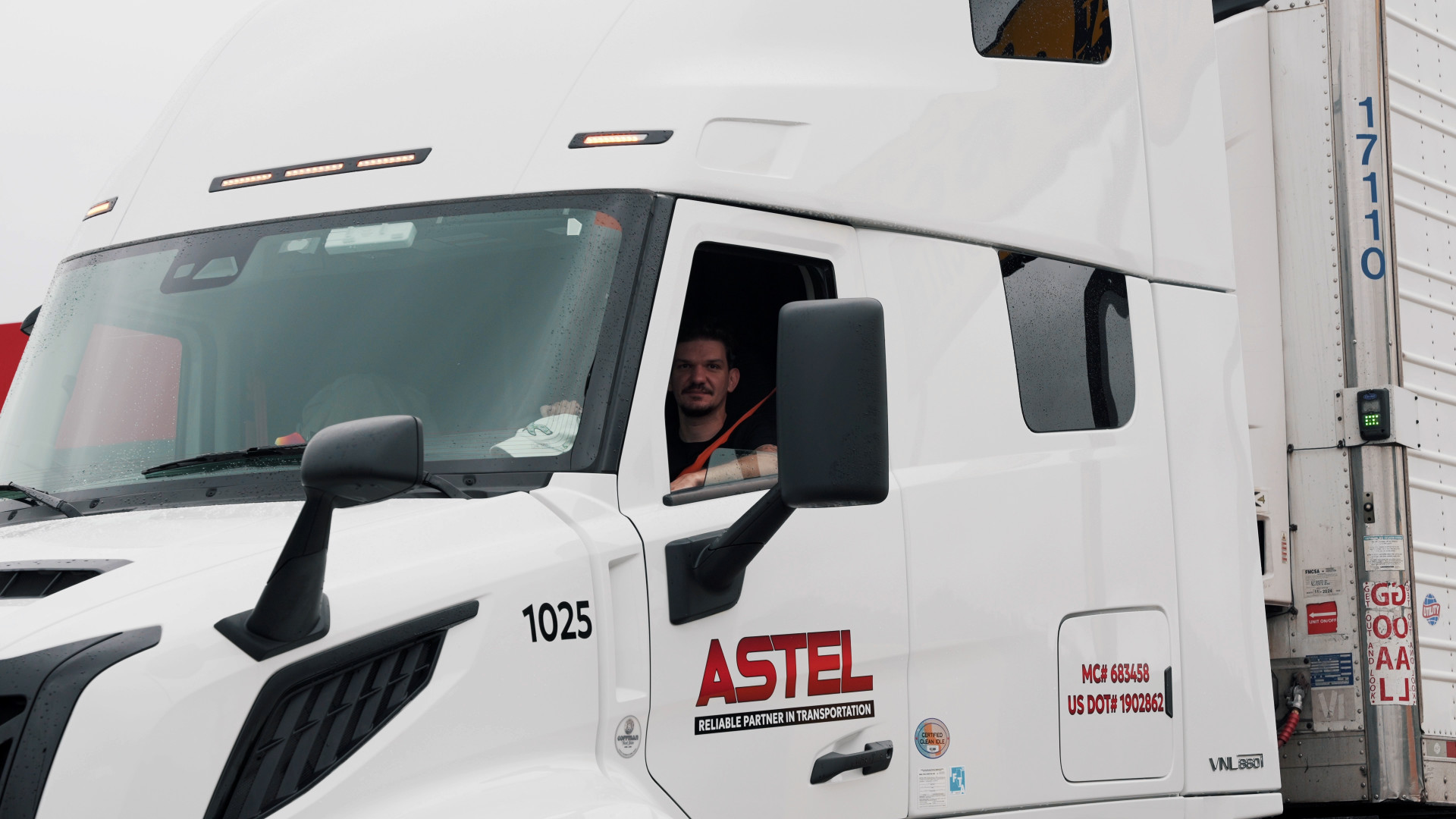
ASTEL runs refrigerated freight year-round out of a Chicago yard. Drivers with 1+ year of experience get a flat $0.80 per mile. There are two raises in the first year, and top drivers earn 90 cents a mile.
Every mile is counted ZIP-to-ZIP by PC*Miler, which runs within about 5% of the odometer, and all miles are paid, empty miles to the next pickup included. Pay goes out weekly. Request it before noon and the money arrives the same day; a Friday evening request lands on Monday.
The miles are seasonal. In the August–March peak, drivers run 3,500–3,700 miles a week. April through July is slower, with short runs and extra stops, and the company pays extra for short miles to drivers who meet its expectations, starting with 600–700 miles a day over 11 hours of driving. The schedule is 4+1, about four weeks out and one week home, with dates agreed with dispatch in advance. It's reefer, so you check the load and the unit 2–3 times a day, and no rate makes up for a routine that doesn't suit you.
The full terms are on our for drivers page, and our guide to truck driver pay explains how per-mile pay is built across the industry.
Frequently asked questions about truck driver pay increases
Is truck driver pay going up in 2026?
Yes. A Q2 2026 recruiting survey found that 26% of carriers had raised driver pay, and fleets such as Crete Carrier, Nussbaum and Roehl announced second raises this year. Most increases run 2–5 cents a mile for current drivers, with jumps of up to 10 cents for specific groups. Raises follow the freight market, so they can slow down if capacity returns.
How much is a 1 cent per mile raise over a year?
About $25 a week and $1,200 a year at 2,500 paid miles a week over 48 working weeks, before taxes. At 3,000 paid miles a week it comes to about $1,440 a year. The paid miles matter as much as the cents, so check how your carrier counts them.
Why is my actual pay per mile lower than the rate in the job ad?
Ads often quote a top rate that comes with years of service, and the rate may apply only to loaded miles counted by the shortest HHG route. Unpaid deadhead and settlement deductions pull the real rate lower still. Divide your gross pay by the miles you actually drove to see what you earn per mile.
Should I switch trucking companies for a pay raise?
Switch when the new offer pays more on the miles you drive, backed by real settlements, with home time and freight that suit you. Stay if you are close to a scheduled raise at your carrier or the other offer wins only on its advertised top rate. Every move costs an orientation week and a gap between paychecks.
A raise counts only on the miles that get paid
ASTEL is a family-owned carrier out of Chicago running refrigerated freight year-round on late-model Volvo trucks, with our own repair shop and mechanics, 24/7 dispatch and a direct line to the owner. Drivers earn $90,000–$110,000 a year — $2,400–2,700+ a week gross, a flat $0.80 per mile for drivers with 1+ year of experience, all miles paid ZIP-to-ZIP, weekly pay, plus $50/$200/$500 bonuses for clean DOT inspections.
Apply in 2 minutes →Sources: Anderson Trucking Service release of September 8, 2026, as reported by Trucking Dive (September 11, 2026) and Truckers News; Crete Carrier announcements of raises effective May 30 and August 1, 2026, and Truckers News; Transport Topics and Truckers News on Melton Truck Lines (June 2–3, 2026); Conversion Interactive Agency Q2 2026 Driver Recruiting and Retention report as covered by The Trucker (July 31, 2026) and Transport Topics (August 14, 2026, including comments by J.J. Keller); CCJ and HDT on Nussbaum Transportation (May and September 2026); Trucking Dive on Roehl Transport (September 22, 2026); DAT dry van and reefer reports of August 26, September 21 and September 23, 2026; FreightWaves count of trucking bankruptcies (September 2026); EIA weekly on-highway diesel prices for September 21 and 28, 2026. Current as of September 2026; carrier pay plans, market rates and fuel prices may change. Round-number examples are illustrations on stated assumptions, not typical pay. Pay and mileage figures describe ASTEL driver ranges, not guarantees. General information, not financial advice.