


Is Truck Driving Worth It in 2026? An Honest Answer From the Road
Is truck driving worth it? For three years the honest answer was "maybe, if you can ride out a bad market." As of September 2026 the picture has changed. The Cass Freight Index just posted its first year-over-year shipment gain since January 2023, ending a 42-month downturn, the longest on record, and spot truckload rates are running about a third above last year. Carriers are raising driver pay again. What hasn't changed is the job: weeks away from home, long hours alone and a hard first year. Here is the full ledger, so you can decide for yourself.
The 2026 freight market turned around
After the pandemic boom, trucking spent roughly three years in a freight recession: too many trucks, not enough freight, rates that barely covered costs, and raises for company drivers mostly stalled. In the summer of 2026 the numbers turned.
- Freight volume is growing again. Cass Freight Index shipments rose 2.1% year over year in August 2026, the first annual gain since January 2023. The Cass truckload linehaul rate index was up 11.3% over the same month a year earlier.
- Spot rates jumped. DAT's national dry van spot linehaul rate averaged $2.39 a mile in July 2026, 76 cents above July 2025; reefer averaged $2.75, up 79 cents. In DAT's September 21 report, van rates still ran 32.8% above the same week of 2025.
- Capacity is shrinking. DAT analysts wrote in late August that the tightening "owes almost entirely to capacity leaving, not to freight demand coming back." Truck postings on the DAT load board were down 28.4% year over year.
- Driver pay is moving. The Driver Pay Index from Superior Trucking Payroll Service, built on carrier payroll data, put total driver pay about 58% above January 2020 as of August 2026. Nussbaum Transportation added 3 cents a mile for current OTR drivers in May and announced a second pay package on September 23; Roehl announced its second raise of the year, effective October 4.
Two honest caveats apply here. A spot rate is what a shipper pays a carrier, not what lands on your settlement, and company pay follows the market with a lag. The National Transportation Institute described 2026 raises as "targeted rather than universal": they go first to experienced OTR drivers and specialized roles, not to everyone with a fresh CDL.
What truck drivers really make at each stage
Start with national numbers, not recruiting ads. The U.S. Bureau of Labor Statistics put the median pay for heavy and tractor-trailer truck drivers at $58,640 in May 2025, with the bottom 10% under $40,140 and the top 10% above $79,380; that mixes local and regional work with long-haul jobs. The American Trucking Associations' latest Driver Compensation Study, covering 2023, found a median of $76,420 for truckload drivers, $94,525 for less-than-truckload linehaul drivers and $95,114 at private fleets.
| Stage | Typical market picture | What moves you up |
|---|---|---|
| First year | Usually the lowest-paid year: rookie per-mile rates are typically lower, and weekly miles are uneven while you learn to plan trips, back and park | Clean inspections, on-time deliveries, zero incidents; many carriers raise pay at set milestones |
| 1–3 years | Around the BLS median and above; a clean record starts to qualify you for experienced rates and better freight | Safety record, reliability, willingness to run OTR, reefer or other demanding freight |
| Experienced / specialized | BLS top 10% above $79,380; ATA medians of about $95,000 for LTL linehaul and private-fleet drivers (2023 data) | Reefer, hazmat, tanker, team, dedicated and LTL linehaul jobs |
| ASTEL, reefer OTR | $90,000–$110,000 a year; $2,400–2,700+ a week gross | A flat $0.80 per mile for drivers with 1+ year of experience; two raises during the first year; top drivers earn 90¢ a mile |
Compare offers by paid miles, not the cents number
Cents per mile only matters next to paid miles. Ask three questions of every offer. Are miles counted ZIP-to-ZIP (practical) or as shorter "household" miles? Are empty miles paid? How many miles does an average driver on this fleet run in a normal week, not the best driver in the best month? A 60-cent offer on 3,000 paid miles ($1,800) beats a 70-cent offer on 2,400 ($1,680). Our truck driver pay guide breaks down per-mile pay, percentage pay and hourly pay.
The real downsides of truck driving
Every recruiter talks about the money. This is the other column of the ledger, the part that makes people quit.
Time away from home
The BLS says it plainly: long-haul drivers "can be away from home for days or weeks at a time" and spend much of that time alone. You will miss birthdays, school events and some holidays. Families who make it work agree on the schedule before the first trip and keep a routine for calls. Our guide to truck driver home time shows how carriers actually schedule it and what to ask before you sign.
Your health takes the hit
Eleven hours behind the wheel, truck-stop food and broken sleep add up. In NIOSH's national survey of long-haul drivers (data collected in 2010), 69% were obese versus 31% of U.S. workers, and 51% smoked versus 19%. Your health is also your license: you need a DOT medical card, issued for up to 24 months, and uncontrolled blood pressure, diabetes or untreated sleep apnea can take you off the road. Small habits work; our truck driver health guide covers food, exercise and sleep habits that fit a real driving day.
The cost of getting in
Class A CDL school typically costs $3,000 to $10,000 as of 2026 (it varies by state and may change), and most programs run three to eight weeks. Add fees for the DOT physical, the permit and testing. Then add a drug test and several weeks with little income. Some carriers pay for training in exchange for a work commitment; read that contract, because leaving early usually means paying it back. Our breakdown of how much CDL school costs compares the options.
The first year is the hardest
Year one is where you learn to back a 53-foot trailer into a tight dock at night, find parking after 6 p.m., plan around the 11-hour driving limit inside the 14-hour window, and survive your first winter. Pay is lowest while stress is highest, and many new drivers quit here. Those who stay usually had realistic expectations and a carrier that answered the phone.
Diesel hits owner-operators, not company drivers
The EIA's national average for diesel was $6.529 a gallon for the week of September 21, 2026, $2.78 above a year earlier; California was at $8.246. A company driver paid by the mile doesn't buy fuel. An owner-operator does: at 6.5 mpg over 2,500 miles a week that's about 385 gallons, so the year-over-year jump alone adds roughly $1,070 a week before a fuel surcharge recovers part of it, usually with a lag.
Rules keep getting stricter
Since February 7, 2022, first-time Class A applicants must complete entry-level driver training (ELDT) with a provider listed in FMCSA's Training Provider Registry. Since March 16, 2026, non-domiciled CDLs have been limited to holders of H-2A, H-2B or E-2 visas; the rule is still being challenged in court, so if it could apply to you, check your situation with your state DMV. Rules may change; confirm the current version before you pay for school.
Who truck driving is worth it for, and who should skip it
The same job can be the best decision of one person's life and a miserable year for another. Be honest about which profile is closest to yours.
| Your situation | Worth it? | Why |
|---|---|---|
| Single or no kids at home, want to pay off debt or save fast | Usually yes | OTR miles plus low living costs on the road |
| Career changer, grown kids, partner on board | Often yes | Maturity helps in the first year; the schedule fits an empty nest |
| Parent of young kids who wants to be home every night | Not OTR | Look at local or regional jobs, and expect lower pay for the home time |
| Uncontrolled blood pressure, diabetes or untreated sleep apnea | Check first | Talk to a DOT medical examiner before paying for school |
| Recent DUI, serious violations or a failed drug test | Hard right now | Insurance and hiring standards will close most doors until the record clears |
| Hates being alone, needs a fixed daily routine | Probably not | Days alone, changing appointments and night driving are part of the job |
| Dreams of owning a truck next year | Not yet | With diesel above $6, learn freight, costs and safety as a company driver first |
The path into trucking, step by step
From "maybe" to your first paycheck typically takes two to four months.
- Pick the right license. Class A covers tractor-trailers and opens the door to OTR work, regional work and most higher-paid jobs; Class B covers straight trucks and buses and mostly means local work. Our step-by-step guide to getting a CDL covers both.
- Check the basics. You must be at least 21 to drive interstate, pass a DOT physical and a drug test, and have a driving record an insurer will accept.
- Choose a school carefully. Confirm it's listed in FMCSA's Training Provider Registry, ask how many hours you'll really spend behind the wheel, and walk away from anyone promising you'll pass.
- Get your permit, train, test. Knowledge tests for the permit, ELDT theory and range work, then the skills test: pre-trip, basic control and the road test.
- Land a first job with a carrier that hires new drivers. Not every fleet does; our guide to truck driving jobs with no experience explains what rookie-friendly carriers look for.
- Treat the first 90 days as training. Orientation, first loads, learning your ELD and your dispatcher. Chase safety and on-time delivery, not miles; the miles follow.
- Decide how far you'll run. Compare OTR work against regional and local work below, and read what OTR trucking really involves.
- Only then think about your own truck. Two or three years as a company driver teach you the freight business, the real costs and safety habits for free. Our comparison of company driver vs owner-operator shows the real math.
| Type of work | Home time | Miles and pay | Best for |
|---|---|---|---|
| OTR (long haul) | Several weeks out, then days to a week home | Most miles; typically the best earning potential for a new Class A driver | Earning and learning fast |
| Regional | Often home weekly | Fewer miles, more stops; pay varies by fleet | Family routine with some nights out |
| Local | Home most nights | Often hourly; long, physical days | Parents of young kids; usually needs experience |
Five questions to decide for yourself
Before you pay a dollar for school, answer these honestly, out loud, with whoever shares your life:
- Can my household run without me for four weeks at a stretch? Bills, kids, repairs: who handles them while you're 1,500 miles away?
- Can I afford the way in? School and fees come first, then one to two months of low income. If the answer is a high-interest loan, look at carrier-paid programs or a community college.
- Will I pass a DOT physical and a drug test today? Not sure? See a certified medical examiner first; it's the cheapest step in the whole process.
- Do I like my own company? Most hours are alone, and most problems (a closed dock, a flat, a late appointment) you'll start solving yourself.
- What's my number, and which offer really gets me there? Write down the weekly amount you need and check offers against paid miles, not best-case miles from the ad.
Four "yes" answers and a clear number for the fifth? Then truck driving is very likely worth it for you.
What a good first carrier looks like in 2026
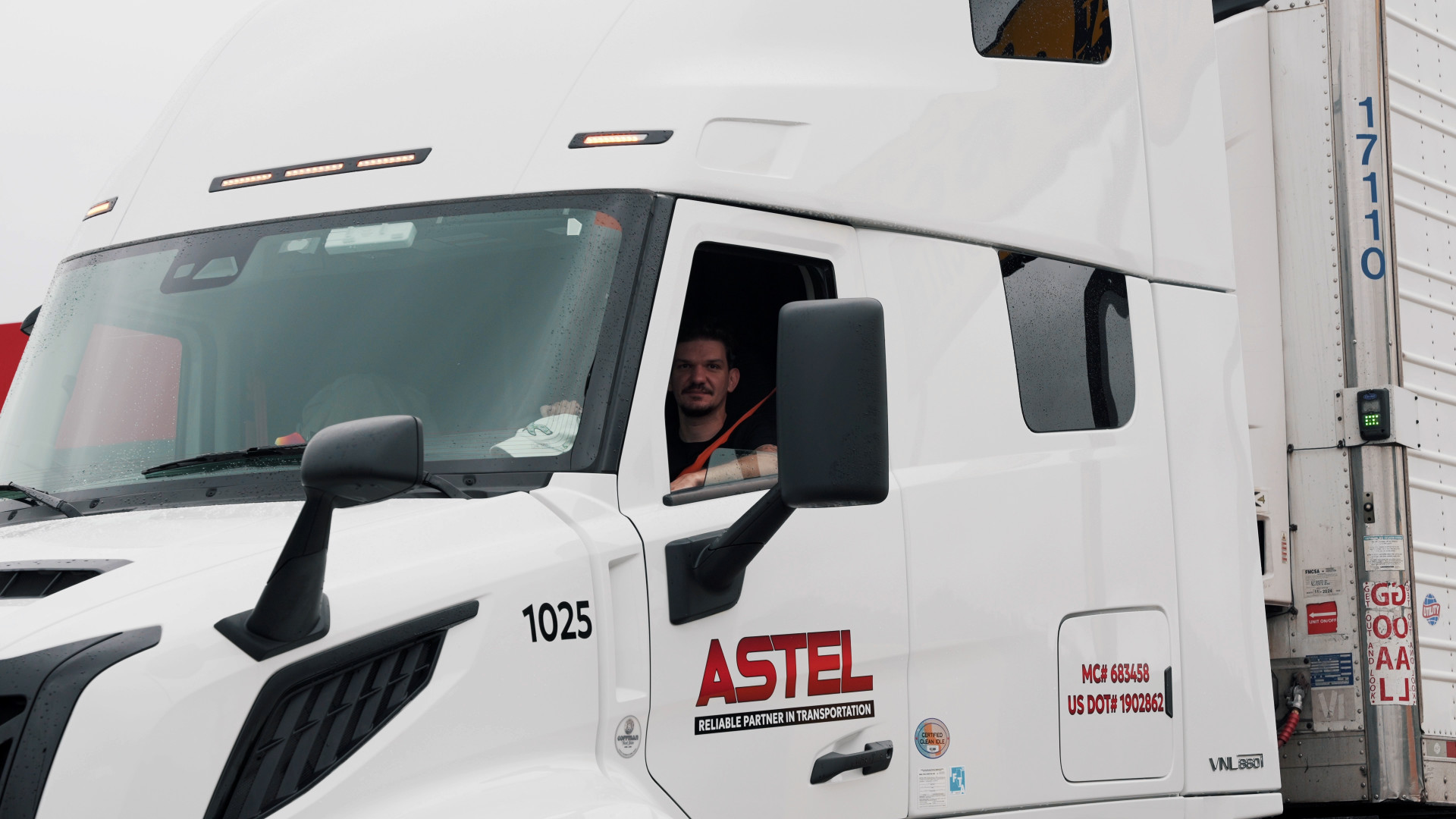
In a tighter market you have more choice than drivers did two years ago, so use it. Look for a carrier that pays every mile, pays weekly, puts raises in writing, keeps trucks fixed and answers the phone at night. That's how ASTEL is built. We run refrigerated freight year-round, and in the August–March peak strong drivers run 3,500–3,700 miles a week. Every mile is counted ZIP-to-ZIP by PC*Miler and paid every week, loaded miles and empty miles alike. Drivers with 1+ year of experience earn a flat $0.80 per mile, newer drivers get two raises in their first year, and top drivers earn 90¢ a mile. The schedule is 4+1: four or more weeks out, about a week home. Trucks are late-model Volvos with automatic transmissions, our own mechanics keep them running, and a breakdown means a replacement truck. The owner is a former driver and takes drivers' calls directly. We hire new drivers too; a deposit applies only if you have less than 3 months of OTR experience.
FAQ: is truck driving worth it?
Is truck driving worth it in 2026?
For people who can handle weeks away from home and a demanding first year, yes. As of September 2026 freight volumes are growing again, spot rates are about a third above last year and carriers are raising pay for safe, experienced drivers. It is a poor fit if you need to be home every night or cannot pass a DOT physical.
How much do first-year truck drivers make?
The first year is usually the lowest-paid year because rookie per-mile rates are lower and weekly miles are uneven. For reference, the BLS median for heavy and tractor-trailer drivers was $58,640 in May 2025, and many carriers raise pay at set milestones during the first year.
How long does it take to become a truck driver?
Typically two to four months from deciding to your first paycheck. Most Class A CDL programs run three to eight weeks, and you also need a permit, a DOT physical, a drug test, the skills test and carrier orientation.
Should a new driver start with OTR or local jobs?
Most new Class A drivers start OTR because it offers the most miles and the most carriers that hire without experience. Local jobs keep you home most nights but often require experience first and usually pay by the hour.
Should a new driver become an owner-operator right away?
Usually not. With diesel above $6 a gallon as of September 2026, the owner pays for fuel. The owner also covers repairs and insurance, on top of every empty mile. Two or three years as a company driver teaches the freight business, the real costs and the safety habits you need before buying a truck.
Worth it, when every mile is paid
ASTEL is a family-owned carrier out of Chicago running refrigerated freight year-round on late-model Volvo trucks, with our own repair shop and mechanics, 24/7 dispatch and a direct line to the owner. Drivers earn $90,000–$110,000 a year — $2,400–2,700+ a week gross, a flat $0.80 per mile for drivers with 1+ year of experience, all miles paid ZIP-to-ZIP, weekly pay, plus $50/$200/$500 bonuses for clean DOT inspections.
Apply in 2 minutes →Market data as of September 2026: Cass Freight Index (August 2026), DAT Freight & Analytics (July to September 2026 reports), Superior Trucking Payroll Service Driver Pay Index (August 2026), National Transportation Institute (June 2026), U.S. Bureau of Labor Statistics (May 2025 data), ATA Driver Compensation Study (2023 data), EIA weekly diesel prices (September 21, 2026), NIOSH long-haul driver health survey, FMCSA rules and carrier announcements. Rates, fuel prices, school costs and regulations may change. Pay and mileage figures describe ASTEL driver ranges, not guarantees. General information, not legal or financial advice.