

Can CDL Drivers Use CBD? Not Without Betting the License
The new federal hemp law starts to bite on November 12, 2026, when synthetic cannabinoids lose their legal hemp status. On December 11 most hemp products with more than 0.4 milligrams of THC per container follow them. For anyone who types "can CDL drivers use CBD" into a search bar, none of this opens a door. It closes a few more, and the answer stays where it has been since 2020: not without risking a positive marijuana test that DOT will not excuse.
What changed in 2026, and what stayed put
Three federal changes landed between November 2025 and November 2026. None of them touched the DOT testing rules in 49 CFR part 40, and none created an exception for drivers. Here is the timeline with what each step means behind the wheel.
| Date | What happened | What it means for a CDL driver |
|---|---|---|
| November 12, 2025 | Congress redefined hemp in the funding law that ended the fall 2025 shutdown: total THC counts, THCA included, with a cap of 0.4 mg of total THC per container for finished products | Most "hemp THC" gummies and drinks, along with full-spectrum CBD, fall outside hemp once the rule takes effect |
| April 28, 2026 | Marijuana in FDA-approved drugs and under state medical marijuana licenses moved to Schedule III (91 FR 22714) | No change in testing. A state medical card still doesn't excuse a positive |
| May 2026 | DOT's drug and alcohol policy office answered questions about the move | Part 40 unchanged; a medical review officer reports state medical marijuana as a positive |
| From June 29, 2026 | DEA hearing on moving all marijuana to Schedule III | No final order as of November 11, 2026. Recreational marijuana is still Schedule I |
| September 2, 2026 | A stopgap funding law, H.R. 6500, pushed most of the hemp change to December 11 | A month of delay, nothing new for drivers |
| November 12, 2026 | Synthetic cannabinoids that the plant can't produce are no longer hemp | Lab-made THC products become controlled substances |
| December 11, 2026 | The total THC standard and the 0.4 mg per container cap take effect | Most THC-containing hemp products become marijuana under federal law |
Congress could still change the December date. Bills to delay the hemp change to 2028, to repeal it or to replace it with regulation were pending in the fall of 2026. For a CDL driver it doesn't matter which one wins, because the drug test never asked whether a product was legal.
Why a CBD product can fail a DOT test
The lab never tests for CBD. Under 49 CFR 40.85 it screens urine for marijuana metabolites at 50 nanograms per milliliter and confirms at 15. Whatever put THC into your body, the confirmed result reads marijuana.
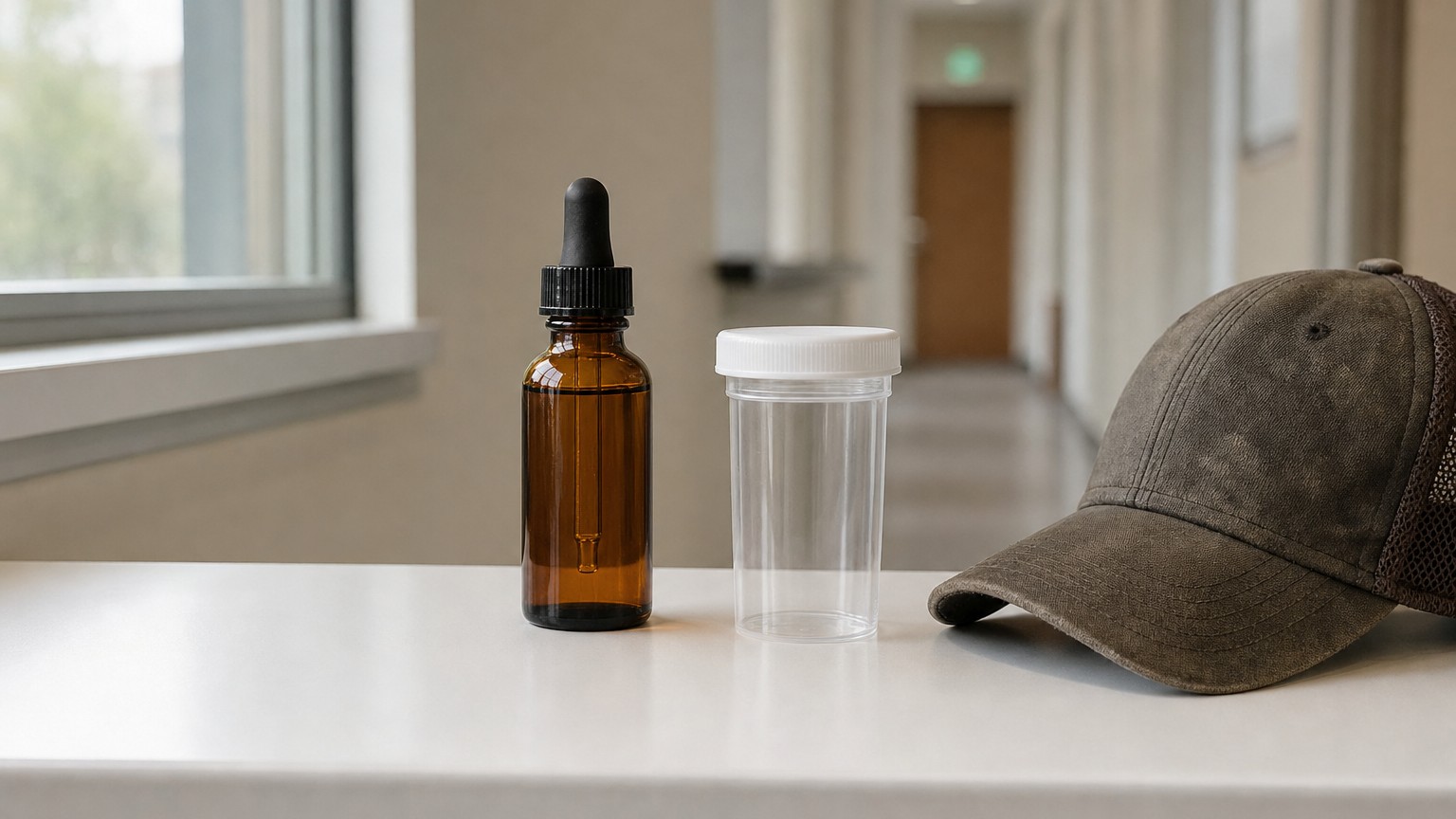
CBD products are where that THC hides. DOT warned in its CBD notice of February 2020 that the FDA does not certify THC levels in CBD products, so the label can be wrong. Until December 11, 2026, a hemp product could legally hold up to 0.3 percent delta-9 THC by dry weight. A 30-milliliter bottle of full-spectrum oil weighs about 27 grams, so at 0.3 percent it can carry roughly 80 milligrams of THC. That is 200 times the new per-container cap.
Then comes the review. A medical review officer calls you before reporting a positive, and the rules tell that doctor what not to accept. Section 40.151(f) bars accepting use of a hemp or other non-prescription marijuana product as a reason to call the test negative. Section 40.151(d) does the same for unknowing ingestion, such as a brownie someone else baked or smoke in a closed car. "It was only CBD" is not a defense. It is a confession that ends the call.
Delta-8, THCA flower and gas station gummies
The hemp aisle grew fast after 2018 because the old law only counted delta-9 THC. Delta-8 gummies, THC-O vapes and THCA flower were sold as legal hemp, often at gas stations and truck stops.
The new definition counts total THC, including THCA and other cannabinoids with similar effects. THCA flower makes the point clearly: THCA turns into delta-9 THC when it is heated or smoked, which is the whole reason people buy it. Lab-made cannabinoids that the plant can't produce drop out of the hemp definition first, on November 12.
None of this changed the risk for drivers, which was already total. The medical review officer doesn't care what the package calls the product. Any hemp product is off the table as an explanation.
Medical marijuana after the April 2026 rescheduling
Drivers ask about this more than anything else since April. The confusion comes from 49 CFR 382.213. Part (a) bars any Schedule I substance. Part (b) allows drugs from the other schedules only when a licensed practitioner who knows your history prescribed them and told you they won't affect your driving.
State-licensed medical marijuana is in Schedule III now, so it can look like part (b) applies. It doesn't. A state card is a recommendation, not a prescription for an FDA-approved drug, and DOT confirmed in May 2026 that medical review officers must still report it as a positive. Recreational marijuana didn't move at all and remains Schedule I.
If you have a condition you treat with cannabis, talk to a doctor about prescription options and bring the list to your DOT physical. A legally prescribed medication goes through the medical review officer, who keeps it confidential unless it raises a safety concern.
What one positive test costs
The sequence is fixed. You are removed from driving the same day. The result goes into the Drug and Alcohol Clearinghouse, and every carrier sees it in the pre-employment query for five years or until you finish return-to-duty and follow-up testing, whichever is later.
Since November 18, 2024 the state also acts. Under 49 CFR 383.73(q), once the Clearinghouse reports you as prohibited, your state must downgrade the CDL within 60 days. You keep a regular license, but the commercial privilege is gone until the process is complete.
A refusal counts the same as a positive. Walking out of the collection site, delaying without a reason or tampering with the specimen leads to the same removal and the same Clearinghouse record.
Getting back means an evaluation by a substance abuse professional, education or treatment, a directly observed return-to-duty test and at least six unannounced follow-up tests in the first 12 months, which can stretch to five years. The driver usually pays for the program. Our article on the DOT drug test covers each step, and our guide to CDL disqualification lists the other ways to lose the license.
When the medical review officer calls
A non-negative result doesn't go straight to your employer. First the medical review officer, a physician, calls you to ask whether there is a legitimate medical explanation. Answer that call. If you miss it and don't call back, the officer can verify the result without hearing from you.
Have your prescriptions ready: the drug, the dose, the pharmacy and the prescribing doctor. A legal prescription is exactly what this call exists for. CBD, hemp gummies, a state card or a party where people smoked are not, and the rules list them by name. Telling the truth about them won't hurt you more than the lab result already does, but it won't change the outcome either.
Home time doesn't reset anything
Some drivers treat the week at home as a safe window. It isn't. Random tests are unannounced, and for 2026 FMCSA set the minimum random drug testing rate at 50 percent of driver positions, so on average one test a year for every two drivers. The selection can land on your first morning back. Carriers also run a Clearinghouse query on every driver at least once a year, so a violation from another employer surfaces even if you never mention it.
The same goes for secondhand smoke at a party. Under 40.151(d) passive exposure isn't a medical explanation, and the medical review officer will not weigh it. If a week at home involves people smoking, leave the room. For sleep, pain and stress, the habits in our article on truck driver health do more than any gummy, and they don't end careers.
How ASTEL handles testing
ASTEL hires drivers without experience, and every new driver goes through the same federal steps: a pre-employment drug test and a full Clearinghouse query before the first load, as our article on orientation and the first load describes. There is no separate track for anyone.
The schedule is 4+1: about four weeks on the road and a week at home. Random selection doesn't know which week you are in, so the only safe plan is the one that works on both.
Frequently asked questions
Can a CBD product make you fail a DOT drug test?
Yes. CBD itself isn't on the panel, but CBD products can contain enough THC to produce a confirmed marijuana positive. Under 49 CFR 40.151(f) the medical review officer must not accept hemp or CBD use as an explanation, so the result is reported as a violation.
Is CBD legal for truck drivers after the 2026 hemp law?
Federal hemp law never protected CDL drivers from a positive test. From December 11, 2026, most hemp products with more than 0.4 milligrams of total THC per container also fall outside the federal definition of hemp and count as marijuana.
Did marijuana rescheduling change DOT drug testing?
No. The April 28, 2026 rule moved FDA-approved marijuana drugs and state-licensed medical marijuana to Schedule III, but DOT kept 49 CFR part 40 unchanged and still treats a marijuana positive as a violation.
Can I use medical marijuana with a CDL if I have a state card?
No. A state card is not a prescription for an FDA-approved drug, and DOT confirmed in May 2026 that medical review officers must report state medical marijuana use as a positive test.
Does the DOT drug test check for CBD?
No. The urine test looks for a marijuana metabolite, screening at 50 nanograms per milliliter and confirming at 15. CBD matters only because CBD products can contain THC.
Same rules for every driver, and a dispatcher who answers 24/7
ASTEL is a family-owned carrier out of Chicago running refrigerated freight year-round on late-model Volvo trucks, with our own repair shop and mechanics, 24/7 dispatch and a direct line to the owner. Drivers earn $90,000–$110,000 a year — $2,400–2,700+ a week gross, a flat $0.80 per mile for drivers with 1+ year of experience, all miles paid ZIP-to-ZIP, weekly pay, plus $50/$200/$500 bonuses for clean DOT inspections.
Apply in 2 minutes →Sources: 49 CFR 40.85, 40.151(d), (e) and (f), 382.213 and 383.73(q) (eCFR, November 2026); 91 FR 22714 (April 28, 2026), rescheduling of FDA-approved and state-licensed medical marijuana; U.S. DOT Office of Drug and Alcohol Policy and Compliance, CBD notice (February 2020) and guidance on the Schedule III move (May 2026); Continuing Appropriations, Agriculture, Legislative Branch, Military Construction and Veterans Affairs, and Extensions Act, 2026, section 781 (signed November 12, 2025); Continuing Appropriations and Extensions Act, 2027, H.R. 6500 (September 2, 2026); Congressional Research Service, LSB11381 (December 2025); Federal Register search of DEA rules (November 11, 2026); FMCSA random testing rates for 2026. The 80-milligram figure is a calculation. Congress may still change the hemp dates. Current as of November 2026. General information, not legal or medical advice.