


CDL Disqualification and the Violations That Take You Off the Road
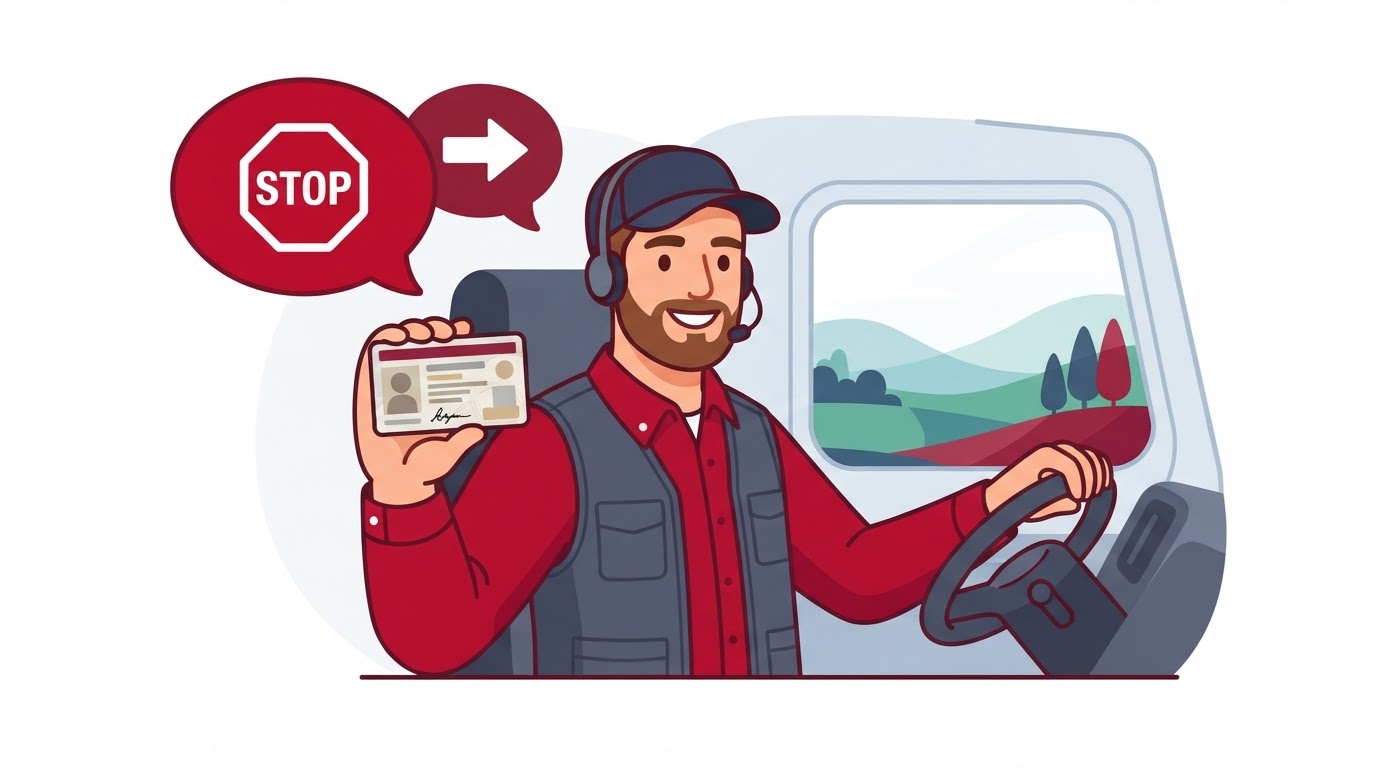
The CDL disqualification that surprises drivers most starts with a speeding ticket paid online in two minutes. Federal rules treat paying the fine as a conviction. If the ticket was for 15 mph or more over the limit, it's a serious traffic violation, and a second one within three years takes your CDL for 60 days. One of the two can come in your own pickup. Sixty days without a CDL is two months without a paycheck.
Seven mistakes that end in a disqualification letter
- Paying a ticket without reading it. Under 49 CFR 383.5 the payment of a fine or court cost is a conviction, the same as a guilty verdict.
- Thinking your own car doesn't count. Each conviction from a separate incident is counted whether it happened in a CMV or a non-CMV, under 383.51(a)(4).
- Asking the court for traffic school or a deferral. For a CDL holder, the state can't mask the conviction or keep it off the record through a diversion program (49 CFR 384.226).
- Holding the phone at a red light. For the texting and hand-held phone rules, a truck stopped in traffic or at a signal is still being driven.
- Moving the truck after an out-of-service order because the load is late. A first conviction costs at least 180 days.
- "One beer at lunch." No alcohol within 4 hours before duty, and any detected alcohol on duty means 24 hours out of service under 49 CFR 392.5. At 0.04 in a CMV the penalty becomes a year.
- Keeping a ticket quiet. Drivers must tell their employer about every traffic conviction within 30 days, and about a suspension by the end of the next business day.
Most of these come down to timing. The ticket happens in a minute, the conviction comes weeks later when you pay or lose in court, and the disqualification arrives as a letter from the state that issued your CDL. By then the choices are gone. Act between the ticket and the court date.
Major offenses cost a year, or a career
Table 1 of 383.51 lists the offenses where one conviction is enough. A first conviction in a truck or in your own car brings a 1-year disqualification. If you were driving a CMV with placarded hazmat, it's 3 years. A second conviction for any combination of these offenses, in separate incidents, means a lifetime disqualification.
| Offense | First conviction | Second conviction |
|---|---|---|
| Driving under the influence of alcohol, as defined by state law | 1 year (3 with hazmat) | Life |
| Driving under the influence of a controlled substance | 1 year (3 with hazmat) | Life |
| Alcohol concentration of 0.04 or more while driving a CMV | 1 year (3 with hazmat) | Life |
| Refusing an alcohol test under a state implied consent law | 1 year (3 with hazmat) | Life |
| Leaving the scene of an accident | 1 year (3 with hazmat) | Life |
| Using a vehicle to commit a felony | 1 year (3 with hazmat) | Life |
| Driving a CMV while your CDL is suspended or revoked for earlier CMV violations | 1 year (3 with hazmat) | Life |
| Causing a death through negligent operation of a CMV | 1 year (3 with hazmat) | Life |
| Using a vehicle in a felony involving making or distributing controlled substances | Life, no reinstatement | Life, no reinstatement |
| Using a CMV in a felony involving human trafficking | Life, no reinstatement | Life, no reinstatement |
The 0.04 limit applies only in a CMV. In your own car, the state's DUI law sets the line, usually 0.08. A DUI conviction in a personal vehicle still costs the CDL for a year.
Lifetime doesn't always mean forever. Under 383.51(a)(6) a state may reinstate a driver disqualified for life after 10 years, if the driver completes a rehabilitation program the state approves. It's a state option, not a right, and it works once. A driver reinstated this way who gets one more major conviction can't be reinstated again. The drug-distribution and trafficking felonies never qualify.
Serious traffic violations add up over three years
Table 2 covers the everyday tickets. One conviction doesn't disqualify you. Two convictions in separate incidents within 3 years mean 60 days. Three or more mean 120 days, and the periods stack on top of any disqualification you already have, under 383.51(a)(5).
The list is short and specific. It covers speeding 15 mph or more over the posted limit, reckless driving as your state defines it, improper or erratic lane changes and following too closely. It also includes a traffic-control violation connected with a fatal crash, and driving a CMV without a CDL, without the right class or endorsement, or without the license in your possession. That last one is forgiven if you show the court a valid CDL by your court date. Texting while driving a CMV and using a hand-held phone while driving a CMV round out the list.
Tickets in your personal car count in two ways. A serious-violation conviction in your own car goes into the same three-year count, so a second one in the truck disqualifies you. When the second conviction itself comes in your own car, it disqualifies you only if it also leads the state to suspend, revoke or cancel your license or your non-CMV driving privileges.
Phone rules catch good drivers. Federal rules define driving for this purpose as operating the truck on a highway, including while it is temporarily stopped in traffic, at a light or in another short delay. Pull fully off the road to a safe spot before you touch the phone. Then call.
Railroad crossings carry their own table
Table 3 lists six crossing violations, and these disqualify on the first conviction: at least 60 days the first time, at least 120 days for a second within 3 years, and at least a year for a third. The six are:
- not slowing down to check that the tracks are clear where a full stop isn't required;
- not stopping before the crossing when the tracks aren't clear;
- not stopping where a stop is always required, as with placarded hazmat;
- not having room to drive all the way through without stopping on the tracks;
- ignoring a traffic-control device or an officer at the crossing;
- getting hung up on the crossing because of low undercarriage clearance.
The last item is a trailer problem as much as a driving one. A long trailer with little ground clearance can high-center on a humped crossing, and the rule counts that as your violation. Watch for the low-ground-clearance warning sign. It's there for a reason.
An out-of-service order is a hard stop
Table 4 is the harshest for a single act. Driving after an out-of-service order on nonhazardous freight brings at least 180 days and up to a year for a first conviction. A second within 10 years means 2–5 years, and a third 3–5 years. With placarded hazmat or a vehicle designed for 16 or more people, the first conviction can reach 2 years.
Out-of-service orders come at roadside inspections, for hours violations, for alcohol under 392.5 and for vehicle defects. Call dispatch, wait out the order or get the repair done, and get the release in writing before the wheels turn. What happens at each inspection level is in our guide to DOT roadside inspections.
Two deadlines to tell your employer
Under 49 CFR 383.31, a CDL holder convicted of any traffic violation other than parking, in any vehicle, must notify the current employer within 30 days of the conviction. The notice has to be in writing. It lists your name and license number, the date and location of the conviction, the offense, any suspension that came with it, whether you were in a CMV, and your signature.
A suspension, revocation or disqualification has a much shorter clock. Under 383.33 you report it before the end of the business day after you get the notice. Your carrier also pulls your motor vehicle record at least once every 12 months under 49 CFR 391.25, so a hidden ticket comes out anyway.
One old duty is gone. Until July 22, 2026, federal rules also told you to report a conviction from another state to your own licensing state. FMCSA dropped that part in a rule published June 22, 2026, because states now trade conviction data electronically. Your state may still keep its own reporting rule, and the employer notice above hasn't changed.
The same convictions show up when you apply somewhere new. A recruiter reads the MVR and the PSP report side by side, as explained in CSA, PSP and MVR explained.
Drug tests and medical cards can also end a CDL
Two other paths don't run through 383.51 at all. Since November 18, 2024, a state that learns from the Drug and Alcohol Clearinghouse that a driver is prohibited from driving a CMV must downgrade the CDL within 60 days. The license comes back only after the return-to-duty process is finished and FMCSA tells the state. A positive test, a refusal or an employer's report of actual knowledge all put a driver in that status. The testing side is covered in our article on the DOT drug test.
The other path is paperwork. If your medical certification lapses on your state record, the state downgrades the CDL as well. Once the temporary exemption for paper cards ends at 11:59 p.m. on October 11, 2026, the electronic record is the only proof that counts, as explained in paper medical card rules after October 11.
A ticket before conviction is still fixable
Between the citation and the court date you still have options. Read the ticket for the exact charge and speed. Ask a traffic attorney who handles CDL cases whether the charge can be reduced to a violation that isn't on the serious list, since a plain speeding charge under 15 mph over isn't one. Keep in mind that the court can't defer or hide the conviction for a CDL holder.
If the ticket followed a crash, the first steps at the scene matter for the record later, and they're listed in what to do after a semi truck accident. Video helps too, and the case for a road-facing camera is in dash cams for truck drivers.
ASTEL pays for a clean record
At ASTEL a clean record is part of the paycheck. The Safety bonus adds $0.02 per mile. Clean DOT inspections pay $500 for a full Level I, $200 for Level II and $50 for Level III. If you're placed out of service anywhere on the road, call dispatch first, because dispatch is on the line 24/7 and the next move is a decision you make together.
Frequently asked questions
What disqualifies you from having a CDL?
Under 49 CFR 383.51, major offenses such as DUI, refusing an alcohol test, leaving the scene of an accident or using a vehicle in a felony disqualify you for at least a year. Two serious traffic violations within 3 years cost 60 days, railroad crossing violations at least 60 days and violating an out-of-service order at least 180 days.
Does a speeding ticket in my personal car affect my CDL?
Yes. A conviction for 15 mph or more over in your own car is a serious traffic violation that counts toward the 3-year total, so a second one in a truck means 60 days. If the second conviction comes in your own car, it disqualifies you when the state also suspends, revokes or cancels your license. A DUI in your own car costs the CDL for a year.
How long is a CDL disqualification for a DUI?
One year for a first conviction, in a truck or in a personal vehicle, and 3 years if you were driving a CMV with placarded hazardous materials. A second DUI or other major offense in a separate incident means a lifetime disqualification, with possible state reinstatement after 10 years and a rehabilitation program.
How many serious traffic violations before you lose your CDL?
Two. A second conviction for a serious traffic violation within 3 years means 60 days of disqualification, and a third or later conviction in that period means 120 days. Serious violations include speeding 15 mph or more over, reckless driving, following too closely and texting while driving a CMV.
Can traffic school keep a ticket off my CDL record?
No. Under 49 CFR 384.226 a state may not mask, defer or divert a conviction for a CDL holder for any traffic violation other than parking, weight or vehicle defects, in any type of vehicle. The conviction has to appear on the driver record.
Do I have to tell my employer about a traffic ticket?
Yes, once it becomes a conviction. A CDL driver must notify the current employer in writing within 30 days of any traffic conviction other than parking, in any vehicle. A license suspension or disqualification has to be reported by the end of the next business day.
A clean record pays here, by the mile
ASTEL is a family-owned carrier out of Chicago running refrigerated freight year-round on late-model Volvo trucks, with our own repair shop and mechanics, 24/7 dispatch and a direct line to the owner. Drivers earn $90,000–$110,000 a year — $2,400–2,700+ a week gross, a flat $0.80 per mile for drivers with 1+ year of experience, all miles paid ZIP-to-ZIP, weekly pay, plus $50/$200/$500 bonuses for clean DOT inspections.
Apply in 2 minutes →Sources: 49 CFR 383.51, disqualification of drivers, Tables 1–4; 49 CFR 383.5, definitions of conviction and disqualification; 49 CFR 383.31 and 383.33, notifying the employer, and the FMCSA final rule removing driver self-reporting to the licensing state (June 22, 2026, effective July 22, 2026); 49 CFR 384.226, prohibition on masking convictions; 49 CFR 383.73(o) and (q), medical certification and Drug and Alcohol Clearinghouse downgrades; 49 CFR 382.501; 49 CFR 391.25, annual review of driving records; 49 CFR 392.5, alcohol prohibition; 49 CFR 392.80 and 392.82, texting and hand-held phones. Current as of October 2026; federal and state rules may change, and states can set stricter penalties. Pay and bonus figures describe ASTEL driver terms, not guarantees. General information, not legal advice; talk to a traffic attorney about a ticket before your court date.