

How Much English Do You Really Need to Drive a Truck in the USA? (2026 ELP Rules)
If English is not your first language, one question decides your whole career on the road: how good does it actually have to be? In 2025 the rules got stricter, in 2026 they tightened again, and here's exactly what's required now, what an officer checks, and how to be ready.
Enforcement got strict in 2025
The English requirement itself is old. Federal regulation 49 CFR § 391.11(b)(2) has required drivers to read and speak English "sufficiently" since 1937. What changed is enforcement, and it tightened in several steps, one after another:
- In 2016, guidance told inspectors not to place drivers out of service just for English.
- An Executive Order (April 28, 2025) directed FMCSA to rescind that guidance and to make an English failure an out-of-service violation again.
- FMCSA rescinded the 2016 guidance and issued new enforcement guidance on May 20, 2025.
- The Commercial Vehicle Safety Alliance (CVSA) added English Language Proficiency (ELP) to the Out-of-Service Criteria, effective June 25, 2025.
- In April 2026, FMCSA (April 16) and CVSA (April 19) narrowed the exception for the U.S.-Mexico border commercial zones.
- On August 10, 2026, FMCSA proposed writing the out-of-service rule into the federal regulations themselves (docket FMCSA-2026-0826). Comments closed on October 9, 2026, and as of mid-October the rule is still a proposal.
Bottom line: an ELP failure is now an out-of-service violation in all 50 states for interstate drivers. Inside the U.S.-Mexico border commercial zones a driver gets only a citation if the current trip stays inside the zone; since April 2026, if the trip goes deeper into the U.S., the driver is placed out of service there too. FMCSA counted 60,399 ELP violations between June 25, 2025 and March 19, 2026, and 19,045 of them ended with the driver placed out of service.
The roadside check runs in two steps
FMCSA uses a two-step assessment during an inspection:
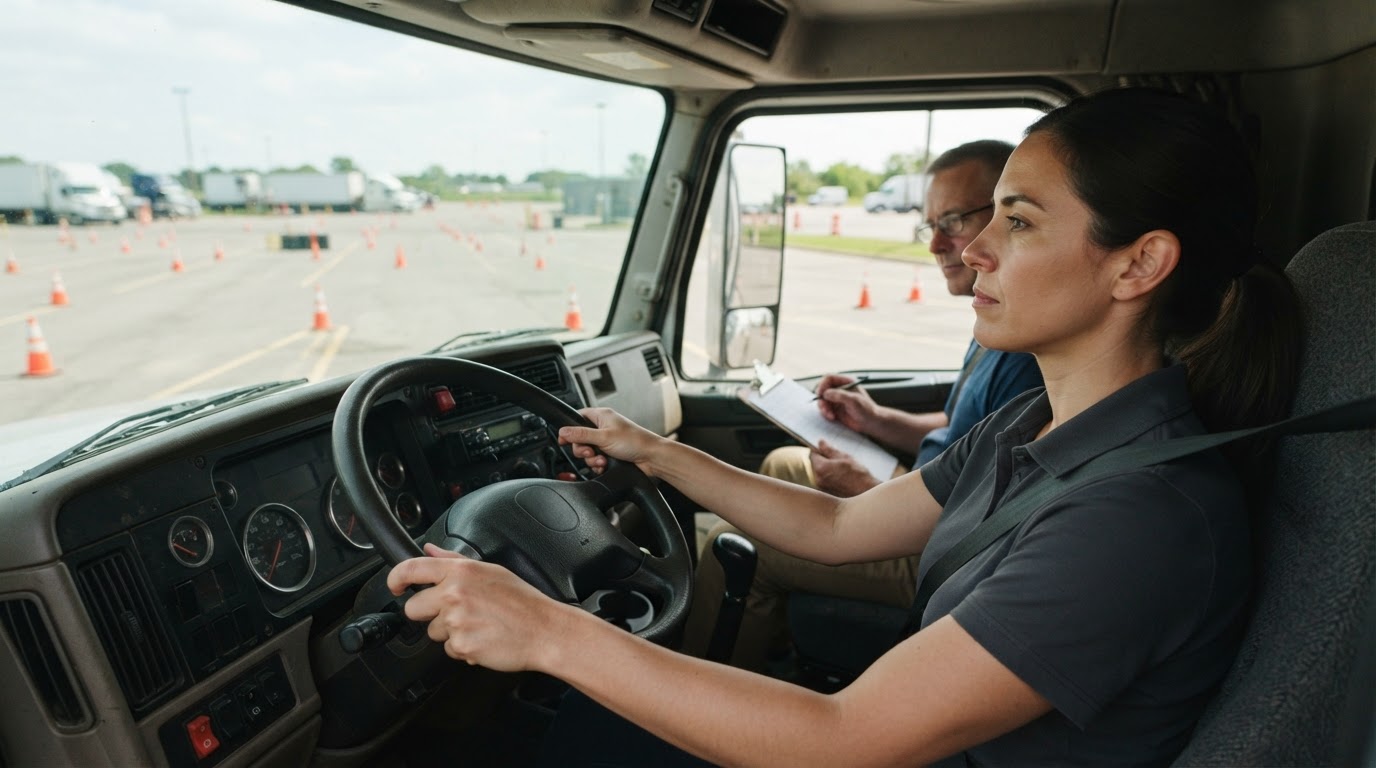
- Driver interview. The inspection starts in English and you must respond in English. Interpreters, I-Speak cards, cue cards, smartphone translation apps, and phone interpretation services may not be used during this step.
- Highway sign recognition. You must show you can read and understand U.S. traffic signs, including electronic changeable-message signs.
Fail either step and you're placed out of service on the spot: you can't drive on, the carrier has to send another qualified driver for the truck, and FMCSA may also start an action to disqualify you from interstate driving.
The bar is functional English, not fluent English
The standard is functional, not fluent. You are not being graded on grammar or accent. In practice, you need to comfortably handle a predictable, job-specific set of situations:
| You need to… | Real example |
|---|---|
| Understand an officer's questions | "License and registration." "Where are you headed?" "What are you hauling?" |
| Answer so you're understood | Say your route and cargo, your hours, your company, clearly |
| Read road signs & instructions | Weight limits, detours, low clearance, "trucks must exit," message boards |
| Handle paperwork | Read and fill in logs, inspection reports, bills of lading |
A practical plan to get ready
- Learn the script. Practice the exact questions and answers of a roadside stop out loud, every day, until they're automatic.
- Learn the signs. Make sure you recognize and understand common signs, such as yield, detour, low clearance, weigh station, and no thru trucks, including electronic message boards.
- Use free resources. YouTube channels and apps aimed specifically at CDL/roadside English are enough for most drivers.
- Skip the translator plan. It isn't allowed in the interview, so it can't be your backup. Build the real skill instead.
- Test with a partner. Have someone role-play the officer. If you can pass that, you can pass the road.
English is required before you even get the CDL
Yes, the license itself is gated by English. Under 49 CFR § 383.133, the CDL skills test must be conducted in English: no interpreter is allowed, and you must understand the examiner's verbal commands in English. Federal rules still let a state offer the written knowledge test in another language, but never with an interpreter, and that option is shrinking: Florida moved all license exams to English only on February 6, 2026, Texas did the same for CDL and permit knowledge tests on June 1, 2026, and in February 2026 the U.S. DOT announced a rulemaking to make every CDL test English only. And after June 2025, you'll need working English on the road regardless of how you passed the test.
Frequently asked questions
Can I use a translation app during a roadside inspection?
No. During the driver-interview step, interpreters, cue cards, and phone/app translation are not allowed. You must respond in English yourself.
Do I need to speak English fluently to be a truck driver in the US?
Realistically, yes. You need to speak English confidently, not just a few memorized phrases. It's not only about the roadside inspection: you'll communicate every day with your dispatcher, fleet manager, shippers and receivers. A driver who knows only a couple of phrases can't do that job. You don't need a perfect accent or flawless grammar, but you do need to hold a real conversation. Learning "a few phrases" is not enough to be a truck driver.
Can I get placed out of service just for weak English?
Yes. Since June 25, 2025, an English Language Proficiency failure is an out-of-service violation for interstate drivers in all 50 states. FMCSA counted 19,045 such out-of-service orders between June 25, 2025 and March 19, 2026.
Can I take the CDL test in Russian or Spanish?
The skills test must be in English with no interpreter. Federal rules still allow the written knowledge test in another language where a state offers it, but Florida and Texas dropped that option in 2026 and the U.S. DOT plans an English-only rule for every state. An interpreter can never be used during either test.
Start driving for a company that actually helps you succeed
ASTEL hires CDL-A drivers — including newcomers with no experience — with recruiters who talk to you with respect and 24/7 road support. Drivers earn $110,000–$150,000 a year, paid weekly.
Apply in 2 minutes →Sources: FMCSA guidance on English Language Proficiency (2025); CVSA Out-of-Service Criteria effective June 25, 2025; 49 CFR § 391.11(b)(2) and § 383.133; FMCSA policy memo MC-SEE-2026-0002 (April 16, 2026); FMCSA proposed rule, 91 FR 51422 (August 10, 2026); Florida HSMV (February 2026); Texas DPS (June 1, 2026). Rules can change — verify current requirements with FMCSA before making decisions.