


A CDL for Veterans Can Skip the Road Test and Sometimes the Written One
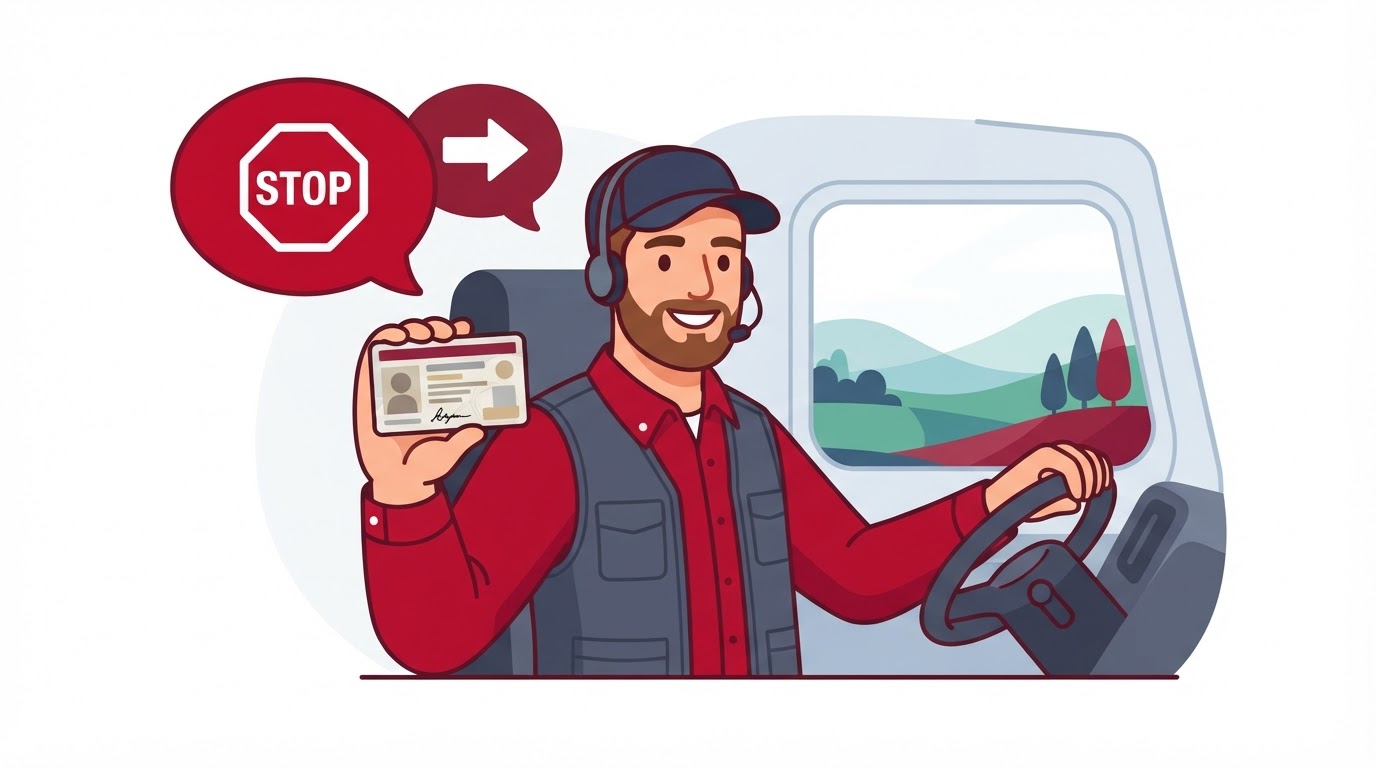
An Army motor transport operator who spent the last two years of service driving a tractor-trailer can get a civilian Class A license without a road test at the DMV. That swap sits at the center of every CDL for veterans program: federal rules let a state accept your military driving record in place of the skills test, and 34 states also drop the written test for certain military jobs. In the summer of 2026 the window to use the road test waiver got longer, at least for now.
Here is how it can work, as an example. Say you were an Army motor transport operator, job code 88M, and spent your last three years driving M915 line-haul tractors with semitrailers before leaving active duty in January 2026. You move home to Indiana, one of the seven states that signed up for Even Exchange in July 2026. You bring the waiver form with your former commander's signature, pass a DOT physical and apply for a commercial learner's permit.
Indiana can waive the written test because of your job code and the road test because of your driving record. Under the one-year rule your deadline would be January 2027. Under FMCSA's temporary two-year window it moves to January 2028, as long as that waiver is in force on the day you apply.
Seven steps from a military license to a civilian CDL
- Before you separate, get copies of your operator qualification records (the DA Form 348 in the Army) and the list of vehicles you were licensed on. They prove the two years of driving.
- Get your state's skills test waiver form and have the commander's part signed while you still have access to your unit.
- Pass a DOT physical with a certified medical examiner and get your medical card. A military physical doesn't replace it.
- Apply for a commercial learner's permit in your home state, or where you are stationed if you are still on active duty.
- Take the knowledge test, unless your state is in Even Exchange and your job code is on the list below.
- Hand in the waiver form instead of booking a road test. The state checks your record against the federal conditions and issues the CDL.
- Add endorsements. A state may also waive the tanker and hazmat knowledge tests if you hauled tankers or hazmat in the service within the last year, but hazmat still needs a TSA background check.
Step 4 got easier in 2026. Federal rules already let an active-duty member apply in the state of the duty station if that state had an agreement with the home state. Since the July 2026 announcement, active-duty members can apply and test where they are stationed instead of flying home for it.
Step 3 trips people up more often than the paperwork. The DOT physical has its own vision, hearing and blood pressure standards, explained in our guide to the DOT physical exam.
Who qualifies for the road test waiver
The waiver is for people who drove a commercial-size vehicle as part of their military job. You have to show that you were regularly employed in that kind of position within the last year and that you operated a vehicle representative of the one you will drive as a civilian for at least the 2 years right before separation.
Representative is the word that matters. Two years in a straight cargo truck support a waiver for Class B. For Class A you need time in a combination: a tractor with a semitrailer or a truck towing a heavy trailer.
Your record for the last 2 years also has to pass five federal conditions:
- no more than one civilian license at a time, besides the military one;
- no license suspended, revoked or cancelled;
- no conviction for a disqualifying offense such as DUI, in any vehicle;
- no more than one conviction for a serious traffic violation, in any vehicle;
- no at-fault crash and no traffic conviction connected to a crash.
The program isn't small. FMCSA says roughly 40,000 service members and veterans have used it. And the military exception that lets you drive without a CDL while serving now covers more people. Since March 23, 2026, dual-status military technicians, civilians who must also belong to an Army or Air Force reserve component, fall under it too.
The window is two years for now
The regulation itself still says one year after you leave the military driving job. At a White House event on July 30, 2026, part of the Freedom Haulers campaign DOT had announced a week earlier, the department said the window would grow to two years. FMCSA did it with a waiver, and under 49 CFR part 381 a waiver lasts no more than three months. The first one ran to October 29, 2026, and FMCSA renewed it for another three months.
So the two-year window depends on renewals. Inside your first year, there is nothing to check. In year two, there is. Ask the DMV whether the extension is in force before you skip road test practice and walk in with only the waiver form, because a state clerk will go by the rules that apply on the day you hand it in. A month of driving lessons costs less than a missed deadline.
Job codes that skip the written test in Even Exchange states
| Branch | Job code | Military title |
|---|---|---|
| Army | 88M | Motor Transport Operator |
| Army | 14T | PATRIOT Launching Station Operator |
| Army | 92F | Fueler |
| Air Force | 2T1 | Vehicle Operator |
| Air Force | 2F0 | Fueler |
| Air Force | 3E2 | Pavement and Construction Equipment Operator |
| Marine Corps | 3531 | Motor Vehicle Operator |
| Navy | E.O. | Equipment Operator |
Even Exchange is the knowledge test waiver written into 383.77(a). States choose whether to offer it. Seven more signed up in July 2026, Alabama, Arkansas, Florida, Indiana, Louisiana, Maryland and Wyoming, which brought the total to 34. You need the job code and the same clean record as for the road test waiver, and you must have held that job within the eligibility window. With both waivers in a participating state, a qualified veteran trades the military license for a CDL without taking either test.
If your job code isn't on the list, you take the written test like everyone else. It is three parts for most Class A applicants: general knowledge, air brakes and combination vehicles. Our article on the CDL permit test covers how it is scored.
You skip entry-level driver training too
Since February 7, 2022, a civilian getting a first Class A or Class B license has to finish entry-level driver training with a provider on FMCSA's registry before the road test. That training is most of what a CDL school charges for, as our breakdown of CDL school costs shows.
Section 380.603(a)(3) exempts military drivers who meet every condition of 383.77. When FMCSA wrote that exception, it said military training meets or exceeds its own standards. In practice a qualified veteran saves weeks of class time and thousands of dollars.
If you never drove a truck in uniform
The waivers don't help a veteran who worked in a different job. The GI Bill does. VA lists truck driving as an example of a non-college degree program, and for August 1, 2026 to July 31, 2027 the Post-9/11 GI Bill pays the net tuition and fees of such a program up to $30,908.34 a year. That rate is for the full benefit level, which you reach with 1,095 days of active duty. Shorter service pays a percentage. The school has to be approved for VA benefits, so check it in VA's GI Bill Comparison Tool before you sign anything.
On-the-job training is the other GI Bill route. Here VA pays a monthly housing amount while an approved employer trains you: 100 percent of the rate for the first 6 months, then 80, 60 and 40 percent, and 20 percent after two years. Months with fewer than 120 hours of training pay less. Only VA-approved programs count, so ask the employer for the approval before you plan around it.
SkillBridge works before you leave. It lets a service member spend up to the last 180 days of service training with an approved civilian partner, CDL schools included, while still drawing military pay. Your commander has to approve it. Ask early.
What stays the same for every new driver
A waiver shortens the licensing part. Hiring stays the same. Federal rules still set the minimum age for interstate driving at 21, as our article on how old you have to be for a CDL explains. Every carrier runs a pre-employment drug test and a query in the Drug and Alcohol Clearinghouse, covered in our guide to the DOT drug test.
Civilian freight also brings electronic logs. The 11-hour driving limit and the 14-hour window feel different from convoy schedules, and our explainer of hours of service rules is worth reading before the first trip. Expect the first month to be about appointments, fuel stops and parking more than about the truck itself.
Where ASTEL fits
ASTEL hires drivers without experience, so a veteran with a CDL from the waiver doesn't have to spend a year at another carrier first. The freight is refrigerated, year-round, on Volvo trucks with automatic transmissions. Dispatch answers 24/7, which helps on the first loads, when every receiver and every truck stop is new.
The schedule is 4+1: about four weeks on the road and a week at home, with dates set with dispatch in advance. Pay comes every week, and a payment requested before noon arrives the same day. If you are weighing several first jobs, our guide to truck driving jobs with no experience lists what to compare.
Frequently asked questions
Can veterans get a CDL without taking the driving test?
Yes, if they qualify for the military skills test waiver under 49 CFR 383.77. That takes at least 2 years of driving a representative military vehicle right before separation, a clean driving record and an application within the eligibility window. You still need a DOT medical card, and you take the knowledge test unless your state is in Even Exchange.
How long after leaving the military can I use the CDL skills test waiver?
The regulation says within one year of leaving the military driving job. Since July 2026 FMCSA has extended the window to two years with temporary waivers that last up to three months each, so ask your DMV whether the extension is in force when you apply.
Does the GI Bill pay for CDL school?
Yes, if the school is approved for VA benefits. From August 1, 2026 to July 31, 2027, the Post-9/11 GI Bill pays net tuition and fees for non-college degree programs, truck driving included, up to $30,908.34 a year at the full benefit level, and you may also get a monthly housing allowance.
Which states are in the Even Exchange program?
Thirty-four states as of July 2026, when Alabama, Arkansas, Florida, Indiana, Louisiana, Maryland and Wyoming joined. Your state's DMV or FMCSA's Even Exchange page has the current list.
Do veterans need entry-level driver training for a CDL?
Not if they meet every condition of the military waiver in 49 CFR 383.77. Section 380.603(a)(3) exempts them from the entry-level training rule that other first-time Class A and Class B applicants must complete.
Your first civilian loads, with dispatch that answers 24/7
ASTEL is a family-owned carrier out of Chicago running refrigerated freight year-round on late-model Volvo trucks, with our own repair shop and mechanics, 24/7 dispatch and a direct line to the owner. Drivers earn $90,000–$110,000 a year — $2,400–2,700+ a week gross, a flat $0.80 per mile for drivers with 1+ year of experience, all miles paid ZIP-to-ZIP, weekly pay, plus $50/$200/$500 bonuses for clean DOT inspections.
Apply in 2 minutes →Sources: 49 CFR 383.3(c), 383.77, 383.79, 380.603(a)(3) and 381.200 (eCFR, November 2026); FMCSA final rule 91 FR 7860 (February 19, 2026) on dual-status military technicians; U.S. DOT and FMCSA announcements of the Freedom Haulers campaign (July 24 and July 30, 2026) and FMCSA waivers extending the military eligibility window (July and October 2026); FMCSA figures on waiver use as reported by FreightWaves (2026); VA, Post-9/11 GI Bill rates effective August 1, 2026 to July 31, 2027, and VA guidance on non-college degree programs and on-the-job training; the military SkillBridge program. The example in the callout is illustrative, not a real person. Waiver dates and state participation change, so confirm with your DMV and VA. Current as of November 2026. General information, not legal advice.