

Truck Driver Tickets Cost More Than the Number on the Citation
Florida fines an overweight truck 5 cents for every pound over the limit once the excess passes 200 pounds, so a load 3,000 pounds heavy comes to $150. That is the cheap part of truck driver tickets. The expensive part is the record that comes with them: a conviction you must report to your employer within 30 days, an inspection on your PSP report for three years and, for moving violations, one step closer to losing the CDL. Who pays the fine depends on whose name is on the citation and on what your carrier put in writing.
What tickets and federal penalties actually cost
| Violation | What it costs | Written to |
|---|---|---|
| Speeding 15–19 mph over, Florida | $150 base fine plus court costs, and a serious violation for a CDL holder | Driver |
| Speeding 20–29 mph over, Florida | $175 base fine plus court costs | Driver |
| Overweight by more than 200 pounds, Florida | 5 cents per pound over the limit, so 3,000 pounds over is $150 | As written on the citation |
| Driver out-of-service violation at a Florida inspection | $100 civil penalty for each violation | As written on the citation |
| Federal penalty for a driver's safety violation | Up to $4,812 | Driver |
| Federal penalty for a carrier's safety violation | Up to $19,246 per violation | Carrier |
| Missing, incomplete or false records, logs included | Up to $1,584 a day, $15,846 at most | Whoever had to keep the record |
| Driving under an out-of-service order | At least $3,961 for a first conviction; $7,155–$39,615 for an employer that allows it | Driver and carrier |
Two kinds of money sit in that table. State tickets are written at the roadside under state law and paid to a court. The federal amounts come from 49 CFR part 386 and apply when FMCSA opens an enforcement case, usually after a review at the carrier. They are maximums and change with inflation every year. Florida is in the table because its statutes spell the fines out plainly. Other states charge more or less, and nearly all of them add court costs on top of the base fine.
The scale ticket in the lead is avoidable for $15 or so at a certified truck scale before you leave the shipper, as our guide to weigh stations and axle weights explains.
The fine is the smallest part of the bill
Under 49 CFR 383.5, paying a fine or court cost is a conviction, exactly like a guilty verdict. Clicking "pay" on a county website ends the case and puts the conviction on your driving record.
Then the paperwork starts. Section 383.31 gives you 30 days after the conviction to tell your employer in writing. The notice needs your name and license number, the date, the offense, whether you were in a commercial vehicle, the location and your signature. A suspension is faster: you report it before the end of the next business day under 383.33. Keeping quiet is a violation on its own, and it doesn't work anyway: carriers must pull every driver's MVR at least once every 12 months under 49 CFR 391.25, so the conviction surfaces at the next annual review.
Recruiters see the rest. Your MVR lists convictions for years, and the PSP report shows three years of roadside inspections and five years of crashes, with violations recorded even when no ticket was written. Our guide to CSA, PSP and MVR walks through each report.
Moving violations add a third cost. Two serious ones within three years, such as speeding 15 mph or more over the limit or texting, take your CDL for 60 days. Sixty days. That is two months without a paycheck, and the full table is in our article on CDL disqualification.
Out-of-service orders cost more than any fine
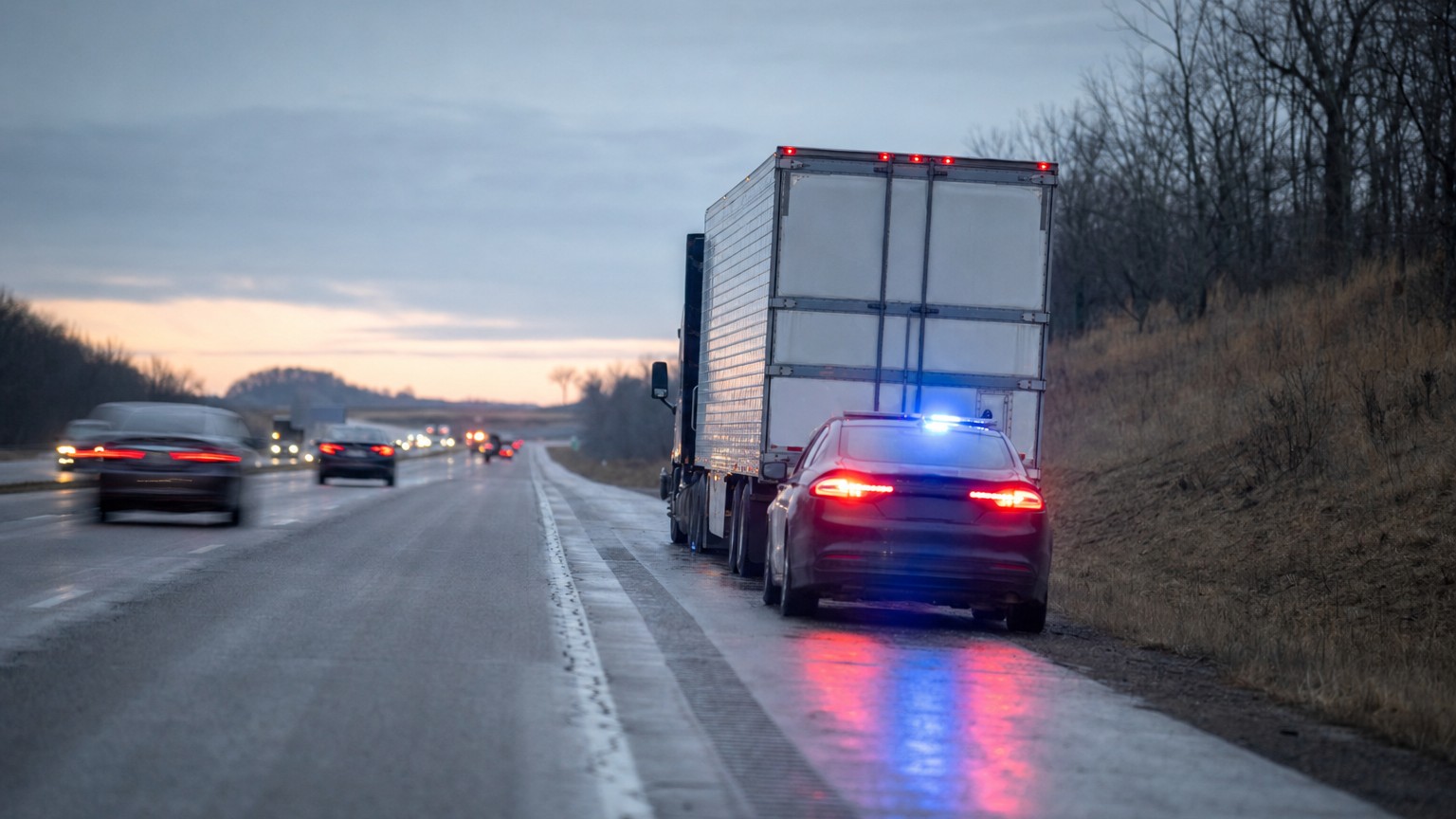
Some roadside findings don't end with a ticket in your hand. They end with an out-of-service order, and the truck doesn't move until the problem is fixed. Over your hours, you sit until you have enough off-duty time to be legal again. A brake or tire defect waits for a repair, sometimes a mobile mechanic at the scale.
Florida adds a $100 civil penalty for each driver out-of-service violation found at an inspection. That is small next to the lost day, the late delivery and the inspection record. The real money is in ignoring the order. A CDL holder convicted of driving under an out-of-service order owes at least $3,961 the first time and at least $7,924 after that, and the conviction carries a disqualification of at least 180 days. A carrier that lets it happen faces $7,155 to $39,615.
Call dispatch while the officer finishes the report. The appointment can be moved, and a repair can be arranged faster from the office than from the cab. Waiting out an order costs hours. Running from one costs the career.
Who pays, ticket by ticket
- Moving violations. Speeding, unsafe lane changes, following too closely, seat belt and phone tickets go to the driver. Nobody else was holding the wheel. The rules for phones in the cab are in our article on cell phone rules for truck drivers.
- Hours of service and logs. The roadside ticket goes to the driver. If dispatch pushed you to run over your hours, the coercion rule in 49 CFR 390.6 makes that the carrier's violation too, and driving more than 3 hours past the limit counts as egregious, which lets FMCSA seek the maximum penalty from both.
- Equipment. Lights, tires and brakes are checked on your pre-trip, so the citation often names the driver. Ask at hiring how the company treats a defect you wrote up on the inspection report versus one nobody checked.
- Weight. Depending on the state, the ticket goes to the driver or to the carrier. A scale ticket from right after pickup is your best evidence when the shipper loaded the trailer heavy.
- Parking and tolls. Parking tickets are left out of the CDL reporting and masking rules, but they still cost money. Toll violations go to the truck's registered owner, usually the carrier, and our article on truck tolls covers how transponders handle them.
Get the company's ticket policy in writing before your first load. Companies differ, and federal rules don't settle it for you. Our guide to how truck dispatch works explains what to do when a load plan doesn't fit your hours.
Your personal car counts the same
The notice rule in 383.31 covers a conviction in any type of motor vehicle, parking excepted. A speeding ticket in your pickup on a home week goes to the employer, to the MVR and into the disqualification count exactly like one in the truck.
Courts also can't soften it for you. Under 49 CFR 384.226 a state may not mask a CDL holder's conviction, defer judgment or send you to a diversion program that keeps it off the record, whatever vehicle you were in. The only exceptions are parking, vehicle weight and vehicle defect violations. Traffic school that a neighbor used to keep points off a car license isn't available to you.
Here is how it adds up, as an example. In March, a ticket for 16 mph over in your own car. In October, a hand-held phone ticket in the truck. Both fines are modest, and both get paid online in two minutes. That is two serious violations in three years, and the CDL is gone for 60 days.
How to fight a ticket without making it worse
Contesting is legal and often worth it. Here is the order that keeps your options open:
- Don't pay online if you plan to contest. Payment ends the case as a conviction.
- Note the court date and the deadline to respond. A missed date can turn into a license suspension, and driving on a suspended license is a disqualifying offense.
- Call a traffic lawyer in the county that wrote the ticket. In most courts a local lawyer can appear for you, which matters when you are 1,500 miles away on a load.
- Collect evidence: the citation, ELD records, the inspection report, scale tickets, photos.
- If the case ends in dismissal without any fine or court costs, or in a not guilty verdict, file a DataQs request with the court record to remove the matching violation from your PSP.
Step 5 has a catch. A dismissal that still charges court costs counts as a conviction for FMCSA, so the violation stays. Our step-by-step guide to challenging an inspection violation in DataQs shows what evidence works.
How this works at ASTEL
Tickets also cost money inside the company. ASTEL's safety bonus of $0.02 a mile requires, among other things, three months without tickets or DOT violations, and a clean full Level I inspection pays $500. A ticket costs you the first, and a violation found at the inspection costs you the second. Neither depends on speed: the company expects 600–700 miles a day in 11 hours of driving, a plan that already fits inside the posted limits, as our table of truck speed limits by state shows.
If you are stopped, call dispatch after the officer is done. Dispatchers are on the line 24/7 and can move the appointment while you are still at the scale. If the inspection finds a defect, ASTEL has its own mechanics and a replacement truck, so an equipment out-of-service order doesn't turn into a week of unpaid downtime.
Frequently asked questions
Does the driver or the company pay for a truck driver's speeding ticket?
The driver. Speeding is a moving violation written to the person behind the wheel, and federal rules don't make the carrier responsible for it. Carriers set their own policies on tickets, so ask before you are hired.
Does a ticket in my personal car count against my CDL?
Yes. A conviction in any motor vehicle goes on your driving record, has to be reported to your employer and counts toward CDL disqualification for serious violations. A state can't defer or mask it for a CDL holder.
Do I have to tell my employer about a ticket?
You must report a conviction in writing within 30 days under 49 CFR 383.31, for any traffic violation except parking. A license suspension has to be reported by the end of the next business day.
Does paying a ticket count as a conviction?
Yes. The federal definition of conviction in 49 CFR 383.5 includes the payment of a fine or court cost, so paying online has the same effect on a CDL record as a guilty verdict.
Can a carrier be fined for a driver's hours of service violation?
Yes. FMCSA can assess a civil penalty of up to $19,246 per violation against a carrier, and requiring or permitting a driver to exceed the driving limit by more than 3 hours is treated as egregious. Coercing a driver to break the rules is also prohibited under 49 CFR 390.6.
A schedule that doesn't need a heavy foot
ASTEL is a family-owned carrier out of Chicago running refrigerated freight year-round on late-model Volvo trucks, with our own repair shop and mechanics, 24/7 dispatch and a direct line to the owner. Drivers earn $90,000–$110,000 a year — $2,400–2,700+ a week gross, a flat $0.80 per mile for drivers with 1+ year of experience, all miles paid ZIP-to-ZIP, weekly pay, plus $50/$200/$500 bonuses for clean DOT inspections.
Apply in 2 minutes →Sources: Florida Statutes 316.545(3)(a), 318.18(3)(b) and 316.3025(3)(b) (2026); 49 CFR 383.5, 383.31, 383.33, 384.226, 390.6 and part 386, Appendix B (eCFR, November 2026); FMCSA policy on adjudicated citations, 79 FR 32491 (June 5, 2014); ASTEL driver terms (safety bonus and inspection bonuses). The 3,000-pound example is a calculation from the Florida rate. Each state sets its own fines and court costs, and federal amounts are adjusted for inflation every year. Current as of November 2026. General information, not legal advice.