

🧾 CDL Endorsements Worth Getting: Hazmat, Tanker, Doubles/Triples and the Rest
Every recruiter ad says "endorsements a plus," and every forum has a driver swearing the X doubled his pay. The truth is narrower: some endorsements are cheap and open doors, some only matter for freight you'll never haul, and none replaces a clean record and a year of experience. Here is what each letter gets you, what it costs and how long it takes — as of September 2026. 🚛
🔤 What are CDL endorsements and which ones exist?
An endorsement is a letter on your license confirming you passed an extra test for a specific vehicle or cargo. Your CDL class covers the truck; the endorsement covers what's behind it or inside it. Federal rules (49 CFR 383.93) define six, and every state issues the same six:
| Letter | What it allows | What you must pass | Extra requirements | Who really needs it |
|---|---|---|---|---|
| H — Hazardous materials | Placarded hazmat: chemicals, fuel, gases, paints, some batteries | Knowledge test (typically 30 questions, 80% to pass) | ELDT hazmat theory (first time only), TSA assessment with fingerprints; renew every 5 years | Tanker, chemical, LTL and dry-van drivers |
| N — Tank vehicle | Tank trailers, plus totes/drums over the federal threshold | Knowledge test (typically 20–30 questions) | None — no ELDT, no background check | Fuel, chemical and food-grade haulers; anyone who might pull liquid totes |
| X — Hazmat + tank | Everything H and N allow | Both the H and N tests | Same as H (ELDT + TSA) | Fuel and chemical tanker drivers |
| T — Doubles/Triples | Two or three trailers (pups) | Knowledge test | None | LTL linehaul carriers |
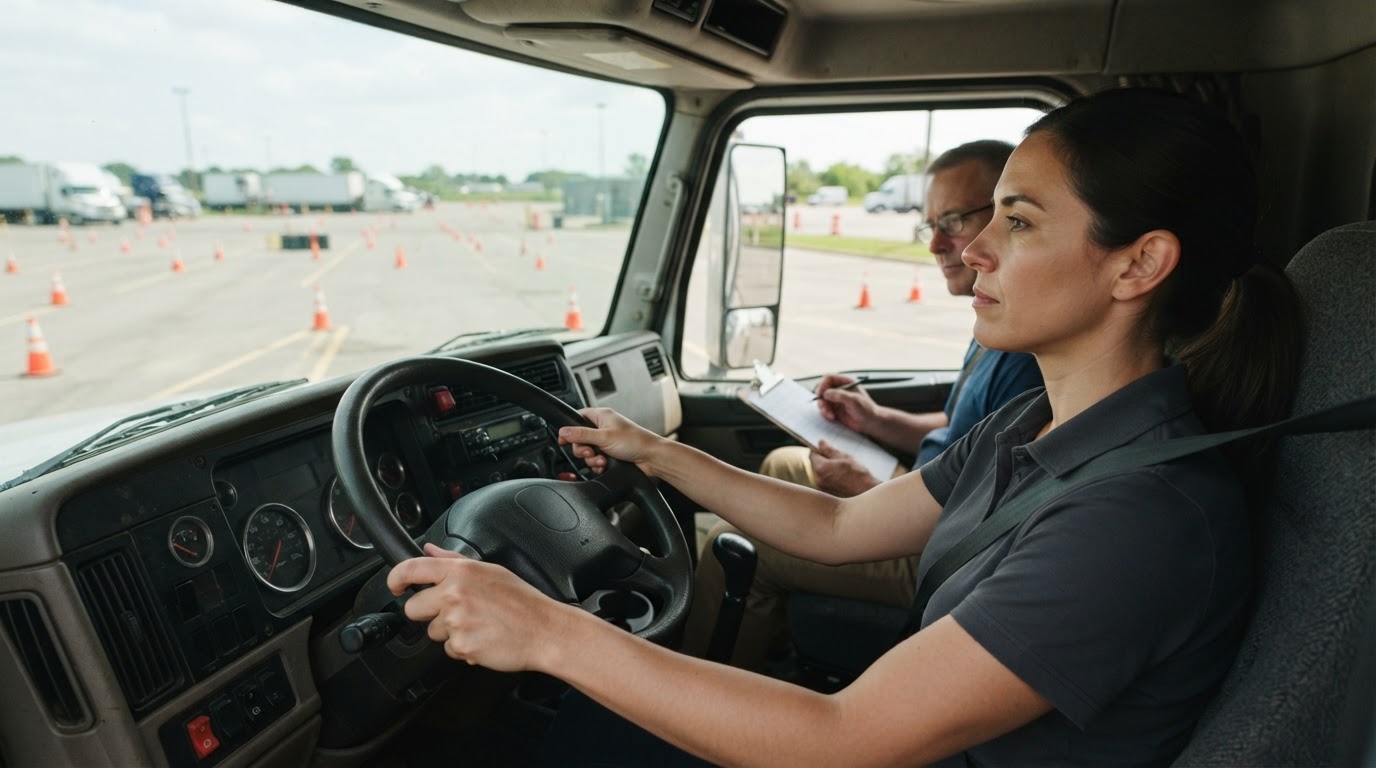
| P — Passenger | Vehicles built for 16+ people including the driver | Knowledge + skills test in a passenger vehicle | ELDT for first-time applicants | Motorcoach, transit, shuttle drivers |
| S — School bus | School buses (requires P) | Knowledge + skills test in a school bus | ELDT plus state background checks | School bus drivers only |
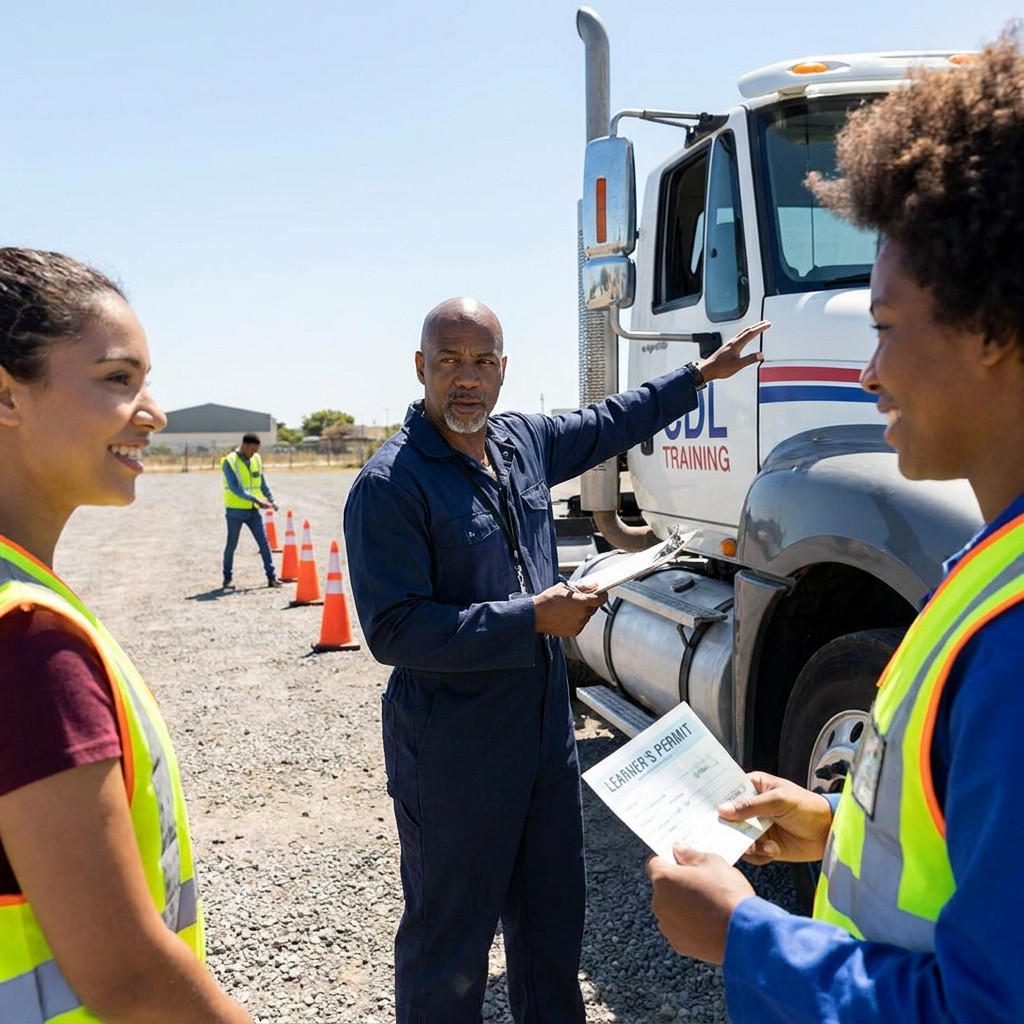
H, N and T are "paper" endorsements: study, pass a knowledge test at the DMV, done (hazmat adds the TSA step). P and S need a road test in a bus plus ELDT and, for S, state background checks — they lead to motorcoach, transit and school-district jobs, not freight, and no trucking recruiter will ask about them. A learner's permit can carry only P, S and N; hazmat goes on a full CDL, so if you're still on the permit tests, hazmat waits until after your road test.
☣️ Hazmat (H): what does it take and is it worth it?
Hazmat gets all the attention because it's the only endorsement with a federal background check. Four parts, in this order.
Step 1 — ELDT hazmat theory
Since February 7, 2022, a first-time H applicant must complete the hazmat theory module of Entry-Level Driver Training with a provider on FMCSA's Training Provider Registry before the state allows the knowledge test. Theory only, usually online and well under $100; the provider reports completion to FMCSA. Drivers who held H before that date renew without it.
Step 2 — the knowledge test
At most DMVs it's 30 questions with 80% to pass: placards and placard tables, shipping papers, loading and segregation, attended-vehicle and parking rules, leaks and fires, tunnel and route restrictions. It's the hardest knowledge-only endorsement simply because there's more to memorize. Test fees are typically $10–$25, plus a state fee to reissue the license with the new letter.
Step 3 — the TSA security threat assessment
This is where the money and, more importantly, the time go. As of September 2026:
- Fee: $85.25 for new and renewing applicants (TSA's rate since January 1, 2025). With a valid TWIC in a participating state, the reduced "comparable assessment" rate is $41.00.
- Fingerprints at a TSA enrollment center: pre-enroll online, then walk in for prints and an ID check. Eight states (Florida, Kentucky, Maryland, New York, Pennsylvania, Texas, Virginia, Wisconsin) enroll through their own DMV.
- Timeline: TSA asks everyone, renewals included, to enroll at least 60 days before they need the determination and warns processing "may exceed 45 days." If a renewal is still pending at expiration, the state may extend an existing HME by up to 90 days.
- What they check: criminal history against a list of disqualifying offenses, immigration status and watchlists.
- Validity: 5 years, then fee, prints and wait repeat.
Step 4 — the state issues the endorsement
Once the DMV has the passed test, the ELDT record and TSA's Determination of No Security Threat, it prints a new license with the H. All in, a first-time hazmat endorsement typically runs $150–$275 and takes 2–3 months — most of it waiting on TSA.
🛢️ Tanker (N): why is it the cheapest endorsement to add?
The tanker endorsement is one knowledge test, typically 20 questions on liquid surge, baffles and bulkheads, outage (room for expansion), center of gravity and why you brake early and take curves slow with a half-full tank. No ELDT, no background check, no waiting. That's why experienced drivers say get it even if you never plan to pull a tank.
Here's what many drivers miss: you may already need it. Under the federal definition, a "tank vehicle" is any commercial vehicle carrying liquid or gas in containers with an individual rated capacity over 119 gallons and an aggregate over 1,000 gallons — loaded or empty, permanently attached or not. Four 275-gallon IBC totes of juice concentrate, liquid egg or sauce on a reefer trailer is 1,100 gallons: a tank vehicle under the rule, and pulling it without the N is a violation on the driver, not the company.
The N also matters at hiring: food-grade tankers, milk haulers and chemical carriers won't open an application without it.
🧪 X: is the combined endorsement more than H plus N?
Not on paper — the X is issued when you pass both the hazmat and tank-vehicle tests; there's no separate X test and no extra TSA step. What X changes is who will hire you: fuel haulers, chemical tankers, propane and industrial-gas carriers list "X required" because their freight is hazardous and in a tank. Those jobs are why X is called the best-paying endorsement combination. If you're going through TSA anyway, take the N test the same day: the X costs one more 20-question test and nothing else.
🚛 Doubles/Triples (T): who actually uses it?
The T is a knowledge test on converter dollies, the "crack-the-whip" effect (the rear trailer amplifies every steering input), longer stopping distances and the extra air lines and pintle hook to inspect. No ELDT, no background check, cheap. But almost nobody outside LTL linehaul pulls doubles: the classic T job is a night run between two terminals with two 28-foot pups, home every morning. If your plan is OTR — reefer, dry van, flatbed — you'll never hook a set. If your plan is to sleep at home and pull pups for an LTL carrier, get the T before you apply.
💰 What do endorsements actually add to your paycheck?
It depends entirely on whether the company hauls that freight: a carrier with no placarded loads pays nothing extra for your H. Where a company does haul hazmat or tank freight, the premium usually shows up one of three ways:
- A per-mile bump for hazmat or tanker drivers — typically a few cents per mile on top of base, on every mile or only on placarded loads, depending on the pay plan.
- A per-load premium on specific hazmat or tank loads, common at dry-van and LTL fleets that see hazmat occasionally.
- Access to better-paying jobs — fuel and chemical tankers and LTL linehaul pay above the OTR average, and the endorsement is the ticket in.
The cost of that premium is real too: tank work often means loading and unloading yourself with hoses, pumps and PPE; hazmat means route restrictions (tunnels, some bridges, city centers), the rule that a placarded vehicle must be attended or parked in a safe haven, and closer attention at scales. The endorsement never pays; the freight does.
🧊 Do you need endorsements for reefer OTR?
No. Refrigerated freight — produce, meat, dairy, frozen food, beverages — is not hazardous and doesn't move in tanks. ASTEL doesn't require a single endorsement, and neither do most reefer carriers; what a reefer recruiter looks at is your MVR, PSP and CSA history, a current DOT medical card and your Clearinghouse status. Experience matters far more than letters: our flat $0.80 per mile is for drivers with 1+ year of experience, and that rate doesn't move because you added an H.
So why would a reefer driver still get H and N? Three reasons:
- The tote rule above. Liquid food in IBC totes is normal reefer freight. With the N you take the load; without it you decline or risk a citation.
- Optionality. A driver holding X can move to fuel or chemical work later without the 2–3 month TSA wait; a driver holding T can jump to LTL linehaul when home time becomes the priority.
- Timing. The cheapest moment to test is when the manual is still in your head: many drivers add N and T the same week they pass the CDL road test.
An endorsement won't fix a shaky first year. A company that takes new drivers and puts you in a late-model automatic with a shop behind you does more for your income than any letter — and an automatic-transmission restriction, not a missing endorsement, is what actually closes doors at some fleets.
🪪 What about TWIC — is it an endorsement?
No. The Transportation Worker Identification Credential is a separate TSA card, not a letter on your CDL, required for unescorted access to secure areas of ports and certain maritime facilities — container drayage, port-side loading, some refineries. As of September 2026:
- Cost: $124.00 new (TSA rate since January 1, 2025); $93.00 reduced if you already hold a hazmat endorsement or a FAST card; online renewal $116.00; replacement card $60.00.
- Valid 5 years. Enroll at least 60 days ahead; processing can run past 45 days.
- Same background check as the HME, so each credential discounts the other.
Reefer OTR rarely needs a TWIC — cold-storage warehouses and grocery DCs aren't port facilities. Get it only when a job asks for it.
🧾 Costs and timelines at a glance
| Item | Typical cost (Sept 2026) | Time | Renewal |
|---|---|---|---|
| ELDT hazmat theory (first-time H only) | Usually under $100, often online | A few hours to a day | Once |
| Knowledge test, any endorsement | $10–$25, varies by state | Same day | Some states retest at CDL renewal |
| TSA threat assessment (H/X) | $85.25; $41.00 with a valid TWIC in eligible states | Enroll 60+ days ahead; often 30–45 days | Every 5 years |
| TWIC (separate card) | $124.00; $93.00 with HME/FAST; $60.00 replacement | Enroll 60+ days ahead | Every 5 years |
Fees and rules may change; check TSA and your DMV before you budget. Some CDL schools bundle N and T into the basic course — ask before paying separately.
📋 Step-by-step: adding H and N (the X) to a Class A
- Check your record first. Anything on TSA's disqualifying-offense list means talking to a lawyer before paying the non-refundable fee.
- Complete ELDT hazmat theory with a Training Provider Registry provider and confirm it shows in the FMCSA system.
- Pass both knowledge tests at the DMV. The N is issued right away; the H waits on TSA.
- Pre-enroll for the HME assessment online, then visit an enrollment center (or the DMV in the eight self-run states) with your CDL and proof of citizenship or immigration status for fingerprints. Pay $85.25 (or $41.00 with a TWIC).
- Get the new license with the X on it, and set a reminder for 4 years and 9 months out.
❓ FAQ: CDL endorsements
Which CDL endorsements are worth getting for an OTR driver?
Tanker (N) first, because it's a single cheap knowledge test with no background check and is legally required as soon as you haul liquid totes over the federal threshold. Hazmat (H) second, if you're willing to do the ELDT theory course, the knowledge test and the TSA assessment; together they form the X. Doubles/triples (T) is worth it only for LTL linehaul, and P and S are for buses.
How much does the hazmat endorsement cost in 2026?
The TSA security threat assessment is $85.25 as of September 2026, or $41.00 if you already hold a valid TWIC in an eligible state. Add the ELDT hazmat theory course (often under $100), a DMV knowledge test fee of roughly $10–$25 and the state's license reissue fee. A first-time hazmat endorsement typically totals $150–$275; renewal every 5 years is cheaper because ELDT isn't repeated.
How long does the TSA hazmat background check take?
TSA asks all applicants, including renewals, to enroll at least 60 days before they need the endorsement and says processing for some applicants may exceed 45 days. Many drivers get a determination in 30–45 days, but plan on two months and never start a renewal later than 60 days before your HME expires.
Do you need endorsements to drive a reefer?
No. Refrigerated freight is not hazardous and doesn't travel in tanks, so reefer carriers, including ASTEL, hire without any endorsements and look at experience, MVR, PSP and a current DOT medical card instead. The one exception is liquid food in IBC totes: more than 1,000 gallons aggregate in containers over 119 gallons each makes the trailer a tank vehicle, and the driver needs the N endorsement.
Is a TWIC card the same as a hazmat endorsement?
No. A TWIC is a separate TSA card for unescorted access to secure port and maritime facilities; it costs $124.00 new ($93.00 if you already hold a hazmat endorsement or a FAST card), is valid 5 years and doesn't appear on your CDL. Both use the same TSA background check, which is why holding one gets you a reduced fee on the other.
🚛 No endorsements required — experience is what we pay for
ASTEL is a family-owned carrier out of Chicago running refrigerated freight year-round on late-model Volvo trucks, with our own repair shop and mechanics, 24/7 dispatch and a direct line to the owner. Drivers earn $90,000–$110,000 a year — $2,400–2,700+ a week gross, a flat $0.80 per mile for drivers with 1+ year of experience, all miles paid ZIP-to-ZIP, weekly pay, plus $50/$200/$500 bonuses for clean DOT inspections.
Apply in 2 minutes →Endorsement definitions and tests follow 49 CFR 383.93 and the tank-vehicle definition in 49 CFR 383.5; ELDT applicability per FMCSA rules effective February 7, 2022; HME and TWIC fees, the 60-day guidance and the state-run enrollment list are from TSA's HAZMAT Endorsement and TWIC pages as of September 2026 (fees effective January 1, 2025). State test fees and question counts vary; all figures may change — verify with TSA and your DMV. Pay effects are described without numbers because premiums differ by carrier and freight. ASTEL pay figures describe driver ranges, not guarantees. General information, not legal advice.