

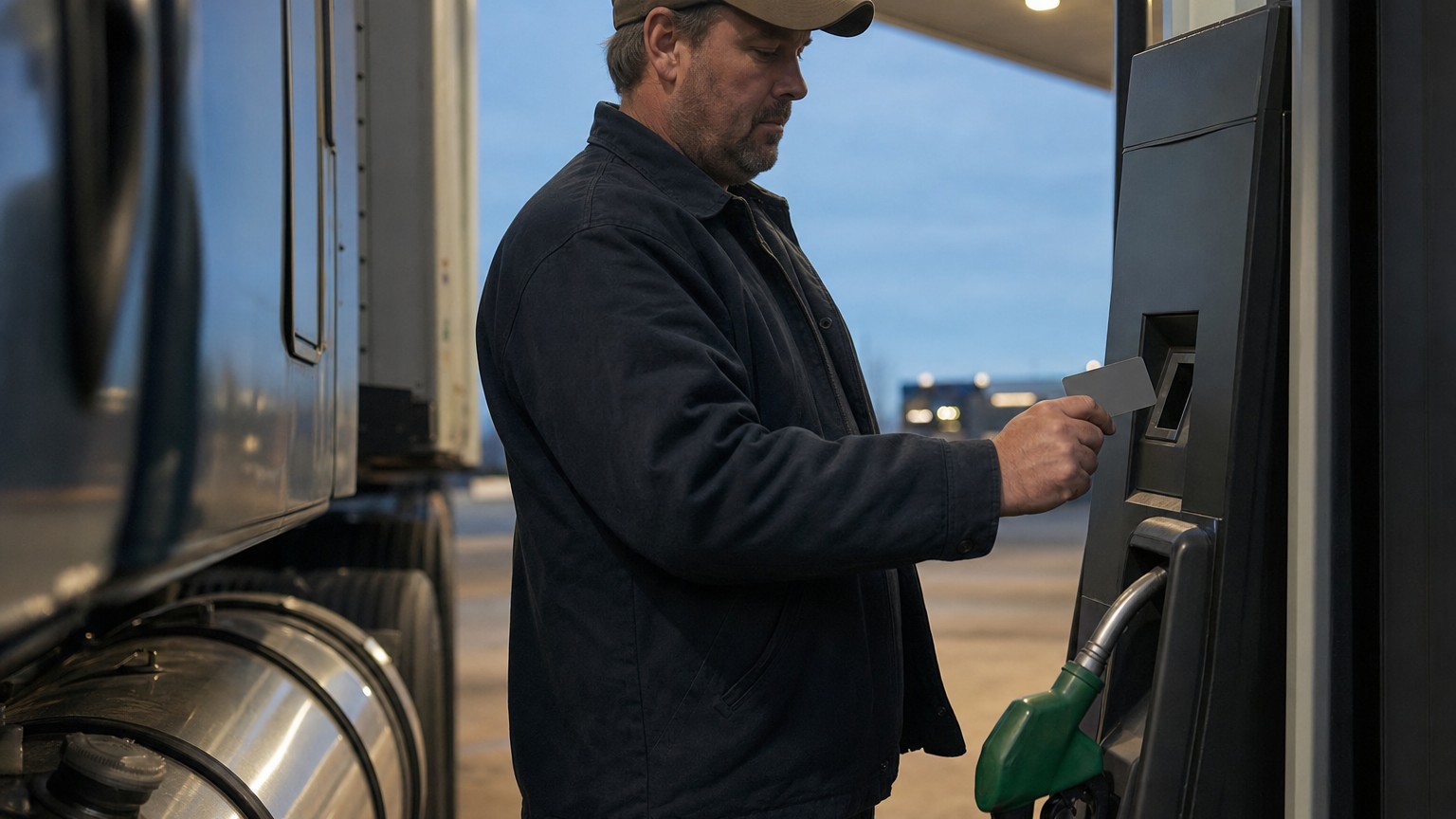
A Trucking Fuel Card, a Comcheck and a Cash Advance When Diesel Costs $6.35
On October 26, 2026, the Energy Information Administration put the US average for on-highway diesel at $6.352 a gallon, $2.63 more than a year earlier. In California it was $8.155. At the national price a 150-gallon fill costs about $953, which is why no company driver pays for fuel out of pocket. The trucking fuel card in your wallet, the express codes dispatch texts you and the advance you can draw against your pay are how that money moves on the road.
Four ways money moves on a trip
Every carrier uses its own mix of tools, but most drivers run into the same four. The table shows what each one pays for and where it usually goes wrong.
| Tool | What it pays for | Who sets the limit | What you keep | Common snag |
|---|---|---|---|---|
| Fuel card at the pump | Tractor diesel and DEF | The carrier, per fill or per day | The pump receipt or a photo of it | A wrong odometer entry or a station outside the approved network |
| Fuel card at the fuel desk | Reefer fuel, scales, approved items | The carrier, item by item | The desk receipt | Reefer fuel run on the same ticket as the tractor |
| Express code (Comcheck) | Lumpers, approved repairs, other one-off costs | Dispatch, for an exact amount | The lumper or shop receipt | A code given out over the phone to a stranger |
| Cash advance | Anything, since it is your own pay | The carrier's advance policy | The settlement line that takes it back | Advances that eat most of the next settlement |
| Your own money | A cost that came up with no card or code available | You, then the carrier's approval | The receipt, sent the same day | Spending first and asking later |
The last row is the one that costs drivers money. A carrier can reimburse a cost it can see on paper. Without the receipt it has nothing to bill and nothing to approve.
The pump asks four questions before it turns on
A fuel card is not a credit card. It is a set of rules the carrier writes, and the pump checks them before it lets you fuel. The usual prompts are a driver ID or PIN, the unit number of the truck, the odometer or hub reading and the product. Type the odometer from the dash, not from memory. That number feeds the carrier's mileage and fuel economy reports, and a typo of one digit can make a truck look like it got 20 miles a gallon.
Limits are normal. A carrier may cap gallons per fill or dollars per day, allow only diesel and DEF, or block certain stations. At $6.35 a gallon those limits get hit sooner, so ask what yours are before the first trip. If the card declines at 2 a.m., don't argue with the cashier. Call dispatch. At ASTEL dispatch answers 24/7, and a declined card is exactly the kind of problem that call is for.
Treat the PIN like a bank PIN. Don't write it on the card, don't say it out loud at the counter, and don't give it to anyone who calls claiming to be from the company. Card skimmers turn up at fuel islands, so look at the reader before you swipe.
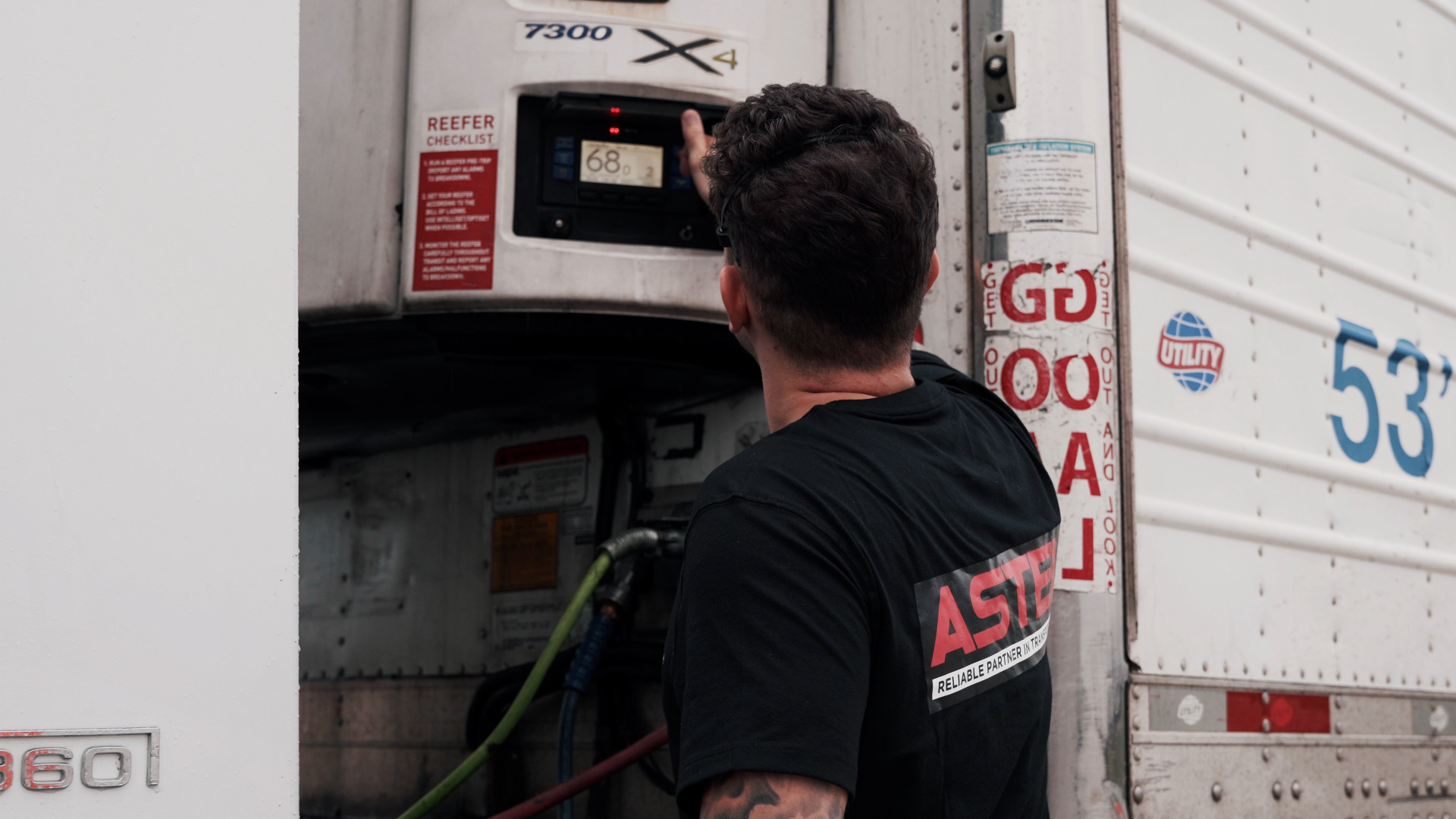
Reefer fuel usually goes through as its own transaction, separate from the tractor, because the carrier tracks it apart from the fuel that moves the truck. Ask how your carrier wants it done. The reefer side of a load is covered in our guide to running a reefer unit.
The fuel desk handles the rest of the card's work. If a load needs weighing, many carriers let the scale ticket go on the same card, and the ticket itself becomes part of the trip paperwork. How scales and axle weights work is in our guide to weigh stations and axle weights. Personal items are a different story. Most cards are set up for fuel, DEF and a short list of approved items, and a snack or a phone charger run on the company card turns into a deduction at best and a policy problem at worst.
Where you fuel is a company decision
Carriers buy diesel through networks and negotiated prices, so the price on the pump sign is not always what the company pays. That is why most cards work only at certain chains or certain stations, and why fueling somewhere else can cost the company more even when the sign looks cheaper.
At ASTEL the rule is to fuel at Pilot or Flying J, or wherever dispatch agrees. Following that rule matters for your pay too. The Fuel bonus adds up to $0.02 a mile for good MPG and fueling by the rules, which means not skipping planned fuel stops and not fueling without approval. With diesel above $6, a small difference in fuel economy is real money for the company and for you. How to squeeze more miles out of each gallon is in our guide to fuel-efficient truck driving, and where the price is heading is tracked in diesel prices for truck drivers.
Comcheck express codes pay the lumper
A lumper crew is waiting, the receiving office doesn't take cash and you have no company credit card. This is where an express code comes in. Dispatch or the broker issues a code for an exact dollar amount. Comdata, which runs the Comchek system, describes it as a 14- to 18-digit number that stands for a set dollar amount. You write a Comchek draft to the lumper service and register the code to it.
Some systems also let you pay from a phone app by entering the lumper's ID. A Comchek can't be cashed until the code is registered to that draft and authorized.
Drivers say "Comcheck" for any system like it, whatever network issued the code. The routine is the same. Get the code from dispatch, pay the exact amount and get a receipt that shows the lumper company, the amount, the date and the load or PO number. Send a photo of it the same day.
Who pays the lumper is not your problem to solve at the dock. Federal law, 49 U.S.C. 14103, puts unloading assistance on the shipper or receiver when they require it, and makes it unlawful to coerce a driver into paying for it. The practical side is in our guide to grocery warehouse delivery and lumper fees.
A code is cash. Never say one out loud to someone who calls you on the road, even if the caller says they're the broker. Hang up and call dispatch back on the number you already know.
A cash advance is your own pay, early
An advance looks like company money. It isn't. It is a piece of your next settlement paid now, and it comes back out as a deduction. Some carriers load advances onto the fuel card, others send a code, and some charge a fee for it. Ask about the fee before you need the money.
Weekly pay makes advances less necessary. ASTEL pays every week, and a pay request made before noon is paid the same day, while one sent Friday evening arrives Monday. For most drivers that is faster than an advance and costs nothing.
Know how your carrier sorts road costs. At ASTEL the company covers costs that are part of the job, agreed with the team and backed by documents. A cost with no receipt counts as an advance and is deducted. Anything above $200 should be agreed in advance. The same logic shows up in any settlement, as explained in our guide to reading a trucking settlement.
Receipts are the carrier's fuel tax record
Fuel receipts do more than prove you didn't pocket the money. Interstate carriers file quarterly fuel tax returns under the International Fuel Tax Agreement, splitting the miles and gallons by state, and every gallon they claim needs a record. A valid fuel record shows the date, the seller's name and address, the gallons and type of fuel, the price, the vehicle and the purchaser.
A change starts on January 1, 2027. J.J. Keller reported on October 13, 2026, that an amendment to the IFTA Procedures Manual will require fuel card transaction listings used for tax credit to come from the fuel card system that handled the original purchase. Carriers that rebuild their fuel data in other software will need the card system's own records. For you that means the card data and the paper receipt should match, so enter the right truck number every time.
Keep a simple habit. Photograph every receipt before you leave the fuel desk and send it through the company app. Put lumper and scale receipts in the trip envelope with the BOL. The full paperwork list is in our guide to BOLs, PODs and trip paperwork.
Frequently asked questions
How does a trucking fuel card work?
The carrier issues the card and sets the rules. At the pump you enter your driver ID or PIN, the truck's unit number and the odometer reading, then fuel within the limits the carrier allows. The transaction goes straight to the carrier, and you keep the receipt.
What is a Comcheck and how do I cash it?
It is a payment draft backed by an express code, a 14- to 18-digit number that dispatch or a broker issues for a set amount. You write the draft to the payee, such as a lumper service, or cash the code at a truck stop fuel desk that accepts it. The draft can't be cashed until the code is registered and authorized.
Can I use a company fuel card for personal purchases?
Usually not without permission. Most carriers limit the card to fuel, DEF and approved items, and anything else becomes a deduction from pay. Ask dispatch before you buy anything that isn't on the list.
What should I do if my fuel card is declined at the pump?
Don't keep swiping. Check that you entered the right driver ID, unit number and odometer, then call dispatch. The usual causes are a limit reached for the day, a station outside the approved network or a typo in a prompt.
What does a fuel receipt need to show for IFTA?
The date, the seller's name and address, the gallons and fuel type, the price, the vehicle and the purchaser. From January 1, 2027, fuel card transaction listings used for tax credit must come from the card system that handled the purchase.
Fuel on the card, receipts reimbursed and pay every week
ASTEL is a family-owned carrier out of Chicago running refrigerated freight year-round on late-model Volvo trucks, with our own repair shop and mechanics, 24/7 dispatch and a direct line to the owner. Drivers earn $90,000–$110,000 a year — $2,400–2,700+ a week gross, a flat $0.80 per mile for drivers with 1+ year of experience, all miles paid ZIP-to-ZIP, weekly pay, plus $50/$200/$500 bonuses for clean DOT inspections.
Apply in 2 minutes →Sources: U.S. Energy Information Administration, Gasoline and Diesel Fuel Update, weekly on-highway diesel prices for October 26, 2026; Comdata, "What is a Comchek Draft?"; 49 U.S.C. 14103; International Fuel Tax Agreement Procedures Manual, fuel record requirements, and J.J. Keller, "Check your fuel card records before the 2027 IFTA change" (October 13, 2026). Diesel prices change weekly, and the 150-gallon figure is a calculation, not a quote. Current as of October 2026; carrier card rules, advance fees and reimbursement policies vary. General information, not legal or tax advice.